
Special Correspondent
Dhaka, September 9: The number of child deaths due to measles and measles-related illnesses in the country has crossed the 1,000 mark. According to the Department of Health, 902 children have died of measles-related illnesses since March 15 this year, and another 100 children have died of measles-related illnesses, taking the total death toll to 1,020. Nearly 1,200 children have been newly infected in the last 24 hours.
Yet, a few years ago, measles was almost eradicated in Bangladesh. According to the World Health Organization, the country has maintained high coverage of the first and second doses of measles vaccine for a long time, and measles-preventive vaccine coverage has been steadily increasing, which has led to a dramatic reduction in the number of laboratory-confirmed measles cases. According to another report, since the introduction of the combined MR vaccine in 2012, this vaccine coverage has been around 90 to 95 percent by 2025—close to the level needed to control measles.
But this achievement could not be sustained. According to the World Health Organization, a national supply shortage of MR vaccine occurred in the country in 2024-25, coupled with gaps in routine vaccination programs and the failure to organize the measles-rubella supplementary mass vaccination program scheduled for 2020 and 2025—all of which increased the number of children at risk of infection.
Media investigative reports revealed that the crisis intensified during the interim government’s tenure from August 2024 to February 2026. During that time, frequent political unrest and strikes disrupted regular vaccination programs, and the measles-rubella supplementary vaccination program scheduled every four years was not organized.
A study found that,
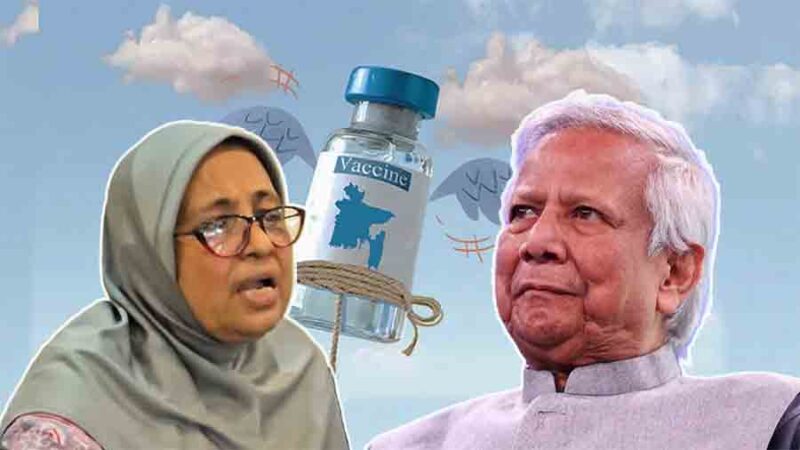
A health department official told UNICEF in May 2025 that the country’s vaccine stockpile would run out in just a few weeks, but new allocations were delayed because the Yunus government reformed vaccine procurement and introduced an open tender system.
A UNICEF statement also acknowledged the lack of timely vaccine delivery.
The impact of this crisis has become apparent since the beginning of this year—according to one report, the number of infected people has increased almost tenfold compared to the previous year, and the pressure on hospital admissions, ICUs, and isolation facilities has increased manifold.
The blame for the crisis is now being shifted at the government level. Recently, Health Minister Sardar Md. Sakhawat Hossain said in parliament that the previous (interim) government is responsible for the severe vaccine crisis and the administrative and policy-making mistakes behind the disruption of vaccination. However, critics question why it took so long to take effective and urgent measures to resolve the crisis even after the elected government took office, during which the death toll crossed the thousand mark.
Former IEDCR director Mahmudur Rahman described this situation as unprecedented in the history of Bangladesh, saying,
Never before have so many children died of measles and never before have so many patients been seen in a single year. In his words, the saddest part is that innocent children are paying this price.
Experts say that the deaths of so many children from a nearly-eradicated, easily preventable disease are not an “unfortunate occurrence”—but rather a direct consequence of a series of failures in vaccine supply management and routine program implementation, beginning with one government and continuing through the next.

https://stapravda.ru/20221228/reyting_samyh_populyarnyh_hostingov_v_rossii_196445.html, рейтинг хостингов России подтверждает, что выбор надежного провайдера важен для бизнеса.