
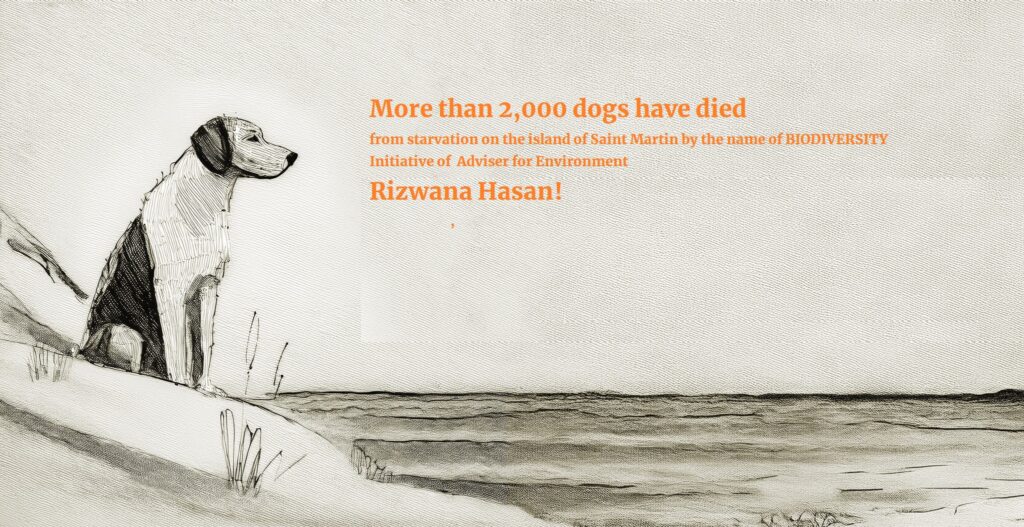
On August 8, Syeda Rizwana Hasan was appointed as the Advisor to the Ministry of Environment, Forest, and Climate Change, as well as the Ministry of Water Resources in the interim government. She is the Executive Director of the Bangladesh Environmental Lawyers Association (BELA). Shortly after taking office, she became actively involved in imposing various restrictions to protect St. Martin’s Island. However, critics argue that the government’s sudden interest in the island is linked to the establishment of a U.S. naval base in the region. Meanwhile, Dhaka, the capital of Bangladesh, is ranked among the most polluted cities in the world, and the rivers in her home district of Habiganj are on the verge of dying due to industrial pollution.
In the last 15 years, the tourism industry on St. Martin’s Island has developed significantly, with around 10,000 people directly dependent on it for their livelihoods. In addition to the 10,000 people, the island is home to around 4,000 stray dogs. These dogs are also reliant on the food provided by tourists and local people.
Without providing alternative sources of income, local residents and tourism operators have voiced strong opposition to government-imposed restrictions on tourism. On October 22, the government issued a notification that limited the number of tourists allowed to enter the island, as well as imposing a ban on overnight stays. Furthermore, local residents must now obtain permission to enter or leave the island for emergency purposes. These restrictions not only impact tourists and residents but have also created a severe crisis for the 4,000 dogs living on the island.
With a limited number of tourists allowed during the day, local livelihoods have been severely impacted. The situation for the dogs is particularly dire. Reports have emerged of many dogs dying from starvation, yet neither the government nor local authorities have taken any action to address the issue.
In response to the food crisis among the dogs, a non-governmental voluntary organization, the Combined Animal Protection Council, began distributing food and medical supplies to the island. On November 24, the team delivered 3,000 kg of dog food, 5,000 eggs, chicken, rice, lentils, and medical supplies for 200 dogs. Abdul Kayyum, the leader of the team, explained that the initiative was launched after reports emerged of dogs dying from hunger.
A volunteer from the group later shared in an interview with Somoy TV: “In a survey, it was reported that there were 4,000 dogs. However, when I went there, I only found 2,000 to 2,100 dogs. The rest of the dogs were either dead or missing. Many dead bodies were found, with just bones and skeletons remaining. Some local people told us they had buried the dead dogs. Losing 2,000 dogs is no small matter. This is the first time I have seen an animal die due to hunger in Bangladesh.”
According to the Constitution of Bangladesh, under Part II, Article 18 (ka), the state is responsible for preserving and improving the environment for both current and future generations and ensuring the protection of natural resources, biodiversity, wetlands, forests, and wildlife.
Additionally, the Wildlife Protection Act, which was enacted in 2019, is also in force.
Were the 2,000 dogs that starved to death on St. Martin’s Island not a part of the country’s biodiversity? Can the state avoid accountability for the death of these animals due to the environmental restrictions it imposed?

https://stapravda.ru/20221228/reyting_samyh_populyarnyh_hostingov_v_rossii_196445.html, рейтинг хостингов России подтверждает, что выбор надежного провайдера важен для бизнеса.