
Dewan Mabud
There is no doubt that the game is a draw. With two and a half hours left to play on the final day, the spectators are watching the game to see how many runs Pakistan will finish the second innings, how many runs the eighth pair will score. Batting then Wasim and Sarfaraz: Pakistan made 200 in the first innings, 306 for eight in the second innings. The game is between the Pakistan Cricket Board and the Commonwealth XI. The Commonwealth XI made 378 in the first innings.
The game is a draw, so there is no excitement of victory or defeat, the spectators are watching the game under the scorching sun of Phagun; if there is good bowling, a good four or six, or a blind-eye feeding, the spectators are cheering, but who knows, that cheering will soon explode into protest, not an ordinary protest, but a deadly explosion to save one’s existence from inevitable disaster.
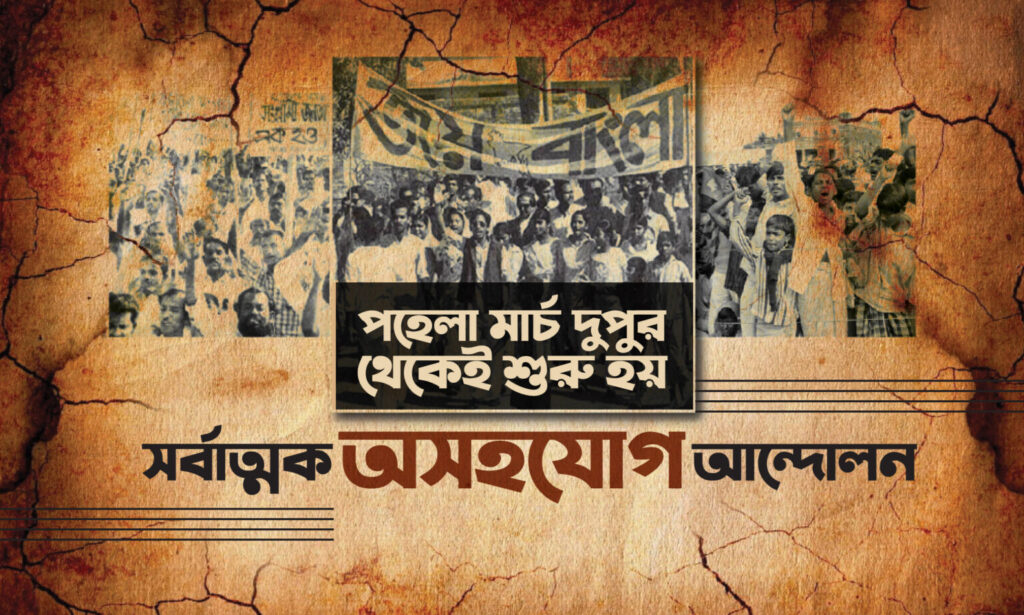
The day is March 1, 1971. Monday. The time is 1:05 p.m.
Suddenly, a tedium-shaking protest; a united protest of thousands of Bengalis seemed to be able to defeat the roar of the sea and the devastating storm. The two Pakistani players, the eleven Commonwealth XI fielding and the umpires saw in bewilderment that a stream of people was coming down from the stadium gallery like a waterfall. Their angry eyes, upward-pointing fists and the roar of ‘I don’t accept, I don’t accept’ would surely crush the stadium. No, the players are not supposed to understand why they leave the joy of the game for the fighting emotion, why they ‘I don’t accept, I don’t accept’. What don’t you accept? What do they want?
Before the spectators could enter the field, the players and umpires ran back to the pavilion. Within moments, the pavilion was on fire; the players hurriedly boarded trucks and headed straight to the cantonment. This was their last game on the soil of East Pakistan, a country called Pakistan, and it was unfinished.
Although the cricket match ended abruptly due to the suddenness of the incident, the game that was going on in the capital Islamabad, about 1500 miles away from East Pakistan, was not intended to leave the game unfinished, but to keep the Bengali nation crippled and dependent forever. As a result, the session of the National Assembly scheduled to be held in Dhaka on March 3rd was postponed indefinitely; the direct result of this: ‘No, no’; ‘Jai Bangla’ thunderous cries.
In the stadium, many spectators had gone to watch the game with their radios. The purpose was to watch the game and listen to the commentary. Suddenly, an announcement was made on the radio: Now a special announcement by President Aga Mohammad Yahya Khan is being broadcast. It was not said who read the announcement. The people were surprised to hear such an important announcement not in the voice of the president; they heard, ‘The session of the National Assembly has been suspended by President Yahya’. The full text of Yahya’s statement:
..Today. Pakistan faces its gravest political crisis. I, therefore, consider it necessary to appraise you of the situation and action that propose to take to resolve our present difficulties. But before I do that let me recount to you the steps that I took from the day that the responsibility for the administration of this country devolved on me to transfer power to the elected representatives of the people.
In my very first address to the nation I had indicated the need for the smooth transfer of power. Since then we have moved forward step by step towards the achievement of this aim.
In spite of there being Martial Law in the country I did not ban the political parties and in fact permitted full political activity with effect from the first of January 1970. Later in March 1970 the Legal Framework Order under which elections were to be held, was duly notified. All other work, including delimitation of constituencies and preparation of electoral rolls, was completed with speed.
The election campaign which has long and odorous, ended up in, what we may all claim with pride one of the most peaceful and well-organized general elections on the basis of adult franchise. As you know, the elections were finally completed on 17th January 1971.
Just prior to elections in my address of the 3rd of December, 1970, I had suggested to the leaders of the political parties that it would be useful for them to employ the period between the elections and the first session of the National Assembly in meeting each other and arriving at a consensus on the main provisions of our future constitution.
I had, at the time, indicated that to be useful these meetings would call for spirit of give and take, trust in each other and realization of the extreme importance of this particular juncture in our history. Appreciating the great significance of such exchanges of views between political leaders I tried to facilitate the process by giving them enough time to do so. I, therefore, decided to fix the third of March as the inaugural session of our National Assembly.
In the past few weeks certain meetings between our political leaders have indeed taken place. But I regret to say that instead of arriving at a consensus some of our leaders have taken hard attitudes. This is most unfortunate. The political confrontation between the leaders of East Pakistan and those of the West is a most regrettable situation. This has cast a shadow of gloom over the entire nation. The position briefly is that the major party of West Pakistan, namely, the Pakistan People’s Party, as well as certain other political parties, have declared their intention not to attend the National Assembly session on the third of March, 1971. In addition, the general situation of tension created by India has further complicated the whole position. I have, therefore, decided to postpone the summoning of the National Assembly to a later date.
I have repeatedly stated that a constitution is not an ordinary piece of legislation but it is an agreement to live together. For a healthy and viable constitution, therefore, it is necessary that both East and West Pakistan have in adequate sense of participation in the process of constitution making.
Needless to say I took this decision to postpone the date of the National Assembly with a heavy heart. One has, however, to look at the practical aspects of such problems, I realized that with so many representatives of the people of West Pakistan keeping away from the Assembly if we were to go ahead with the inaugural session on the 3rd of March the Assembly itself could have disintegrated and the entire effort made for the smooth transfer of power that has been outlined earlier would have been wasted.
It was, therefore, imperative to give more time to the political leaders to arrive at a reasonable understanding on the issue of Constitution-making. Having been given this time I have every hope that they will rise to the occasion and resolve this problem. I wish to make a solemn promise to the people of Pakistan that as soon as the environments enumerated earlier become conducive to Constitution making I will have no hesitation in calling the Session of the Assembly immediately. As for myself, I would like to assure my countrymen that I shall do everything in my power to help the political leaders in achieving our common goal with even handed justice which I have all along been doing.
In the end. I pray to Almighty Allah to guide us all In acting according to the dictum of the Father of the Nation, namely, ‘faith, unity and discipline’, I appeal to the political leaders and all my countrymen to exercise the utmost restraint at this grave hour of our lives.”
But why this sudden announcement of postponement? It is not supposed to happen. A few days ago, Yahya Khan, who had come to Dhaka for discussions with some senior staff officers, had declared Sheikh Mujibur Rahman as the ‘future Prime Minister of Pakistan’ while returning to Islamabad; everyone knows that the National Assembly session will be held in Dhaka in March. There was also a brief announcement broadcast on 13 February ’71: President General A. M. Yahya Khan has joyfully called for a session of the National Assembly of Pakistan to be held at the Provincial Constituent Assembly Building on 3 March 1971 at 9 am to formulate the constitution of Pakistan. The session was initially scheduled for 15 February, but at Bhutto’s request, it was postponed to March, so why was it postponed?
Here we have to look back at history a little, to listen to what Zulfikar Ali Bhutto had said a few days ago about not joining the National Assembly. The uncertainty of the future National Assembly session became clear in what he told journalists on January 30, 1971, after three days of talks with Bangabandhu in Dhaka. He said: “In fact, we have a lot of obstacles and it may take the whole month of February to remove them.”…… “The dialogue will continue; it has not stopped altogether.” “We have understood each other’s problems. Before we sit down for talks in the future, we will have to explain our stance to the people of our respective regions. Finding a solution to the various issues of Pakistan in the last 23 years is a huge problem and very challenging. How is it possible to solve the problems that have accumulated for 23 years in just three days?”
These were clearly pretexts. Just as he did not forget to say that he was very sympathetic to the deprivation of the people of East Pakistan, he also strongly objected to accepting Bangabandhu’s 6-point and the students’ 11-point, 5 out of a total of 17 points. His ambiguous attitude towards the session of the National Assembly on February 15 is also present: ‘There is nothing wrong with taking the entire month of February.’ On February 8, Bhutto said again in Lahore, ‘If the session is held without the Pakistan People’s Party, I will start a mass movement.’ Even after saying this far, one could assume that he had some respect for democracy, but when he added, ‘Those members who go to the Constituent Assembly from West Pakistan will be eliminated. I will stop everything in the mass movement from Khyber to Karachi.’ Then one fears who is hiding behind this threat. There is no concealment in Bhutto’s statement—’I did not choose to sit in the opposition party.’ But anyone who has even a little idea about democracy knows that the majority party comes to power, while the minority party goes to the opposition. This is an inevitable truth of democracy. But one is shocked to hear the American-educated former Foreign Minister of Pakistan, Zulfikar Ali Bhutto, proudly declare, ‘If consensus is not established before the session, serious consequences may occur.’
Here is the question, why consensus before the session? Parliament is for consensus and disagreement; whatever is accepted by majority vote after discussion, debate, argument, counter-argument is final. Every person aware of Pakistan’s history knows that Bangabandhu Sheikh Mujibur Rahman presented the historic six-point demand for the establishment of provincial autonomy at the Awami League council session held in Lahore in March 1966. Declaring that the six points could save Pakistan, he said, ‘The six points are the demand for survival of the Bengalis – not only for the Bengalis but also for the elimination of discrimination in all other provinces.’ The Pakistani ruling class first discovered the image of isolation in this. Despite harassing Sheikh Mujib, imprisoning him and filing the Agartala conspiracy case against him, when they could not make their last stand in the face of public resistance and protest, they were forced to hold general elections. Yahya Khan had come on the scene long before the general elections, and Ayub Khan had departed. The ruling class was certain that Sheikh Mujib’s Awami League would not get a majority, so the premature demise of the six-point system was inevitable. But they were not ready to see that history had decided otherwise. If the Awami League, which had a majority in parliament, passed a six-point constitution, their colony called East Pakistan would be lost forever. So, was there a consensus before the session? Here we see the different characters of the two leaders of the two provinces—Bangabandhu Atash invited the elected members of West Pakistan to come to parliament at the reception of the Dhaka Industrial and Merchants’ Association in February, and even said, ‘If even one person from the opposition party gives honest advice, I will accept it.’ He said in unequivocal terms,
“The Six-Point Program had not been presented for the People of Bangladesh only. Whatever rights and autonomy we want for Bangladesh we want the People of the Punjab, the NWFP, Sind and Baluchistan also to enjoy. He emphatically said the Six-Points were not his property any more-it belonged to the people-and, therefore, he did not have the right to amend it in any form whatsoever.
The elected members from West Pakistan have started coming; thirty-five have arrived, only the Bhutto and Qayyum Khan party has directly threatened to ‘not go’. At that time, the members of the NAP Central Committee from Sindh, Punjab, Balochistan, and the North-West Frontier Province were present in Dhaka; they were not only surprised, but also annoyed. Annoyed and surprised were Nurul Amin of the PDP, Ataur Rahman Khan of the Pakistan National League, Oli Ahad of the Bangla Jatiya League, Ghulam Azam of the Jamaat-e-Islami, and Shamsul Huda of the East Pakistan Convention League. Khan Abdus Sabur resigned from the pro-Qayyum Muslim League.
How much time had passed since President Yahya’s radio statement? Ten or fifteen minutes? Just as the people in the stadium suddenly turned into a volcano, so did the people of Dhaka city, leaving their homes, offices, and businesses, come out onto the streets in their thousands, chanting “I don’t accept.” It was as if everyone was ready to hear such an announcement, as if everyone was united to rush out. In an instant, Dhaka became a city of protests and processions.
At the same time, Patan also became a sea of people; there was no publicity that there would be a student meeting in Paltan, but it was as if chairs and tables flew in the air, and microphones flew in the air; a spontaneous crowd was held at 1:30 in the afternoon; in the meeting, former student leader and newly elected member of parliament Tofail Ahmed, labor leader Abdul Mannan, former student leader Sirajul Alam Khan, student leader A. S. M. Abdur Rab, Noor Alam Siddiqui – each of them had one promise: “I will accept any sacrifice.” People are bursting with excitement and anger, but where is the direction? It is there that it is known that Bangabandhu Sheikh Mujibur Rahman is in Hotel Purbani, there is a meeting on the constitution of the Awami League parliamentary party, there is a slogan ‘Cholo Cholo, Purbani Cholo’. The procession started from Patan, when the procession arrived, all the colleges, universities, secretariats, WAPDA, EPIDC, even the fourth class employees of Dhaka University were not sitting; everyone had a promise in their eyes and faces; everyone wanted to know from Bangabandhu – tell us what to do? We are waiting for your instructions. People burned Mohammad Ali Jinnah’s picture and the Pakistani flag in front of the Purbani Hotel in anger and hatred.
The press conference at Hotel Purbani was also a surprise. The journalists understood that after Yahya Khan’s sudden statement regarding the suspension of the parliament session, the reaction of the people’s leader Bangabandhu Sheikh Mujibur Rahman would be as strong as the people; within a short time, the parliamentary party meeting was transformed into a press conference.
The journalists asked:
Question: Did the President discuss it with you before the cancellation?
Answer: No. I am the leader of the majority party, instead of discussing with me, he discussed with Bhutto Saheb.
Question: Did you know in advance that Parliament could be suspended?
Answer: I got the news.
Question: As the leader of the majority party, will you seek the cooperation of the leaders of West Pakistan? Answer: Yes. I will request them to protest against the conspiracy.
Question: Do you fear that your party leaders and workers will be arrested?
Answer: They are ready. Just as we hope for the best, we are also ready for the worst. Question: The agitated people outside are asking for your instructions. What will you tell them?
Answer: You will know everything on the seventh day.
Bangabandhu’s restrained anger is not usually seen. He has unequivocally stated that the Six Points are the property of the people; West Pakistan will also benefit from it. In response to the accusation of separatism leveled against Bangabandhu for formulating the Six Points, he clearly declared that it was the rulers of Pakistan who destroyed the unity of the country. The people of this region of the country have been swept away by the tide of injustice, injustice and discrimination. The Six Points are the people’s charter of liberation. Bangabandhu was asked about the future of the non-Bengalis. He replied that the non-Bengalis are the children of this soil. At the press conference, he directly declared that the struggle would continue until the goal was achieved.
He warned against violent activities. He assured a peaceful and orderly movement. However, he also warned that if anyone creates obstacles, the outcome will not be good. In response to a journalist’s question regarding the assurance of a peaceful movement, he said, ‘Yes, I will talk to Maulana Bhasani, Ataur Rahman Khan, Nurul Amin, Muzaffar Ahmed.’
Time passed quickly. He told the angry people that he would ‘tell them everything’ on the 7th and called for a strike in Dhaka on March 2nd and throughout East Pakistan on March 3rd. It seemed that the call spread like wildfire throughout the country; even before that, the people of Bangladesh knew what a betrayal they had been subjected to. The countrymen understood that there was an ordeal ahead.
Vice Admiral S.M. Ahsan, who was the Governor of East Pakistan, was removed that same day and Lieutenant General Sahibzada Yakub Khan was appointed to that position. Gradually, it becomes clear that all this is the result of a deep conspiracy. It is understood that just as Governor Ahsan was removed for not being able to kill Bengalis recklessly, Sahibzada Yakub Khan was also removed a few days later; the one who succeeded was Lieutenant General Tikka Khan; known as the ‘Butcher of Beluchintan’. When Tikka’s real role began, there was no more non-cooperation movement, and the first stage of armed struggle had really begun.
On March 1, protests took place in Narayanganj, Chittagong, Sylhet, Barisal, Mymensingh, Khulna and many other places in the province. That evening, the Muzaffar NAP procession held a road rally to express its anger against Yahya Khan’s statement; after Bangabandhu’s press conference at Hotel Purbani, another student rally was held in Paltan. Everywhere, one promise was made – I will not keep it. On this day, Martial Law No. 110 was issued and said – ‘Newspapers are prohibited from printing or publishing any picture, news, opinion, statement, comment, etc., directly or indirectly against the integrity and sovereignty of Pakistan. If this order is violated, Martial Law No. 25 will be applicable. The maximum punishment for this is ten years of rigorous imprisonment.’
But all the newspapers, offices, courts, factories and people have to understand that the people of eastern Pakistan do not want to hear the orders of President Aga Mohammad Yahya Khan, but the instructions of Bangabandhu Sheikh Mujibur Rahman.
Non-Cooperation Movement: 1971
Rashid Haider
Pages: 9 – 21

https://stapravda.ru/20221228/reyting_samyh_populyarnyh_hostingov_v_rossii_196445.html, рейтинг хостингов России подтверждает, что выбор надежного провайдера важен для бизнеса.