
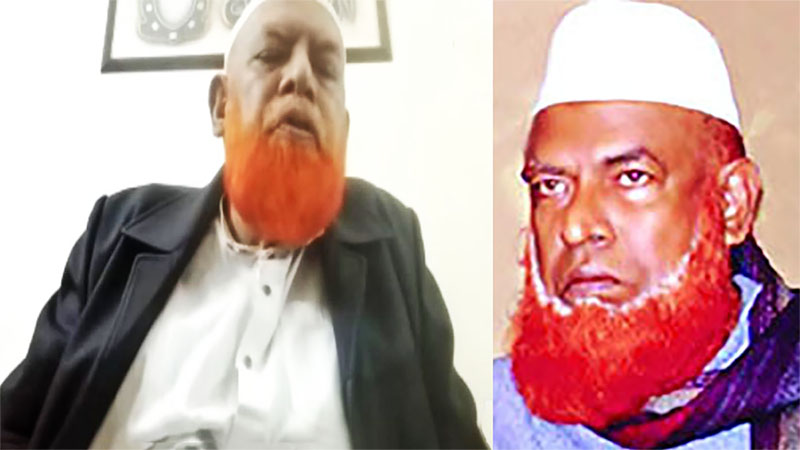
Britto Reza, Senior Reporter
Notorious war criminal and Jamaat-e-Islami leader Bacchu Razakar, whose real name is Abul Kalam Azad, fled to Pakistan after learning about the initiation of the trial process for his war crimes. Sensing favorable conditions in the country, he has now returned from Pakistan.
It has been learned that on Thursday, March 13, at 12:27 AM local time in Dhaka, Thai Airways flight TG-321 touched down at Hazrat Shahjalal International Airport’s runway 14, three minutes ahead of schedule. Bacchu Razakar disembarked from the Boeing 777-2D7 (ER) aircraft and exited the terminal.
Fourteen years ago, he fled the country as war crime cases were filed against him. Although intelligence agencies were aware of his arrival, surprisingly, the Jamaat leader exited the airport terminal without any arrest.
According to intelligence sources, in November of last year, he appeared in an interview with a YouTuber abroad for the first time in 14 years. During that interview, he hinted at his return to the country. On March 11, he boarded Thai Airways flight TG-346 from Lahore, Pakistan, at 11:45 AM local time, heading to Bangkok. The Boeing 777 aircraft flew for 3 hours and 40 minutes before arriving in Bangkok at 5:32 AM local time on March 12.
After a nearly five-hour transit in Bangkok, he boarded Thai Airways flight TG-321 at 10:55 AM, heading to Dhaka. The flight took 2 hours and 17 minutes to reach Dhaka.
Who is Bacchu Razakar?
The International Crimes Tribunal-2 sentenced him to death for crimes including murder, rape, and abduction during the Liberation War. A case was filed against him on April 20, 2009, at the Faridpur Judicial Magistrate Court, prompting him to go into hiding. On April 3, 2012, the tribunal issued an arrest warrant for him on charges of crimes against humanity during the Liberation War.
Prior to this, on April 2, 2012, he allegedly fled to India through the Hili border, according to RAB. A former teacher of the National University reportedly drove him to the border in his car. RAB arrested Bacchu Razakar’s son Shah Mohammad Faisal Azad, Abul Kashem Mohammad Mushfiq Billah Jihad, and his brother-in-law Kazi Ehteshamul Haque Liton for aiding his escape.
During interrogation, his two sons informed RAB that their father had gone to India en route to Pakistan. After reaching the Hili border, he took shelter at his friend Abul Kashem Azad’s Capilla Hotel. RAB also arrested the hotel owner and filed a case against them. At the time, reporters visited Bacchu Razakar’s house in Uttarkhan but found it silent and deserted.
According to his son Jihad, Bacchu Razakar left his Uttarkhan home on the evening of March 30, 2012, as per a prearranged plan. Disguised as a patient, he lay in a black-windowed microbus and traveled to the home of Professor Dr. Yusuf in Agargaon. After eating and gathering necessary items, the microbus headed for Dinajpur around 8 PM. The driver, Alim, was replaced by Jihad near Joypurhat, and they reached the Capilla Hotel in Hili around 3:30 AM. Bacchu Razakar stayed in a room on the third floor.
Jihad further revealed that on April 2, his father sent an SMS asking him to save a number under the name “Dr. Emran Nepal” on his phone. Jihad sent the number to his father via SMS. Dr. Emran, a former student of Dhaka Medical College, was acquainted with Bacchu Razakar through his brother-in-law Ehtesham. Emran currently resides in Nepal and occasionally visited their home in Dhaka.
Intelligence sources indicate that Bacchu Razakar and his two sons acquired three new SIM cards to maintain secrecy in their communications. On April 3, after learning about the arrest warrant, Jihad informed his father via SMS but received no response. Later that afternoon, Bacchu Razakar called his brother-in-law Ehtesham to assure him of his safety. The call came from an Indian number, confirming that he had crossed the Dinajpur border into India.
According to intelligence sources, Bacchu Razakar later traveled to Pakistan without any issues and maintained regular contact with his relatives in Bangladesh.
Background of Bacchu Razakar
Abul Kalam Azad, alias Bacchu Razakar, was born on March 5, 1947, in Faridpur district. He studied at Faridpur Rajendra College. During the Liberation War, he collaborated with the Pakistani forces, initially as a Razakar and later as the commander of the Al-Badr force in Faridpur. Although he was once a prominent figure in Jamaat-e-Islami, he later distanced himself from active politics.
As the head of the Al-Badr force in Faridpur, Bacchu Razakar became a wealthy and influential figure post-independence. He managed five NGOs and had many followers. He used religious sermons to spread misleading narratives and influence people.
During the Liberation War, Bacchu Razakar was closely associated with Ali Ahsan Mohammad Mujahid, the president of the Islami Chhatra Sangha (now Chhatra Shibir). He actively supported Jamaat-e-Islami during the 1970 elections. Before the formal formation of the Razakar force, he was involved in various criminal activities aiding the Pakistani army.
In early May 1971, Bacchu Razakar helped form the Razakar force in Faridpur and later served as the Al-Badr commander. Fluent in Urdu due to his madrasa education, he used this skill to gain favor with the Pakistani forces. Alongside Ali Ahsan Mohammad Mujahid, he worked to win over the Pakistani army stationed at the Faridpur Stadium.
Bacchu Razakar received weapons training from the Pakistani forces and was involved in the massacre of thousands of innocent people at the stadium. Many bodies were buried there or dumped in the river and a location known as “Moylar Gari” in Faridpur. His group was heavily armed, and his atrocities reached extreme levels.
In Hasamdiya village, Bacchu Razakar looted Hindu properties and set fire to 40-50 houses. He was directly involved in the killings at several execution sites in Faridpur, personally shooting numerous people. The prosecution presented evidence of his crimes under the International Crimes (Tribunals) Act, 1973, including genocide, murder, and other atrocities.
During the Liberation War, under Bacchu Razakar’s leadership, crimes such as murder, rape, looting, arson, abduction, and forced displacement occurred in Faridpur, Boalmari, and Nagarkanda. He led attacks on Hindu villages, including Fulbaria, Jaganandi, Ujirpur, Srinagar, Hasamdiya, and Moyendiya, looting properties and forcing Hindus to flee. He also handed over Hindu women to Pakistani soldiers for abuse and deposited looted gold and money with a Pakistani major in Faridpur.
Bacchu Razakar fled the country one day before the arrest warrant was issued. The tribunal delivered its first verdict in his absence. A committee formed by the Law, Home, and Foreign Ministries, based on intelligence reports, concluded that he had crossed into India via the Hili border and later moved to Sweden before settling in Pakistan under the protection of Jamaat leaders there.

https://stapravda.ru/20221228/reyting_samyh_populyarnyh_hostingov_v_rossii_196445.html, рейтинг хостингов России подтверждает, что выбор надежного провайдера важен для бизнеса.