
Syed Iftekhar Hossain
People are more or less familiar with the word genocide. The United Nations defines the word as ‘the deliberate killing of a specific group or group with the intention of destroying it.’ This killing can be direct or indirect. For example, preventing the birth of children in a specific population or killing newborns or killing a specific population group. Genocide can also occur during war, such as the 1971 genocide in Bangladesh or the Nazis’ persecution of Jews in Germany on the eve of World War II. It can also occur during ‘peace’. In 1994, horrific rapes occurred during the civil war in Rwanda, Africa. As a result of all these rapes, the rapists took care that no children were born. If any children were born, they were killed. Various government programs were taken in those countries to prevent the spread of the Yazidi population in Iraq and Syria. The junta in Myanmar has also behaved in such a terrible way with the Rohingya. So genocide does not just mean the direct physical killing of a specific group. It can happen in other ways as well. All of these are mentioned in the UN Human Rights Charter.
Many people may not understand that after the genocide committed by the Pakistan army against Bengalis in 1971 during the Bangladesh Liberation War, another genocide is currently underway in Bangladesh. The victims of that genocide are mainly four specific groups. The first is the religious minority adherents of traditional religions, the second is anyone associated with the Awami League, the third is the freedom fighters or children of freedom fighters, and the last is the newborn children of the country. After the so-called July Uprising (actually a militant uprising) on August 5, 2024, the people of the minority communities in the country were directly attacked by the so-called July fighters. After the fall of the Sheikh Hasina government on August 5, there was no effective government in the country. At this time, mobs or organized terrorist groups were formed in different districts of the country to carry out these attacks. This group mainly consisted of leaders and workers of Jamaat-e-Islam and their affiliate organization Islami Chhatra Shibir, along with members of the banned militant organization Hizb-ut-Tahrir and members of the BNP and Chhatra Dal. Five days later, Dr. Yunus flew in from France and assumed power, expecting the situation to improve. But it was the opposite. He legitimized this mob culture. His council members said that what was happening could not be called a mob, they were a ‘pressure group’. In different parts of the country, these miscreants called mobs selectively attacked and destroyed the houses of minority communities, beat up men or hanged them from trees and burned them alive. They raped the girls of the house. Many of the survivors left the villages. Some migrated. Among them were ordinary laborers as well as teachers, doctors and people of other professions. Many followers of traditional religions in government jobs lost their jobs. Three hundred cadets training at the Sarada Police Academy in Rajshahi were dismissed just before their graduation ceremony. Most of them were children of Awami families or religious minorities.
With the oppression of religious minorities, miscreants pounced on the leaders and workers of the Awami League. For the ‘crime’ of someone in the family being involved in Awami League politics, the entire family became the victims of these miscreants. A new word was born. ‘Friends of tyranny’. School teachers, university vice-chancellors, professors, doctors and people of many other professions were not left out of the list of these friends. In many cases, their families were attacked without being found. Freedom fighters or their family members were not left out. Their crime was that they broke Pakistan. People who once were proud to call themselves freedom fighters went into hiding. Families who received freedom fighter allowances were forced to move to other places and be evicted from their homes.
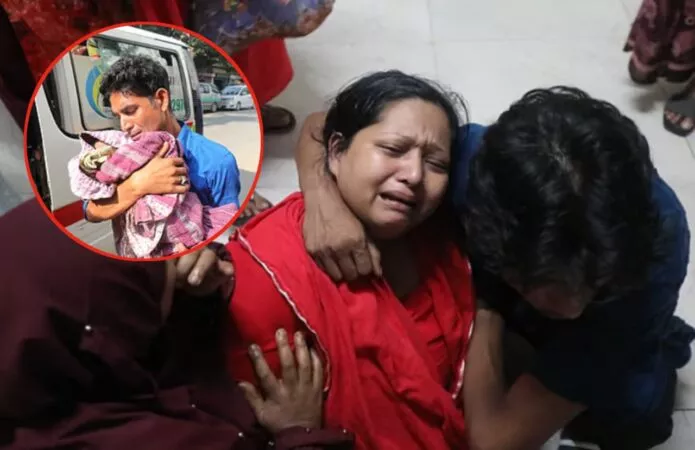
Finally, due to the terrible negligence of the Yunus government, the measles epidemic broke out in the country due to the lack of measles vaccination and as a result, thousands of children were infected and died. According to official estimates, more than seven hundred children have died of measles so far. According to private estimates, it could be over a thousand. There are some diseases in temperate countries like Bangladesh that are not seen in other countries. These include cholera, smallpox, malaria, dengue, typhoid, chikungunya, kala-azar, etc. Most of them are water-borne. At one time, people in vast areas of the country were affected by all these diseases and village after village was devastated due to this epidemic. In the early days of the Liberation War of 1971, thousands of people died of smallpox in many areas of the country. There were not even people to bury the dead.
As a result of the government’s coordinated programs at various times, all these diseases, including measles, have almost disappeared from Bangladesh. This success cannot be attributed to a single government. However, a significant success in this achievement has come during the Sheikh Hasina government in the past. The best example of how successful she was in the vaccination program in the country is the vaccination program planned in Bangladesh during the Covid outbreak. When millions of people died due to this epidemic in other countries around the world, the number of deaths in Bangladesh was 29,500. In India, 533,000 and in the United States, 1.2 million. Bangladesh’s success in controlling Covid was at the top in Southeast Asia. During this time, the country’s economic growth was close to five percent, which is the highest in South Asia.
Now let’s talk about the ongoing measles epidemic in the country. Although measles is mainly a disease of children, it can also affect adults. The last outbreak of this disease was seen nationwide during the period 2000-2006. At this time, Begum Zia’s government was in power. The incidence of the disease began to decrease from 2007. Then, the government of eleven. After Sheikh Hasina formed the government in 2009, she gave importance to this issue. The United Nations came forward to help her. UNICEF, funded by Gabi (Global Alliance for Vaccines and Immunization), collected vaccines from various vaccine manufacturers around the world and handed them over to the Bangladesh government. Bangladesh was also involved in the financing. The World Health Organization helped. The government distributed them through community clinics across the country and made arrangements for vaccinating children. At the same time, it ran a campaign for several weeks to make people aware of this issue across the country. It arranged for miking in some areas. This program achieved great success during Sheikh Hasina’s fifteen-year rule. In 2019, UNICEF and Gavi jointly honored him with a rare honor at the United Nations Headquarters for this achievement. He was given the title of ‘Vaccine Hero’. From the information received, it is seen that this mass vaccination program of children continued in the country until June 2024.
After the so-called July Uprising in 2024, Dr. Yunus illegally seized state power after flying from Paris. He was in power until February 17, 2026. On February 12, BNP won a general election in the country without the Awami League, and on February 17, an ‘elected’ government was formed in the country under the leadership of Tarique Rahman. Yunus’s reign was a dark chapter in the history of Bangladesh. There is no such misdeed that he did not do for his own benefit. However, one of the most misdeeds was to stop the established measles vaccination program. He decided that the vaccine would no longer be collected through Gaver under the conventional rules. It would be through open tender. Maybe he had in mind that he himself would open an organization in the name of Grameen and collect it through it. This was a disastrous decision. At the same time, he stopped the salaries of those involved in this existing vaccination program.
UNICEF’s permanent representative in Bangladesh, Rana Flowers, wrote to Yunus at least five times, opposing his decision, saying, “Please don’t take such a disastrous decision.” Who listens to whom? In the meantime, the number of children affected by measles in the country has started increasing. After Tarique Rahman took office, this problem has become an epidemic. Now, the government may have returned to a somewhat better state. But there are not enough beds for the affected children in the hospitals. Several people in the country have approached the court hoping to be tried for various misdeeds of Yunus. The court has made it clear that Yunus will not be tried in any court in the country. It is left to say, “There is no permission from the upper echelons.” People in the country have long known that Tarique Rahman’s government is an expanded version of the Yunus government. It is understandable that US President Trump also had to stand in the court’s court.
Analyzing the above incident, it is clear that according to the definition of the United Nations, Dr. Yunus has committed many crimes in Bangladesh during his illegal rule. He has been involved in multiple genocides in the country. He may not be tried in the conventional courts of the country, but history will evaluate him. History does not forgive anyone.

https://stapravda.ru/20221228/reyting_samyh_populyarnyh_hostingov_v_rossii_196445.html, рейтинг хостингов России подтверждает, что выбор надежного провайдера важен для бизнеса.