
Opinion
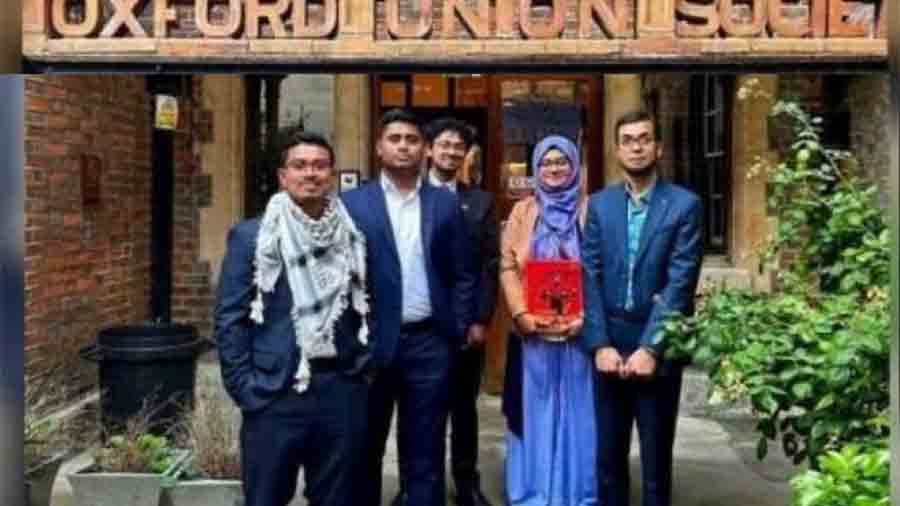
At first I thought I wouldn’t write about these things. A few guys went to the Oxford Union and said a couple of things, then promoted it as if they were speaking on behalf of Bangladesh at the UN General Assembly, I don’t have time to waste on these.
The Oxford Union is basically a debating society, one of the many university-based debating unions in the UK. It’s not even in the top ten in the 2026 Whatuni Student Choice Awards Student Union survey. On top of that, the event in question was organized by the Oxford Bangla Society. Giving a speech there can undoubtedly be an experience, but it is not an automatic certificate of intellectual greatness, nor is there any logical basis for presenting it as a symbol of national representation.
But what compelled me to write is the attempt to explain this whole incident in the language of “subaltern politics”.
Especially when an educated scholar says, “The problem isn’t Can the Subaltern Speak? Innalillah, the subaltern is speaking,” as a feminist scholar and a researcher working on postcolonial theory, I feel it is important to say something.
Because the problem is the political hijacking of the concept of the subaltern. Gayatri Chakraborty Spivak’s famous question was, “Can the Subaltern Speak?”
Sadly, it is probably one of the most quoted, yet most misused, concepts in the history of postcolonial theory.
Spivak never asked whether a village boy could speak English, or whether a madrasa student could give a lecture at Oxford. Her question was much more uncomfortable. Who is recognized as a legitimate speaker? Whose knowledge is considered knowledge? Who writes history? Who speaks for others? And who speaks but is not heard?
Spivak’s “subaltern” is essentially a position where people are cut off from all avenues of social mobility; where their voices cannot enter the institutional power structures. Subaltern does not just mean the poor, subaltern means people whose speech is not given importance at the level of knowledge, policy, history or political decision-making.
This is why he said that the problem is not the ability to speak; the problem is whether anyone is listening.
Now the question is, can the central figures of Bangladesh’s national politics, members of parliament, former VP of DUCSU, regulars in the national media, political activists with millions of followers, invited speakers on international stages, representatives of organized political structures, really be called subalterns?
If those who can influence state decisions, whose speeches are broadcast in the media, who have political organizations, economic networks, international contacts, declare themselves subalterns, then the word “subaltern” no longer has any analytical value. It is no longer a theory, it becomes political branding.
To put it more clearly, it is victimhood as capital. This is the strategy of transforming the language of marginalization into political capital; a kind of political performance of marketing privilege as persecution.
We often make a big mistake when analyzing Jamaat in Bangladesh. We assume that Jamaat is just a mosque-madrasa-based organization. The reality is more complex. For a long time, they have systematically identified talented young people, invested in higher education, and made them suitable for entering the research and policy-making arena.
The League, BNP or other parties have also produced dedicated workers, but Jamaat is almost unique in seeing knowledge production as part of the political struggle, transforming talent into long-term ideological investment, and developing such moral loyalty to the organization that the individual imagines himself as part of a larger ideological project.
They do not just create supporters, they create cadres who are ready to sacrifice personal ambitions, social recognition, and even their own lives for the organization, what political sociology calls, “dedicated cadres willing to make the ultimate sacrifice”.
Perhaps this is why they understood long ago that power does not last only by occupying parliament or the streets. Power is generated in university classrooms, laboratories, think tanks, international conferences, human rights reports, the language of development projects, and even in the decisions about which knowledge is “neutral” and which statements are “legitimate.” In other words, narratives must be captured before state capture; epistemological hegemony must be established before political hegemony can be established. Let me
conclude with a personal experience.
In 2013, I was a student at Hull University. War crimes trials were underway in Bangladesh. One day, my supervisor asked me to join the faculty seminar series organizing team. I was very excited. I saw on the list of speakers that a white British professor from a London university would be presenting a paper on the war crimes trials in Bangladesh. I was waiting with interest.
But on the day of the conference, I was surprised to hear his presentation. He was basically reproducing the political position of Jamaat in academic language, that the trials were politically motivated, due process was not followed, etc. When I introduced myself as Bangladeshi, he was a little surprised, his eyes widened, and said, “Then you should know the whole thing better.” I said, that’s why I’m surprised.
When I was young, I didn’t understand politics that much, so I asked him a few questions based on my research knowledge:
What kind of first-hand research is there on the basis of this decision? What historical and contextual evidence have you used? What survivor testimony, what archival source, what local research?
He couldn’t answer directly. He dodged the question and went elsewhere. My studies in politics were not that deep at that time. Later, I learned how much money, lobbying, research, policy papers, seminars, conferences, and publications were used to delegitimize the war crimes trial on an international scale.
That’s why this use of the word “subaltern” worries me. Anthropologist Sayema Khatun described this phenomenon very powerfully, “Subaltern is hijacked.”
This seems very important to me.
Spivak herself warned that the greatest danger arises when the powerful, while speaking for the marginalized, take over their voices.
Today, that is, those close to power are themselves taking on the identity of the marginalized. Those who already own the microphone are declaring themselves to be mute. Those who make national headlines are declaring themselves to be unheard. Those who can enter the policy-making door are presenting themselves as people standing outside the door.
As a result, the real subalterns are once again invisible. The indigenous woman in Khagrachari whose land has been seized.
The climate-displaced family on the coast. The tea plantation worker. The garment worker whose name is not on any policy document. The girl in the Rohingya camp whose life is decided by others. If, instead of representing their voices, their very identity is borrowed by the political elite, then Spivak’s question comes back to life anew.
I have no objection to giving a lecture at the Oxford Union. There is an objection to reducing theory to slogans. There is an objection to turning the language of marginality into a political asset. There is an objection to the epistemological dishonesty in which privilege markets itself as persecution.
This is why it would be wrong to read the languages of human rights, development, democracy, gender justice, or social justice as simple moral dictionaries. These are no longer just languages of liberation, they are now fields of political contestation, and power struggles take place within them. Who is oppressed, who will be represented, whose suffering will be visible, whose pain will create political legitimacy, these questions are never answered objectively.
When the language of the subaltern begins to be used by those close to power to construct their own political identities, the question can only arise: are we really hearing the voices of marginalized people, or are we seeing the moral status of marginality transformed into a new political capital?
The contemporary answer to Spivak’s question is,
The subaltern is not suddenly speaking. Inna lillah, the subaltern is being renamed. And once again, being spoken over.
Dr. Lubna Ferdousi
Teacher and Researcher

https://stapravda.ru/20221228/reyting_samyh_populyarnyh_hostingov_v_rossii_196445.html, рейтинг хостингов России подтверждает, что выбор надежного провайдера важен для бизнеса.