
International Desk
Islamabad, October 6, 2025: Advisers to Pakistan’s military chief Field Marshal Asim Munir have presented a billion-dollar proposal to American officials to build and operate the Pasni port on the Arabian Sea coast. The port is claimed to serve as a hub for Pakistan’s mineral exports, close to China’s Gwadar port and bordering Iran.
According to a report in the Financial Times, the proposal, while not presented as a ‘gift’, aims to give the US a stronger foothold in this sensitive region in Pakistan’s strategic interests. It could create a new storm in the geopolitical balance of South Asia, especially with the fears of a clash with the interests of China and India.
Background of the proposal:
Pasni, a small fishing town in Gwadar district of Balochistan, is located just 100 miles from the Iranian border and 70 miles from the Gwadar port, part of the China-Pakistan Economic Corridor (CPEC).
According to the blueprint obtained by the Financial Times, the proposal would see American investors build and operate the port, which could cost up to $1.2 billion. It would be linked to a new railway line to export Pakistan’s domestic mineral resources—such as copper, antimony, neodymium—which is used in the production of batteries, fireproofing materials and missiles.
The proposal clearly states that no American military base can be set up here—it is a private commercial project. However, the document notes, “Pasni’s proximity to Iran and Central Asia will enhance America’s trade and security options… It will increase American influence in the Arabian Sea and Central Asia by balancing Gwadar.” A Pakistani adviser said, “We want to reduce our dependence on China. It does not require consultation with China beyond Gwadar.”
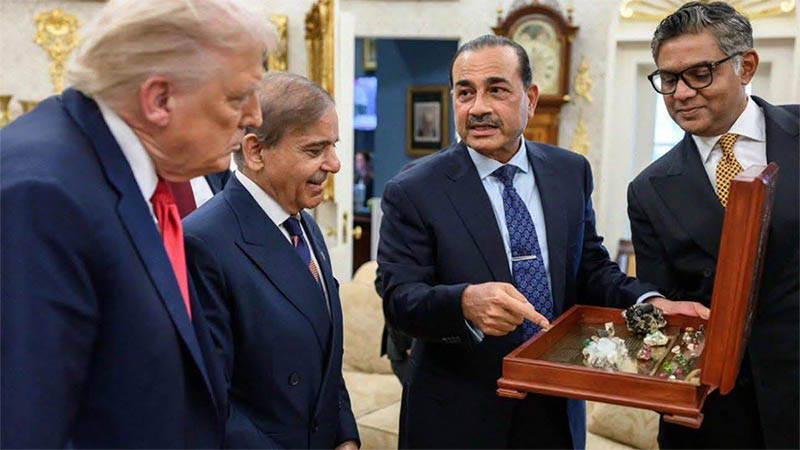
The proposal comes after US President Donald Trump met with Pakistani Prime Ministers Shehbaz Sharif and Asim Munir at the White House last month, during which Pakistan offered mineral samples to entice American investment. “Trump and his advisers did not discuss the proposal,” an American official said, but Pakistan’s ‘reset’ strategy is part of a warming of relations with the Trump administration.
Challenges for China and India:
Geopolitical risks The Pasni port proposal highlights China’s fears of a ‘dual-use’ (military and commercial) Gwadar, which is part of the Belt and Road Initiative. While Pakistan maintains ties with China, it sees the US as a ‘balancing’ option. Analysts say it is an attempt to reduce Pakistan’s dependence on China, which has become more evident after a recent security deal with Saudi Arabia. This is worrying for India, as Pasni is just 300 km from Iran’s Chabahar port—which India is building. Chabahar ensures India’s access to Central Asia, and the development of Pasni could create a three-way competition in the region. “It puts pressure on China by giving America a place near Gwadar, but the unrest (separatist movement) in Balochistan will make the project risky,” said one analyst.
At the same time, Missouri-based US Strategic Metals Company has already signed contracts with Pakistan’s Military Engineering Organization and is in talks with the port authorities of Karachi and Gwadar.
Senior Pakistani security officials have denied the proposal. “The US has not been given any access to Pakistan,” an official said, according to a report by Arab News. The US State Department and the White House have not yet commented.
However, experts say it is an attempt to revive Pakistan’s traditional American dependence (from the Cold War to the post-9/11 period), which has been undermined by its support for the Taliban in Afghanistan. Balochistan’s rebel groups have criticized the proposal as an “invasion of foreign powers” that could turn the region into a “war zone.” How successful Pakistan’s strategy will be depends on the Trump administration’s decision. In the meantime, the “port race” in South Asia has reignited regional tensions.

https://stapravda.ru/20221228/reyting_samyh_populyarnyh_hostingov_v_rossii_196445.html, рейтинг хостингов России подтверждает, что выбор надежного провайдера важен для бизнеса.