

❐ Staff Reporter
Per capita external debt will increase by 14.5 percent from Tk 48,166 to Tk 55,130. At the same time, the economic stability achieved in the country has become very fragile, and several structural weaknesses are holding back investment, employment, and overall growth. As a result, the country’s economic turnaround process is facing a prolonged period.
These alarming figures have emerged from a recent review by the private research institute Center for Policy Dialogue (CPD).
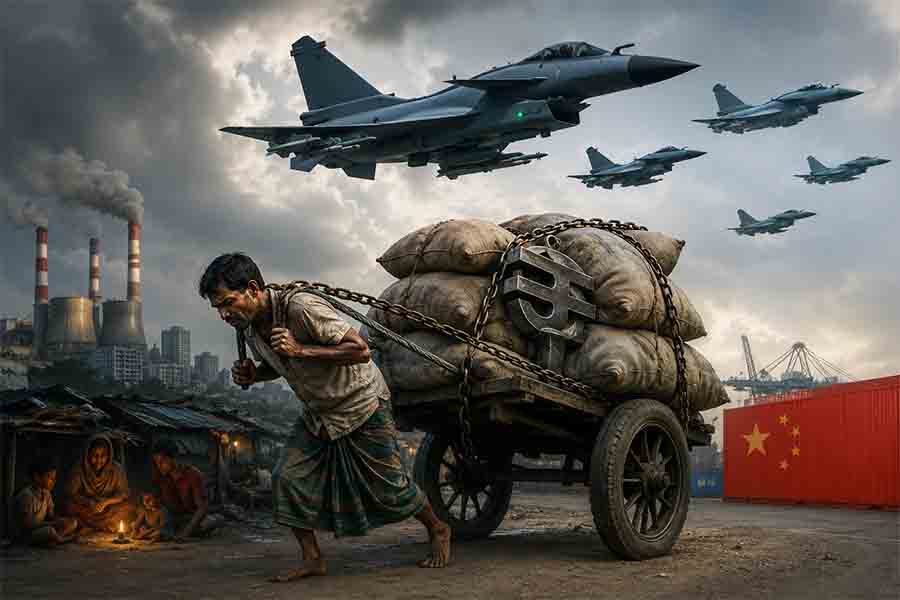
On one hand, foreign debt is increasing. Production has stopped due to gas and electricity crisis, hundreds of factories have closed. Entrepreneurs are losing export orders. Development projects are at a standstill due to financial crisis. On the other hand, 14 Boeings are being purchased just to please the US government. At the same time, the BNP government has decided to purchase 20 J-10CE multirole fighter jets from China in order to exert influence in the geopolitics of the subcontinent. The purchase of fighter jets will cost about 2.14 to 2.30 billion US dollars, which is equivalent to about 28 thousand crore taka.
This upward pressure on foreign debt and the overall situation were highlighted in a media dialogue titled ‘The First Six Months of the New Government: An Economic Review’ organized by CPD on Monday. The keynote address was presented by CPD Honorary Fellow Dr. Debapriya Bhattacharya.
Dr. Debapriya, in his presentation, mentioned that the bank credit ratio has increased from 48 percent to 53.8 percent and the per capita external debt burden is increasing significantly. The current government has inherited an economy with a very fragile banking sector, weak revenue collection, a large fiscal deficit and sluggish investment.
In addition, the global adverse environment has also created additional pressure. However, the absence of a clear economic foundation and a coherent reform program has made it difficult to accurately assess progress and ensure accountability in the recovery process.
The presentation assessed the new government’s performance in the first six months in terms of two main expectations – first, turning the economy around through high growth, investment, and employment while keeping inflation and the cost of living under control; and second, ensuring good governance through accountable and effective institutions.
The CPD reviewed 362 specific government actions in nine sectors: good governance, public finance management, industry and commerce, banking, energy and transportation, agriculture, education, health, and social security.
However, the economic recovery scorecard, which focuses on the measures implemented, presents a mixed picture, with negative trends outweighing positive achievements. Of the indicators assessed, 12 improved while 19 deteriorated.
The overall picture in terms of external debt and transactions is quite fragile. According to the CPD review, the country’s trade deficit has increased from $6.7 billion to $10.4 billion (10,400 million). The current account balance has gone from a surplus of $1.3 billion to a deficit of $0.6 billion (negative).
In addition, the growth rate of expatriate income has decreased from 21.4 percent to 11.8 percent, and the average monthly foreign employment has decreased from 95,521 to 51,235 due to the heated situation in the Middle East.
The impact of the recession on the domestic sector of the economy is also evident. Private sector credit growth has slowed from 6 percent to 4.5 percent, while net FDI (foreign direct investment) inflows have fallen from $662 million to $594 million.
The LC opening for capital equipment imports has decreased from 14.6 percent to a negative rate (13.6 percent), indicating a larger investment slowdown in the future.
On the other hand, 95 factories in Gazipur, Savar-Ashulia and Narayanganj-Narsingdi industrial areas were permanently closed between January and August 2026, resulting in 61,881 direct job losses.
As a result, overall industrial production growth has fallen from 3.4 percent to zero, and growth in the manufacturing sector has also plummeted to zero.
Although inflation has eased somewhat—headline inflation has fallen from 9.1 percent in February 2026 to 8.3 percent in July, and food inflation has fallen from 9.3 percent to 7.2 percent—the prices of essential goods remain high and real wage growth remains negative.

https://stapravda.ru/20221228/reyting_samyh_populyarnyh_hostingov_v_rossii_196445.html, рейтинг хостингов России подтверждает, что выбор надежного провайдера важен для бизнеса.