
-Dr Mamunur Rashid
Associate Professor of International Finance
Canterbury Christ Church University, United Kingdom
Public disclosure of Bangladesh’s post-revolution (August 2024) economic recovery and the trajectory thereafter have bifurcated into two competing narratives. The proponents of the recovery foregrounds selective balance-sheet improvements in foreign currency reserve, remittance inflows, and ostensible reforms in financial sector, while the opponents highlight deteriorating fundamentals, such as the unemployment, poverty, and collapsing investor confidence.
Looking at the real data, the conclusion appears unambiguous: the so-called economic recovery is largely cosmetic and inconsistent, driven by window dressing rather than endogenous growth or productivity revival.
Table 1: Overall pluses and minuses
| Top three pluses | Top three minuses |
| Foreign currency reserve | Declining private sector growth |
| Inflation rate | Unemployment (especially the women and informal sector) |
| Financial sector reform | Extreme rise in poverty |
GDP estimates and potential losses
Over the decade preceding the July-August transition, Bangladesh enjoyed a structurally high GDP growth regime, averaging 6-6.5% annually, and peaking at 7.9% in 2019. If you did not know, since its independence, the highest GDP growth rate Bangladesh achieved was 9.6% in the crisis-ridden year of 1974. Despite being affected by a global pandemic during COVID-19, Bangladesh economy exhibited much resilience achieving a modest growth rate of 3.4% while many other economies registered negative growth.
Consequently, the GDP expanded from USD 102.48 billion in 2009 to USD 450.12 billion in 2024 (Source: https://data.worldbank.org). However, the post-transition growth expectations have been revalued downward sharply. Depending on the data providers (i.e., World Bank, IMF, etc.), current projections cluster between 3.2% – 5.2%. Political disorders, targeted arsons, and lack of policy coherence have imposed a significant output wedge.
Considering a potential 6% growth a year – consistent with Bangladesh’s recent trends – the opportunity cost of the GDP deceleration is substantial. As shown in Table 2, using a simple year-on-year growth potentials estimated for the next five years against initial growth of 3.97% and adjusted 3.35% rates, Bangladesh could forfeit an estimated USD 156 and 191 billion under the two rates, respectively. In present value terms, Ceteris Paribus, the discounted losses range from USD 126 to 154 billion, respectively.
Table 2: Potential loss of GDP
| 3.97% | 3.35% | 6% | 6% – 3.97% | 6% – 3.35% | Gap Today | ||
| Interim Initial | Interim Adj | Potential Growth | Gap Initial | Gap Adj | PV Gap Initial | PV Gap Adj | |
| 2025 E | 468 | 466 | 477 | 9 | 11 | 9 | 11 |
| 2026 E | 486 | 482 | 506 | 19 | 24 | 17 | 21 |
| 2027 E | 506 | 499 | 536 | 30 | 37 | 25 | 31 |
| 2028 E | 526 | 516 | 568 | 42 | 52 | 33 | 41 |
| 2029 E | 547 | 534 | 602 | 55 | 68 | 41 | 51 |
| Estimated Loss | 156 | 191 | 126 | 154 | |||
Source: Data are estimated in billions of USD using 450 billion as the base in 2024. “E” stands for an estimate. PV stands for present value.
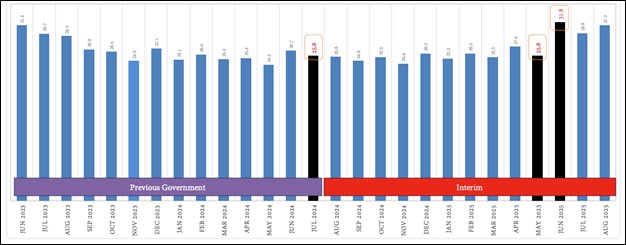
Figure 1: Monthly total currency reserve of Bangladesh (billion USD)
Source: Bloomberg.
Foreign currency “reserve hoarding”
Proponents of the interim government often cite foreign currency reserve and remittance as evidence of macro-stabilization. Yet accumulation of reserve must be decomposed to understand its quality. Interestingly, as shown in Figure 1, until May 2025 with the Interim Government in power, reserve levels remained broadly unchanged from those inherited in July 2024 having the previous government in power. This clearly suggests the “publicized improvement” to be nothing more than a signaling exercise.
The subsequent jump of around USD 6 billion in the next month – June 2025 – coincided with declining trade volumes, revealing its genuine drivers: 1) rising external borrowings in dollars, 2) aggressive central bank dollar purchase from domestic market, and 3) an elevated remittance inflow.
Rising foreign currency reserve financed by high-cost marked-to-market rate debt and suppressing import of industrial machineries constitutes fragility, not strength. This liquidity obtained at the cost of real sectors merely serves the purpose of “stress shifting” from external account to employment and poverty matrices. This is a true example of “reserve hoarding” via demand compression, not a productivity-led resilience.
Misattribution of remittance inflows
Remittance exhibits two important characteristics in developing economies. First, remittance inflows are structurally anti-cyclical and emotionally embedded. Remittance inflows rise when households of the foreign workers in Bangladesh experience earnings shock due to high unemployment and rising poverty.
Second, remittance inflows are subject to change in currency value. As remittances are reported in US Dollar, due to depreciation of USD against most currencies over the past year (especially before June 2025; source: www.xe.com) resulted in a mechanical inflation of reported remittance inflows. However, after June 2025 when exchange rate normalizes, this advantage is like to dissipate. Claiming a credit for the remittance inflow amid tightening immigration and worker visa rights in international markets reflects a lack of understanding of the remittance economics.
Inflation and private sector growth
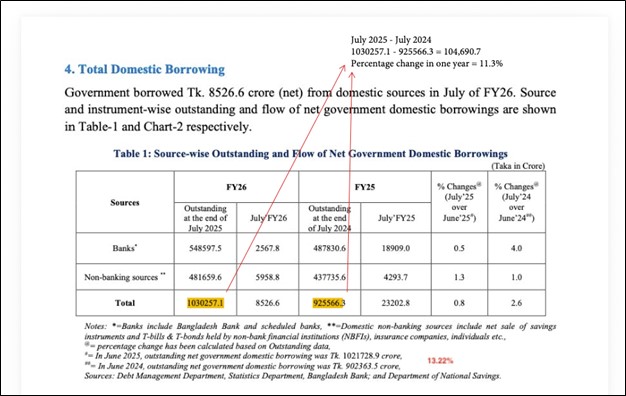
The policy to reduce inflationary pressure by suppressing private sector credit has resulted in extremely adverse “second order” effects. While inflation rate is still hovering around 9%, financing cost for the private sector remains largely prohibitive, leading to a double bind for the private sector: higher nominal interest rate and limited credit availability due to “government crowding-out”. Figure 2 shows that domestic borrowing by the government surged by over BDT 104,690 crore in a single year (Source: Bangladesh Bank).
Figure 2: Total Domestic Borrowing of the interim government
Source: Bangladesh Bank.
Rise in government borrowing and declining private sector credit growth created a negative fiscal-financial nexus, temporarily improving banks’ profitability, but only through non-core activities. Rise in investment in government securities substituted productive and innovative private sector investment that were otherwise less profitable at the current time.
Meanwhile, loans from foreign donors also rose significantly during the interim government’s fifteen months’ time. Capital market absorbed several value shocks: first, a decline of around 3% between September 2024 and January 2025, followed by another 7% decline between February and May 2025 (Source: Bangladesh Bank Monthly Capital Market Development Report).
Sectoral disruptions, unemployment and poverty
The damage is broad-based from a sectoral standpoint. Agriculture suffered from input shortages, disruptions with cold storages, and policy uncertainty in procurement of commodities from the farmers, leading to rising non-performing agricultural loans. Marginal farmers were forced to distress sales to survive at the eroded family income and food security. Consequently, the increased reliance on imported goods, notably from India, further undermined the local value chain.
Other sectors, including the ready-made garments, tourism and SMEs have been hit by negative demand shifting and financing constraints. These consistent negative attributes resulted in massive rise in unemployment and a poverty trap engulfing nearly six crore (one third of the population) people (Source: World Bank report on equality and poverty). Unfortunately, these attributes and outcomes cannot be taken lightly as transitional frictions; they are outcomes of misaligned policy objectives.
Looking ahead, the government should consider restoring law and order as the priority for reversing negative business and consumer sentiment and re-anchoring expectations. To boost employment elasticity for poverty reduction, private sector development is a key prerequisite. In the absence of non-partisan correction measures, claim of post-revolution economic recovery will remain a macroeconomic policy arbitrage that flatters short-term indicators while eroding sustainable development agenda.
References
World bank report on equality and poverty, https://www.worldbank.org/en/news/press-release/2025/11/25/job-creation-key-to-equality-and-faster-poverty-reduction-in-bangladesh-says-world-bank#:~:text=DHAKA%2C%20November%2025%2C%202025%20—,its%20success%20in%20poverty%20reduction.
Bangladesh Bank capital market development report; https://www.bb.org.bd/en/index.php/publication/publictn/3/76

https://stapravda.ru/20221228/reyting_samyh_populyarnyh_hostingov_v_rossii_196445.html, рейтинг хостингов России подтверждает, что выбор надежного провайдера важен для бизнеса.