
International Desk
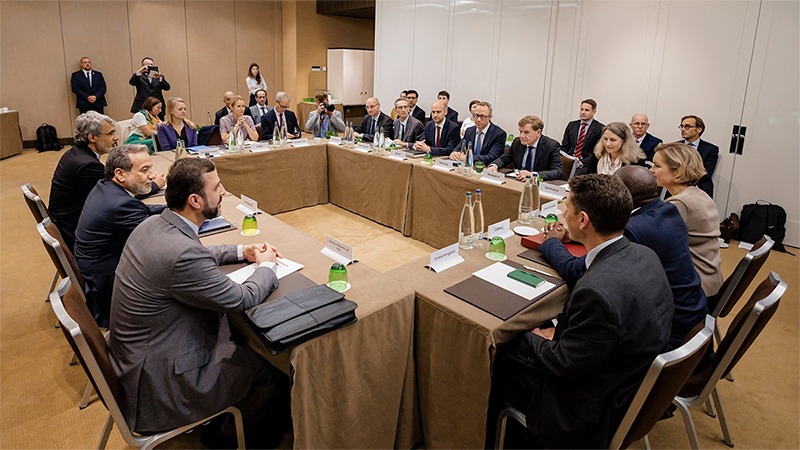
In Geneva, Switzerland, Iranian Foreign Minister Abbas Araghchi participated in an important meeting with representatives from Germany, France, the United Kingdom, and the European Union (EU). This meeting was held with the aim of reducing tensions in the Middle East against the backdrop of Iran’s nuclear program and the Iran-Israel conflict. This marks the first direct talks between Iran and Western countries following the week-long Iran-Israel conflict.
Context of the Meeting
The recent conflict between Iran and Israel has intensified. Since June 16, both sides have launched missile attacks, resulting in civilian casualties. Israel has continued its military strikes with the objective of destroying Iran’s nuclear weapons capabilities. In this situation, European countries have taken the initiative to seek a diplomatic solution.
Tensions have long persisted between Iran and the international community over its nuclear program. After the U.S. unilaterally withdrew from the 2015 Joint Comprehensive Plan of Action (JCPOA) in 2018, Iran accelerated its uranium enrichment activities. The main objective of this meeting was to secure assurances that Iran’s nuclear program would remain peaceful and limited to civilian purposes.
Participants in the meeting included Iranian Foreign Minister Abbas Araghchi, German Foreign Minister Johann Wadephul, French Foreign Minister Jean-Noël Barrot, British Foreign Minister David Lammy, and the EU’s High Representative for Foreign Affairs, Kaja Kallas. Before the meeting, European ministers held preparatory discussions with Kaja Kallas at Germany’s permanent mission.
Key Discussion Points
European countries sought assurances from Iran that its nuclear program would be used solely for civilian purposes. French Foreign Minister Jean-Noël Barrot emphasized that the goal of the talks was to permanently roll back Iran’s nuclear and ballistic missile programs. Additionally, efforts were made to explore ways to establish a ceasefire and de-escalate tensions in light of the recent conflict. European leaders stressed the need for a diplomatic solution between Iran and Israel.
German sources confirmed that the meeting was coordinated with the U.S. Although U.S. President Donald Trump mentioned the possibility of talks with Iran, Iran has made it clear that it will not engage in discussions with the U.S. unless Israeli attacks cease.
European countries also expressed concerns over Iran’s ballistic missile program. However, during a previous discussion in January 2025, Iran had refused to consider this issue as part of future negotiations.
Before the meeting, Iranian Foreign Minister Abbas Araghchi stated in state media that there would be no opportunity for talks with the U.S. unless Israeli aggression stopped. He accused the U.S. of being complicit in Israel’s aggression. However, his presence in Geneva for talks with European countries indicates Iran’s partially positive stance toward a diplomatic solution.
Behrouz Kamalvandi, spokesperson for Iran’s Atomic Energy Organization, stated that Iran would continue technical and security cooperation with the International Atomic Energy Agency (IAEA). However, Iran has recently activated a new uranium enrichment facility, adding further complexity to the negotiations.
European Countries’ Stance
German Foreign Minister Johann Wadephul emphasized the importance of controlling Iran’s nuclear program to resolve conflicts in the Middle East. He stated that it was crucial to ensure Iran does not become a threat to Israel or Europe. France also supports permanently limiting Iran’s nuclear and missile programs.
British Foreign Minister David Lammy, after meeting with U.S. officials in Washington, said there was still room for a diplomatic solution regarding Iran’s nuclear program. He viewed the Geneva meeting as a step toward preventing regional conflict. EU representative Kaja Kallas is also attempting to mediate in de-escalating tensions.
Although the U.S. played a coordinating role in the meeting, it did not participate directly. President Trump has hinted at the possibility of military action against Iran but has also expressed support for a diplomatic solution.
Reports indicate that Israel is focused on destroying Iran’s nuclear capabilities and prefers military action over diplomatic talks. At the UN Human Rights Council session in Geneva, Israeli Ambassador Daniel Meron issued a statement condemning Iran.
However, Russia and China are not directly involved in these discussions, though their strategic relations with Iran influence the context of the talks.
Further expert-level discussions are planned after the meeting. German sources indicated that these talks could lay the groundwork for a structured dialogue. However, Iran’s firm stance and Israel’s ongoing attacks may hinder progress.
Meanwhile, Iran has threatened to close the Strait of Hormuz, through which about 20% of the world’s oil and gas supplies flow, raising concerns of an energy crisis for European countries.
The Geneva meeting is a significant step toward de-escalating tensions in the Middle East and controlling Iran’s nuclear program. However, Iran’s rigid position, Israel’s military strikes, and the U.S.’s dual policies have cast uncertainty over the outcome. Future expert-level discussions and coordinated efforts by the international community will play a crucial role in resolving this crisis.

https://stapravda.ru/20221228/reyting_samyh_populyarnyh_hostingov_v_rossii_196445.html, рейтинг хостингов России подтверждает, что выбор надежного провайдера важен для бизнеса.