
Eurasia Times
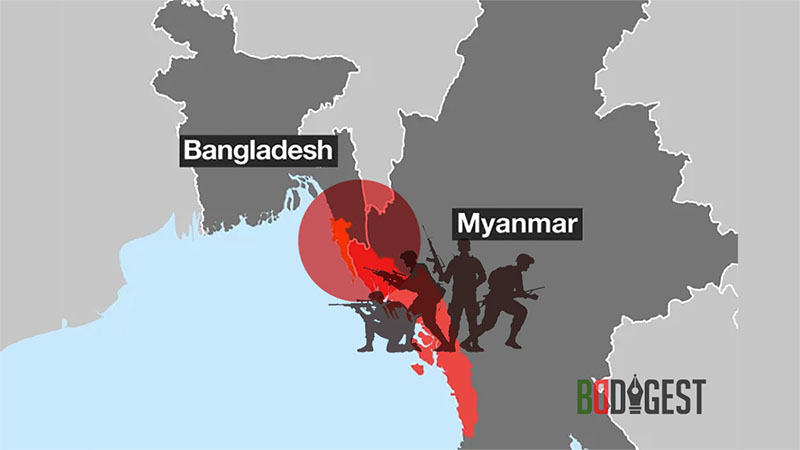
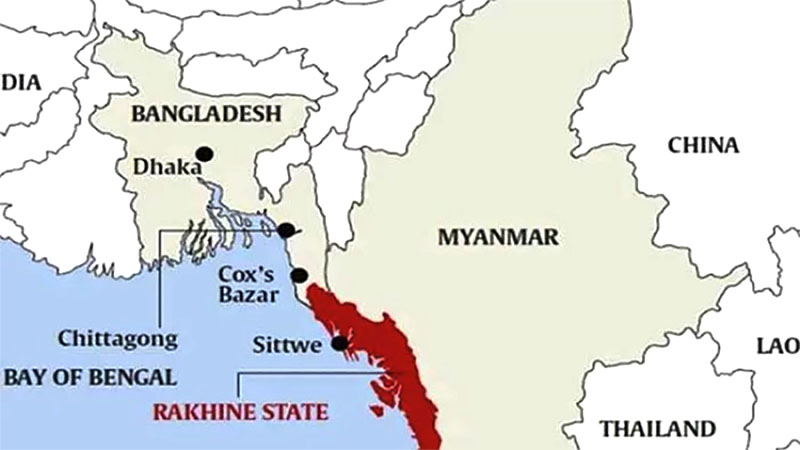
The Rakhine Corridor has rapidly become an important and sensitive area in the geopolitics of South Asia over the past few years. While this corridor is seen from the outside as a humanitarian aid route to northern Rakhine, it hides a much deeper and strategic geopolitical purpose. At the center of which is Bangladesh and its sovereignty at stake.
Currently, most of Rakhine State is under the control of the Arakan Army, as a result of which this corridor has now become a competition ground for regional powers including the United States, China, India. And in the middle of this, Bangladesh has been caught in this exciting game. International superpowers are breathing down Bangladesh’s neck.
A cunning trap disguised as humanity
Dr. Yunus’s interim government claims that the corridor is a way to reach aid for the nearly two million people in northern Rakhine State. UN Secretary-General Antonio Guterres, during a visit to Cox’s Bazar, has also spoken sympathetically, calling the disruption of humanitarian aid a “crime”.
But according to international political analysts, there is a larger strategy of the United States behind this humanitarian narrative—one that aims to expand its influence in the Bay of Bengal. This is something that Bangladesh’s elected Prime Minister Sheikh Hasina has been saying for a long time. But at that time, many tried to cover up these words by calling them ‘political statements’.
The opening of this corridor, as per a UN-US-Bangladesh proposal, has raised widespread concerns in the Bangladesh army. Bangladesh Army Chief General Waqar-uz-Zaman has called the corridor a “bloody corridor” and said it is a threat to the country’s sovereignty.
The Bangladesh Army believes that through this corridor, Western intelligence agencies will have the opportunity to dominate China’s neighboring areas (Myanmar).

Arakan Army Chief General Tun Myat Naing
Bangladesh in the throes of conflict
Ignoring the military, Dr. Yunus’ interim government is showing great interest in the corridor in the face of US pressure. In this regard, analysts point to Dr. Yunus’s pro-Western – especially US-centric interests.
Above all, the military sees the corridor as a trap. General Waqar is demanding elections by December 2025, challenging the Yunus government’s strategy of delaying power.
This conflict is not unexpected. General Waqar draws on Pakistan’s history of the 1980s – where US support for the anti-Soviet Mujahideen later cost Pakistan dearly. Terrorism has decimated Pakistan like a gnat. In this case, everyone knows about US-backed political Islamization, intelligence interference and long-term instability.
The Bangladesh Army therefore sees the Rakhine Corridor as a potential repeat of the “Afghanistan strategy.” This corridor will also become a poison for Bangladesh, which the Army is sensing.
China’s separate accounting
This corridor is also a major strategic threat to China. Because the key part of the China-Myanmar Economic Corridor is the Kyakphyu port in Rakhine—which is a profitable and alternative route for China, bypassing the Strait of Malacca. If Western interference occurs in this corridor, China will lose strategic influence in the region. China has good relations with the military junta of Myanmar. At the same time, it is also continuing security cooperation with various separatist groups, including the Arakan Army.
As a result, if this corridor makes the Arakan Army more powerful, China will see it as a direct threat to itself.
India’s silent role
India’s position here is quite complex. While the country needs to engage and cooperate with the United States at all levels, in reality, Delhi’s concerns are similar to those of China.
India has invested heavily in the Kaladan project, so it needs stability in Rakhine for its own interests. At the same time, India does not want Western intelligence agencies to try to influence the sensitive northeastern region for India. So in this case, India’s position coincides with the position of the Bangladesh army at one point. So they want to interfere with Bangladesh’s strategic independence to maintain regional integrity. This can prevent Western influence and in the future, they can also maintain their own channels of communication with the Arakan Army or the rebels of the Chin State of Myanmar.
Various media outlets have reported that Indian security officials have met with Arakan Army representatives in Mizoram, where India has provided non-lethal assistance and diplomatic contacts, but has not publicly taken sides.
The rise and risk of the Arakan Army
The Arakan Army now controls about 90 percent of Rakhine and runs its own administration there. But this dominance comes with some serious risks. If aid were to flow through the corridor into Arakan Army-controlled areas, it would be a recognition of the insurgents—which could undermine Myanmar’s territorial integrity and turn the region into a proxy war zone.
And for Bangladesh, it means being caught in the middle of the violence and facing angry reactions from both China and Myanmar.
The trap of proxy wars
The reason why this corridor is being called so important is because it could be a model for future proxy conflicts. Humanitarian aid is just a disguise, behind which the real objective is to spread influence.
The Bangladesh Army sees it as a trap, China sees it as an interference in its plans, and India wants to see it as its own. The Arakan Army also sees these developments as an opportunity to use them to its advantage and become part of international politics.
On the other hand, while the United States has not shown much aggression towards this corridor, the Burma Act of 2022 and increasing lobbying in Washington have made US aggression clear in this regard.
The outcome depends on the next step.
The steps taken in the next few months will determine the geopolitical landscape of the Bay of Bengal for the next decade. For example:
- If Bangladesh approves the corridor, pressure on the military will increase—and there could even be internal conflict.
- And if the military wants elections and rejects the corridor, then there is a possibility of a silent alliance with India and China. Then India could take an active role in Rakhine.
For India, supporting General Waqar-uz-Zaman would be a pragmatic strategy—it would secure its northeastern region, keep the situation in Bangladesh under control, and allow it to take the lead in future negotiations with the separatist forces in Myanmar.
On the other hand, if the corridor fails, it will be possible for China to maintain its influence in Southeast Asia, protect Kyaukpyu, and prevent US infiltration.
Conclusion: This is not a corridor, it is a battleground.
The Rakhine Corridor is not really a humanitarian corridor—it is a reflection of a new competition in South and Southeast Asia. This war is no longer fought through warships, but through supplies, influence, and infrastructure.
Bangladesh has become a insignificant pawn in this game – the decision-makers will determine whether this country will remain its own, or be used in the game of outside powers.
At stake here is not just humanity, but the future of regional order—who will dominate the Indian Ocean, whose flag will fly in Rakhine ports, and who will control another corridor in the future.
Future historians may see this Rakhine Corridor as a courageous bridge of aid, or as an open door to a strategic trap.
The bottom line: The game has only just begun—Dhaka, Delhi, Beijing, Washington—have all entered the fray, and the conflict over control is now in its final stages.
Author: Lieutenant General (Retd.) Abhay Krishna
Profile: International politics and military analyst

https://stapravda.ru/20221228/reyting_samyh_populyarnyh_hostingov_v_rossii_196445.html, рейтинг хостингов России подтверждает, что выбор надежного провайдера важен для бизнеса.