
Opinion
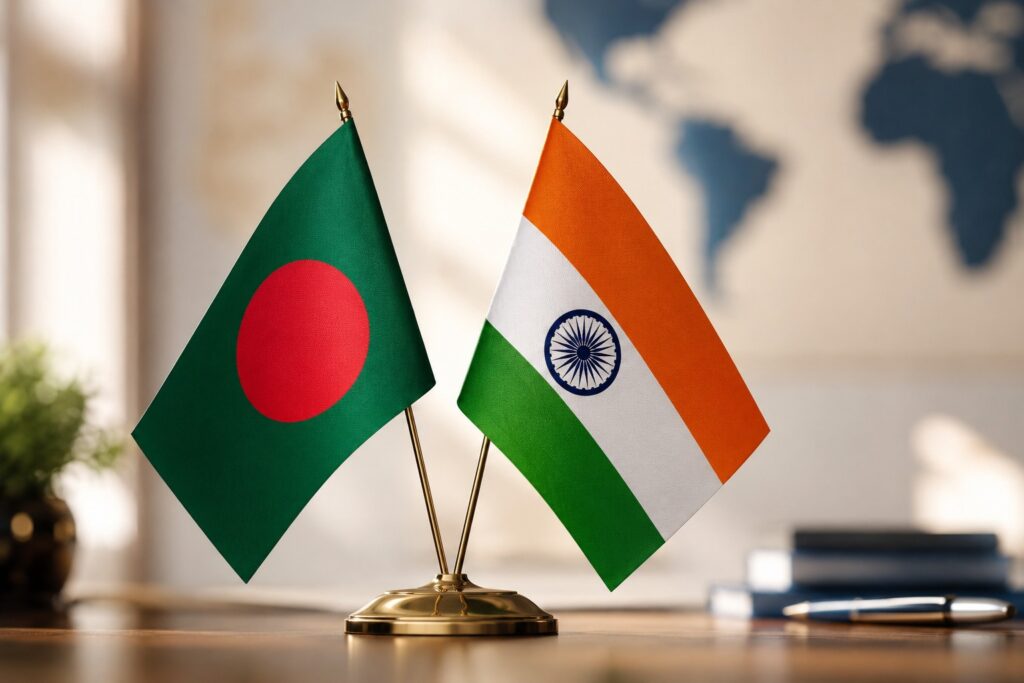
It is often said that neighbours do not have the luxury of choosing each other. India and Bangladesh certainly did not. Geography brought them together, history intertwined their destinies, and over the past five decades, they have built a relationship that has witnessed moments of extraordinary cooperation as well as periods of disappointment. Today, bilateral ties are once again passing through a difficult phase. Political rhetoric has hardened, trust has weakened, and every diplomatic engagement is viewed through the prism of strategic competition.
Yet, if one steps back from the headlines, a different picture begins to emerge. The most important questions confronting India and Bangladesh today are no longer confined to traditional bilateral disputes. They are increasingly shaped by forces beyond their borders. Climate change, disruptions to global supply chains, maritime security, cyber threats, artificial intelligence, energy transition, and economic uncertainty have become the defining challenges of our time. None of these recognise political boundaries, and none can be addressed effectively in isolation.
Perhaps this is the moment for both countries to look beyond managing differences and begin building a partnership based on shared resilience.
The world is entering an era of profound geopolitical uncertainty. Wars in Europe and the Middle East have exposed the fragility of global supply chains. Intensifying competition among major powers is reshaping trade, technology, and investment flows. Maritime routes that sustain international commerce are increasingly vulnerable to disruption. Even developments in distant regions now have immediate consequences for South Asia. The interconnected nature of these challenges means that national security can no longer be viewed solely through military or political lenses. Economic resilience, climate adaptation, technological preparedness, and social stability have become equally important.
For India and Bangladesh, this changing landscape presents both a challenge and an opportunity.
Climate security is perhaps the clearest example. The Bay of Bengal is among the world’s most climate-vulnerable regions. Rising sea levels, stronger cyclones, coastal erosion, salinity intrusion, and unpredictable river systems threaten millions of lives on both sides of the border. These realities affect farmers in northern Bangladesh as much as fishing communities along India’s eastern coastline. They do not distinguish between nationalities or political affiliations. Discussions on shared rivers have understandably focused on water-sharing arrangements. While these remain important, there is now an equally compelling case for expanding cooperation into river restoration, sediment management, flood forecasting, ecological conservation, and climate adaptation. A shared river system should not merely be viewed as a source of negotiation. It should be recognised as a shared ecological lifeline that demands collaborative stewardship.
The Bay of Bengal offers another opportunity to redefine the relationship. Once regarded primarily as a maritime boundary, it has now become one of the most strategically important regions in the Indo-Pacific. It supports international trade, energy transportation, fisheries, and emerging blue economy initiatives. It is also attracting unprecedented attention from major powers.
For India and Bangladesh, however, the Bay should not become another theatre of geopolitical rivalry. Instead, it should remain a space for cooperation. Maritime domain awareness, humanitarian assistance, disaster relief, marine environmental protection, sustainable fisheries, offshore renewable energy, and coastal resilience are areas where the interests of both countries naturally converge. These are practical initiatives capable of generating mutual confidence while delivering tangible benefits to ordinary citizens. Economic cooperation also deserves to be viewed through a wider lens. Bilateral trade has expanded considerably over the years, but recent global disruptions have demonstrated that resilience matters as much as growth. Bangladesh’s globally competitive manufacturing sector and India’s expanding industrial ecosystem are complementary in many respects. Better connectivity through rail, roads, inland waterways, ports, and digital infrastructure can help create regional value chains that reduce dependence on distant markets while generating employment and investment across eastern South Asia.
Technology presents another frontier for cooperation. Artificial intelligence, cybersecurity, digital governance, and protection of critical infrastructure are no longer concerns confined to advanced economies. As India and Bangladesh accelerate digital transformation, both face similar challenges in securing financial systems, protecting sensitive data, combating misinformation, and preparing younger generations for rapidly changing labour markets. Exchanging expertise and developing compatible digital frameworks would strengthen resilience on both sides of the border.
Yet no relationship can flourish on economics and security alone. The strongest foundation of India-Bangladesh relations has always been its people.
Few countries share such deep cultural and linguistic connections. Literature, music, cinema, cuisine, and intellectual traditions have travelled freely across borders for generations. Families remain connected despite political boundaries, and the Bengali language continues to serve as a powerful bridge between communities. Governments may occasionally disagree, but cultural memory has consistently outlived political cycles.
In this context, the recent appointment of India’s High Commissioner to Bangladesh, Dinesh Trivedi, offers an opportunity that extends beyond diplomacy in its conventional sense. His appointment is significant because he becomes the first political leader in recent years to be entrusted with this responsibility while also being accorded Cabinet rank, a distinction that signals the importance New Delhi attaches to its relationship with Dhaka. Equally significant is his personal journey. Although his roots lie in India’s Hindi heartland, much of his public life has been shaped by West Bengal, from where he began his parliamentary career. His academic exposure in the United States, combined with his long-standing appreciation for music, literature, and cultural engagement, gives him an understanding of Bengal that is both political and deeply personal.
This unique background creates an opportunity to strengthen one of the least contentious yet most enduring pillars of India-Bangladesh relations: cultural diplomacy. The shared Bengali language, the literary legacies of Rabindranath Tagore and Kazi Nazrul Islam, the rich traditions of music and theatre, and the vibrant academic communities on both sides of the border continue to bind the two societies in ways that formal diplomacy often cannot. The future of educational and cultural engagement should therefore move beyond individual scholarships alone. While initiatives supported by the Indian Council for Cultural Relations have made meaningful contributions over the years, there is considerable scope to build sustained institutional partnerships linking universities, research centres, archives, cultural academies, music conservatories, and think tanks. Such collaborations would create lasting networks of scholars, artists, researchers, and young professionals who can shape the next generation of bilateral understanding.
In this regard, the recent resumption of visa services is a welcome and encouraging development. Easier mobility for students, researchers, entrepreneurs, artists, and families has the potential to restore confidence at a time when both societies would benefit from greater interaction rather than greater distance. Trust is often rebuilt not through official communiqués but through everyday human connections.
None of this suggests that longstanding differences should be ignored. Questions relating to water sharing, border management, migration, security, and political trust will continue to require patience, maturity, and sustained dialogue. They cannot be resolved overnight, nor should they be allowed to dominate every aspect of the relationship. The history of India and Bangladesh depicts that even during periods of political disagreement, both countries have found ways to cooperate in areas where their interests converge. Counterterrorism, energy trade, connectivity, disaster response, and economic integration stand as reminders that pragmatic engagement is not only possible but productive.
As the global order continues to evolve, India and Bangladesh face a simple but consequential choice. They can remain prisoners of recurring disputes, or they can recognise that the greatest challenges of the coming decades are shared challenges that demand shared solutions. Geography made the two countries neighbours. History made them partners. The future should make them collaborators in building resilience against an increasingly uncertain world.
In the end, the true measure of India-Bangladesh relations will not be the absence of disagreements. It will be the ability of two close neighbours to transform shared vulnerabilities into shared strength and, in doing so, offer an example of constructive regional cooperation in an increasingly fragmented world.
-Monojit Das
Independent Geopolitical Analyst

https://stapravda.ru/20221228/reyting_samyh_populyarnyh_hostingov_v_rossii_196445.html, рейтинг хостингов России подтверждает, что выбор надежного провайдера важен для бизнеса.