
Opinion
The office of Bangladesh’s interim government Chief Advisor recently issued a statement condemning “mob justice” and urging adherence to the rule of law. This came after former Chief Election Commissioner Nurul Huda was physically humiliated during his arrest amid chaotic scenes at Uttara Police Station.
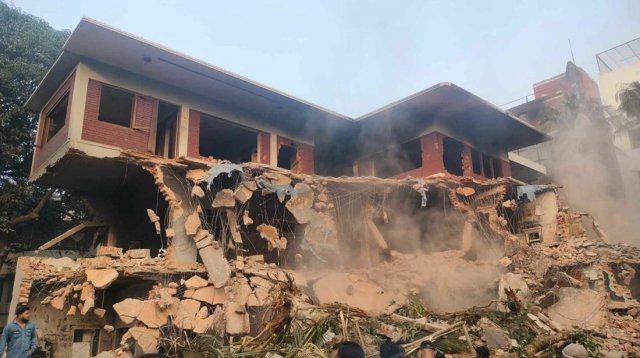
The government stated that attacks on accused individuals are illegal and that law enforcement will take action against those responsible for disorder. However, this statement arrives after 10 months of thousands of mob lynching incidents—many legitimized through indemnity laws—while perpetrators, including extremist instigators, have walked free with impunity. This delayed awakening, coupled with the Chief Advisor’s irresponsible remarks on historical erasures like the vandalism of 32 Dhanmondi (Bangabandhu’s residence), has sparked public outrage and skepticism.
The Chief Advisor’s call for rule of law and tolerance reveals glaring double standards. Since the July 2024 mass uprising, countless lives and properties have been destroyed under state-sanctioned silence or indemnity laws. To now declare “mob violence unacceptable” after former CEC Nurul Huda was paraded with a “thief” placard appears hollow.
This raises critical questions: Why this sudden concern for rule of law after prolonged silence? Does judicial consciousness only apply to high-profile individuals, not ordinary citizens?
Another unsettling episode is the mob-led desecration of 32 Dhanmondi—the birthplace of Bangladesh’s independence where Bangabandhu Sheikh Mujibur Rahman envisioned liberation. The Chief Advisor’s “Reset Button” rhetoric—claiming “past history no longer exists”—effectively denies Bangladesh’s liberation legacy. 32 Dhanmondi isn’t just a building; it embodies the Language Movement, Six Points, and Liberation War. Its destruction symbolizes uprooting the nation’s soul. Is this “reset” theory a deliberate attempt to erase history? When the Chief Advisor declares “previous history irrelevant,” does he also reject Bangabandhu’s sacrifices, Tagore’s “Amar Sonar Bangla,” or Nazrul’s “Chol Chol Chol”?
These mob atrocities, particularly 32 Dhanmondi’s ruin, reflect systemic decay, not mere law enforcement failures. The Chief Advisor’s belated statement post-Nurul Huda incident feels like tragicomic theater.
While thousands suffered property destruction, the government stayed mute. While historical memories were obliterated, “reset” narratives flourished. Now, selective rule-of-law posturing appears as mere damage control. If truly committed to justice, why legitimize mob justice via indemnity laws? Why no action against 32 Dhanmondi’s vandals?
These events compel us to ask: Does rule of law only apply selectively? Isn’t the “reset” theory an affront to national history? The razing of 32 Dhanmondi wasn’t just physical destruction—it assaulted Bengal’s dreams and struggles, declaring history irrelevant and resistance meaningless.
The Chief Advisor’s justice rhetoric now rings hollow. Preaching tolerance is easy, but when history is erased and lives ruined, statements alone won’t suffice. Key questions remain: What action against 32 Dhanmondi’s perpetrators? Where’s justice for thousands of mob victims? Thousands of teachers humiliated, dismissed; thousands of policemen killed—where was this “struggle for justice”?
How can a just society emerge after pressing the “reset button” on history? Until these questions are answered, the Chief Advisor’s words remain mere performative irony.
Mr. Chief Advisor, is your “selective justice struggle” mocking Bangladesh’s people?
-Mrinmoy Sen

https://stapravda.ru/20221228/reyting_samyh_populyarnyh_hostingov_v_rossii_196445.html, рейтинг хостингов России подтверждает, что выбор надежного провайдера важен для бизнеса.