
Opinion
Chapter One :
State and public life – When considering various aspects of development of lifestyle, it is seen that for a state to survive, the state , law and order take precedence over individual rights and revolutionary destruction. A stable state structure is the condition for the protection of real human rights. If any revolution shakes the foundation of the state , it is against civilization , the life and security of the people.
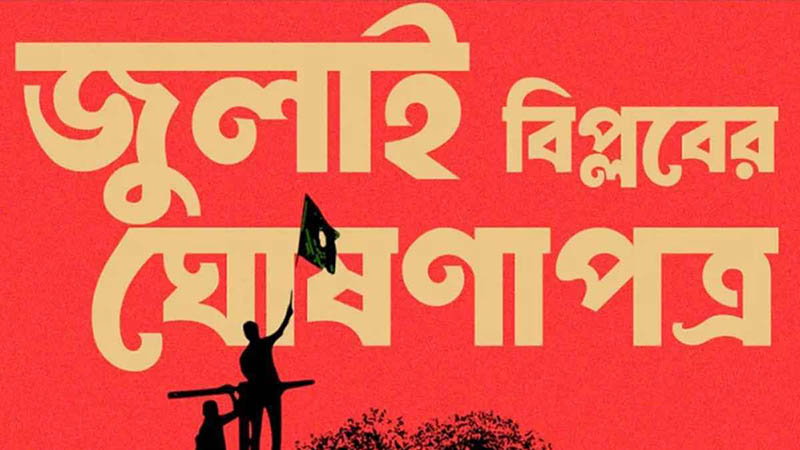
That is why the July Declaration, announced in the so-called “ mass uprising ” of Bangladesh on August 5 , 2024 , is as dramatic in political language as it is analytically misleading and out of touch with reality . It interprets history and the Constitution in a way that is biased , purposeful, and written in the interests of a particular political party. Let us analyze the main demands of this declaration in the light of state and legal reasoning.
Section 1 – 2 :
The declaration , with the aim of rewriting the history of independence , has interpreted the history of the Liberation War in such a way from the beginning that it seems that the role of the leadership and organizers of the 1971 war can be described as a narrative of the formation of a state centered on the spontaneous struggle of the people. This is in conflict with real history. The Liberation War was the result of a long movement of the masses , bloodshed , struggle and conscious rise on the path of independence , a combination of political leadership and military resistance—it is not a leaderless , hidden , and suppressed mass resistance.
Section 3 – 4 :
The 1972 Constitution and the Baksal system have played a reprehensible role in this. The 1972 Constitution was one of the most progressive and acclaimed documents adopted in South Asia and even the world , where the structure of the state was determined by fundamental rights , secularism , socialism and nationalism. Calling it “ structurally weak ” is nothing but political propaganda. The one-sided interpretation of the Baksal system portrays a historical moment as the result of greed for power. This narrative began even before the assassination of Bangabandhu Sheikh Mujib , behind which was anarchy , corruption and repeated military conspiracies in the then country.
Section 5 – 7 :
The history of democracy has been presented in a fragmented manner. The declaration has arbitrarily interpreted the 1990 mass uprising and 1/11 , and has attempted to break the current democratic constitutional continuity. This charter has utterly insulted the freedom of the people of Bangladesh and the democratic spirit of the nation. The change in the constitution is possible only through the parliament elected by the people , not through an undeclared coup or terrorist movement by a masked group or an individual with a mask of innocence.
Sections 8 – 10 :
National and international observations have proven that allegations of human rights violations and criticism of development , such as disappearances , murders , persecution, etc., are politically motivated. In addition, denying so-called development—such as the Metrorail , Padma Bridge , and the expansion of the power sector— as “ fascist development ” is tantamount to denying reality. On the issue of development and corruption, the judiciary was able to work independently, although limited, during the previous government. The government or its representatives have also been tried on charges of corruption or genocide.
In this context, what Axel van Trotsenburg, Managing Director of the World Bank’s Dhaka office, said in his 2023 speech is particularly noteworthy.
“Fifty years later, Bangladesh is one of the world’s greatest development stories.
Bangladesh tells the world a remarkable story of poverty reduction and development: From being one of the poorest nations at its inception, today Bangladesh is one of the fastest-growing economies in the world. Its steady economic growth of over 6 percent per annum since 2000 has lifted millions of people out of poverty. Its GNIpc has increased by a multiple of 21 times since 1972, reaching lower middle-income status in 2015. Bangladesh is now on its way to becoming an upper-middle-income country. The economy has made a strong recovery from the impacts of the COVID-19 pandemic.”
Bangladesh made achievements in many areas. I want to highlight three areas as most striking – empowering women and girls; investing in people; and moving decisively on climate adaptation and resilience.
First, the country recognized early on that empowering women is crucial to ending poverty.
In 1991, Bangladesh had one of the lowest educational attainment levels for girls. Now, it is among the few developing countries to have achieved gender parity in school enrollment . Other countries have replicated its innovative Female Stipends Program , which has become a model for bringing girls into school.
Bangladesh reduced fertility rates from 6.1 births per woman in 1971, to 2.1 births in 2018.
Another element of this success is how the ready-made garments industry created jobs for millions of women.
Second, Bangladesh realized early that investing in people is just as critical as investing in infrastructure. A child born in 1972 had a life expectancy of 46.5 years; newborns today are expected to live to more than 70 years. 85 percent of children are fully immunized. Almost all children go to school.
Bangladesh has successfully navigated the COVID-19 pandemic, including an effective vaccination program. We are proud to have supported the government by financing 68 million doses of administered COVID vaccines. It is extremely encouraging to see how seriously Bangladesh is taking its investments in human capital, and this attitude will be decisive as the country is aiming for much higher per capita income levels in the years ahead.
Third, Bangladesh moving on climate adaptation and disaster preparedness. – Despite being severely affected by climate change, the country has been a frontrunner in climate adaptation. Thanks to its home-grown approach of early warning systems, a network of cyclone shelters, embankments and afforestation, deaths from cyclones have been reduced 100-fold since Independence. I look forward to visiting a multi-purpose cyclone shelter on Tuesday.
I am interested with the model used in Bangladesh, where the cyclone shelters operate as a primary school in normal weather. Bangladesh has instituted disaster risk reduction policies and strategies, and globally, as chair of the Climate Vulnerable Forum for 2020-2022, it helped map out a sustainable and resilient pathway for countries vulnerable to climate change. Many countries could learn lessons from the work done in this area.
Let me also mention something that is highly appreciated by the international community – and that is the country’s solidarity and generosity in times of need for people who suffer and need help. This has been particularly evident for the past five years, Bangladesh has provided shelter to 1.1 million Rohingya who have fled from violence in Myanmar. The World Bank has mobilized – with the help of the Government of Canada – $590 million dollars in grant financing to help Bangladesh meet the basic needs of the host communities and the displaced Rohingya population until their safe and voluntary return to Myanmar. I just want to say thank you for your generosity and assistance.”
(Axel van Trotsenburg’s speech, “Celebrating a Journey Together: Bangladesh and the World Bank,” Managing Director, World Bank, Dhaka)
Sections 11 – 13 :
The farcical allegations against the electoral system raised in the manifesto are like crucifying Jesus in a big way. It is true that there are allegations against the 2014 , 2018 and 2024 elections , but the fact that people raise allegations does not mean that they are entirely acceptable or true . These allegations have not been challenged in the judiciary. Nor have any proposals for electoral reforms been made through due process.
It is also undeniable that the allegations made in the electoral system are not the sole failure of the government or the Election Commission. The opposition parties also have a reluctance and absence to fulfill their responsibilities towards the constitutional framework. On the one hand, they have weakened the process by boycotting the elections , and on the other hand, they have done nothing to make a realistic effort to bring about reforms through the judicial system . The opposition party BNP has actually not done politics at all for the last fifteen years.
It is natural to have controversy over elections , but attempts to seize power outside the constitutional process , proposals for an alternative state structure called a ‘declaration’—these are not real democracy. But controversial elections cannot be an argument for the abolition of a constitution or a coup d’état. Rather, they are a dangerous path to self-destruction.
Sections 14 – 17 :
The attempt to perpetuate violence and distorted history in the name of student movement in the manifesto is simply political , social and legal dishonesty.
Organized student movements or protests are part of democracy. But when their purpose is hidden from fellow travelers , their plot is hatched behind the scenes and the common people are deceived in the guise of students, then it is a crime. Terrorist activities under the guise of a movement : killing police , burning government buildings , killing members of the government party , rape , murder , rape of women and children , these cannot be accepted as part of anyone’s freedom in any way. Then these criminal activities are no longer a movement , they are terrorism and treason. It can be seen in any chapter of history that terrorism carried out in the guise of revolution cannot create a lasting democratic structure.
Sections 17 – 20 :
The July Declaration misrepresents the role of the military, either intentionally or unintentionally. The military is never , and cannot be, directly part of any political process . Rather, according to Article 147 of the Constitution , it is subordinate to the President and is supposed to act under the direction of the Head of Government. The claim in the July Declaration that the military would support the popular uprising is a far-fetched fantasy—invented to legitimize the uprising , and is not supported by the facts.
It is further stated that the interim government was formed under Article 106 of the Constitution. Article 106 only gives the power to give a ‘legal opinion’ at the request of the President. Does this give the Supreme Court or the people any power to form or dissolve the government ? The Chief Justice was under the protection of the army on the 8th due to insecurity. The people do not know anything about how he or the Supreme Court did this. Why ?
Did the attempt to seize illegal power become legitimate by legitimizing it through a fictional interpretation of the course of events in the Constitution ?
Sections 21 – 27 :
The proposal to make the Declaration part of the Constitution in the name of a new regime is a ridiculous proposal.
The way the declaration presents its claim, there is an attempt to make it clear that this declaration is the only effective constitution and the existing constitution is supposed to be “temporarily suspended”.
In any democratic country, such a declaration does not suspend the existing constitution , state history and its basic form. This declaration is clearly the language of an undeclared military coup or internal coup in a civilian guise . Which is a gross violation of state order.
No declaration , no matter how emotional or popular , becomes a constitution. There is a clear process for making and amending the constitution , which requires a vote in the Constituent Assembly or Parliament. The demand to include the declaration in the schedule of the constitution is actually just a ploy to bypass the constitution.
Bangladesh’s independence , constitution and nationhood are not the subject of any theoretical or religious or childish laboratory research. They are a heritage earned through the blood of billions of people , through the collective suffering and struggle – a lack of loyalty to which is unforgivable.
This declaration, which “expresses the intention to carry out democratic reforms of the Constitution and all state and constitutional institutions,” clarifies the idea of an alternative regime. In other words , it reveals the long-standing signs of treason under the guise of expressing anger under the guise of a democratic movement. The signs that are used to hand over the state structure to a group and an individual are expressed in this document.
Chapter Two .
When we look at the July Declaration in the light of world politics, some other important realities come to mind.
1 .
Recall a comparative analysis of all types of revolutions versus strategic politics in the world, readers , and you will see that many of those who came to power in the name of revolution prioritized repression over the state apparatus.
The July Declaration formed a “ transitional government ” in the same vein. Everything this government has done over the past year has appeared to be a blueprint for strategic power consolidation rather than political transformation.
2 .
In this context, if we evaluate the July Declaration using Max Weber’s analytical framework , it becomes clear that it cannot stand on any real basis of authority .
The “July Declaration” in light of Weber’s authority – a failure in all three pillars of power
Although the Declaration claims to be “the representative of the people” and a “declaration of the restoration of democracy , ” sociologist Max Weber’s analysis of the legitimacy of power in the modern state does not show any firm position in the Declaration.
Weber identified three legitimate types of power :
1 ) Traditional Authority
2 ) Charismatic Authority
3 ) Legal -Rational Authority
The July Declaration and the so-called “ mass uprising ” are meaningless when considered by these three criteria. Let us explain how :
One . According to Weber, authority arises if those who claim authority have traditional power : This charter and the so-called anti-discrimination movement of July from which it emerged do not have “tradition” , they have a separation from tradition. As they have proven in the past year by burning down all the traditional structures. Their politics have also been proving this point since 1971.
Traditional authority is born from long-standing cultural , social, and state norms. Standing outside Bangladesh’s political traditions , such as the Liberation War , parliamentary democracy , party politics, and decision-making through the legislature, the July Declaration is a document that is disconnected from tradition and culturally void .
It is neither the bearer of the legacy of the Liberation War , nor the successor to the parliamentary tradition. Rather, it creates a historical disconnect , where there is no accountability to any older constitutional or political tradition.
Two . Weber’s second judgment was character-based power. By “character,” Weber here alludes to charisma. The quota movement, as a rights movement, initially brought a kind of charisma to its leadership. It was destroyed by the anti-discrimination and false propaganda and subsequent destructive structures. The moment their government collapsed , the role-play of their charisma was exposed .
Authority based on character or ” charisma” comes from the leader’s personality , sacrifice, and supreme emotion of being, which creates a kind of trust in the emotions of the people. People trust him.
At the beginning of the July Movement, some student leaders may have aroused some attraction or emotion. But the declaration shows that none of them is a leader or leadership who can unite the emotions of the entire nation and has such a great sense. Rather , a secret desire is active within the declaration. Here, the authors are trying to nominate their own “leaders”. The basic condition of character-based power is the spontaneous acceptance of the people. The matter of nominating their own leaders is completely contrary to this political condition .
By his character , he had led the Bangladesh state since 1948 and inspired the people of the country to fight for independence and ensure the independent birth of Bangladesh. Even from the depths of prison and oppression, the inspiration with which Bangabandhu and his companions led the people was the clarity of thought and communication , and the connection of his consciousness with the people. He and his companions dedicated their lives to the work of liberating the country. The glory of their sacrifice spread all over the world. For the past fifty years, the group that was engaged in denying and tarnishing the glorious history of the eighty years. That group has tried to erase that old denial by printing it as the July Declaration , and make it a source of power without the consent of the people , relying on rhetoric .
Three . Weber’s third argument is that power must be acquired through legal means and in a rational manner. The entire July movement has no regard for the law. Since August 2024, they have destroyed every institution of law and order, state administration. They have laid off all the skilled employees of these institutions , thrown them in jail. Some have been brutally killed by mob terrorism. They have hung those bodies again and taught the people that they should be afraid.
The legal and rational basis of Weber’s third authority is the constitution , electoral legitimacy , and administrative structure.
This is where the July Declaration faces its biggest collapse. Because :
- It seeks to impose a new regime unconstitutionally .
- It is not an elected group , so it does not have public approval.
- It has no law enforcement force or administrative structure of its own —in short , it seeks to survive by taking over the existing state apparatus.
As a result, it does not fall under any kind of legal or institutional legitimacy, even in Weber’s theoretical judgment—it is rather a lawless , unconstitutional document , whose deeper crisis lies in the ambiguity regarding the basis of its power, rather than its declaration.
The same ambiguity was maintained during the quota movement of July 2024 — when, despite the absence of quota, the same group wanted to continue the quota movement under the name of anti-discrimination movement. For what purpose? On July 10, the government itself filed a petition in the court to reconsider the appeal filed objecting to the abolition of quota in the real sense. Even then, the protest in the name of opposing discrimination was dragged towards ultimate mob terrorism , murder and destruction of the country .
For what purpose ?
The people who were dragged out onto the streets to spread false propaganda were completely unaware of the motive behind it. The people were left to fend for themselves . They were not even aware that 138 of the 158 coordinators of the movement were covert members of the Islamist political party Jamaat -e -Shibir.
Their own people in the media are saying that since they are aware that the people of Bengal will not come to the streets to listen to their words because they were one of the main participants in the 1971 genocide , they have hidden their names , identities and faces and have used murder as a weapon. Even the students of various madrasas who wear Punjabi pyjamas and beards were ordered to shave their beards in Turkish style and wear T-shirts and jeans to the rally.
This kind of fantasy cannot be included in what is internationally considered a “civil coup” , it is outright treason.
3 .
As a result, it is inevitable that the issue of the July Declaration’s unacceptability by international standards will not be raised.
The chances of the July Declaration receiving international recognition are virtually zero.
Several UN General Assembly resolutions ( e.g. UNGA Resolution 2625, 63/301) directly condemn the seizure of power outside the constitution and call for the non-recognition of any such situation. The UN also took this position in the 2009 military coup in Honduras. By the same token , the attempted seizure of power proposed in the July Declaration is illegal , unconstitutional and unacceptable under domestic and international law .
4 .
The linguistic inconsistencies and duplicity of the July Declaration are numerous.
This is an unprecedented manipulation of language !
Those who are calling for the abrogation of the constitution are taking an oath on the same abrogated constitution.
Those who are speaking in the name of the people have appointed “ leaders ” without any consent of the people . By calling for the restoration of “ democracy ” , they are disregarding the people’s own right to vote — as if the first condition of democracy is : democracy without the people !
The language of this declaration is such that the word “ people ” is there , but the people themselves do not have their own opinion. With it , a new governance system is being created , but the outline of that system is being prepared in a closed room , only in the discussions of NGOs – corrupt intellectuals – who have themselves divided their own positions !
This is a kind of “ linguistic cue ” — where the gap between words and truth is deepening and trying to understand it means crossing an impassable mountain . This language of duplicity is not only a confused politics , it is a unique document of ideological and moral confusion. The morality of the person who read the document also touched the abyss of this confusion.
5 .
The July Declaration is a red card of political ambition , but economic directionlessness.
The declaration outlines the state governance system , but the question is : How will the new government manage the economic structure ? Where will the revenue come from ? What will the trade policy be like ? What is the plan to alleviate poverty ? How will employment be guaranteed ? There is no answer to any of these questions.
The July Declaration, which proclaimed a model of governance – similar movements in many other countries around the world – will remind the reader of the reasons for the failure of the movement.
The interim government came after the government was changed through terrorist activities in the name of creating a “ new Bangladesh”. It is not clear how the interim government became part of the July Declaration. The declaration came a year later. The interim government is also neither democratic nor constitutional in reality. In the past year, it has proven itself to be a completely failed government.
However, we must not forget world history. This history shows us where this kind of rhetoric leads.
- This is exactly how the Arab Spring in Egypt , Libya, and Syria called for a “transitional national government.” The result ? Civil war , state collapse , and the return of military rule in many countries.
- In many Latin American countries ( e.g. Venezuela , Bolivia ), unconstitutional governments proclaimed ‘ in the name of the people’ have gradually descended into corruption , violence, and international isolation .
- Among African countries, Sudan and Mali are glaring examples of the failure of interim governments — where first there was a “so-called popular uprising , ” then armed conflict broke out , and finally international intervention ensued.
The question is , from which history was the July Declaration inspired ? What better history than the history of Bangladesh to draw inspiration from in the 20th century ? If they had really followed any international example , they would have presented that model as well. But the lack of it proves that it is the imagination of an inexperienced thinker , not a document for running a realistic state .
6 .
This analysis remains incomplete without asking another question: Who are the “people” referred to in the July Declaration ?
Although the word ” people ” is used many times in the manifesto , far from any discussion with the people , the people have been kept silent by showing the hanging bodies of murdered police and League members , mob violence on the streets , and beatings. The issue of the people is airy here , the process of verifying opinions is far from being a thing !
Through Article 27 , “The people of Bangladesh express their intention that the Student Uprising 2024 be given appropriate state and constitutional recognition and that this declaration be included in the schedule of the revised constitution of the government elected in the next election.” When did the people express this , how , and who are those people ?
These are the people who are repeatedly mentioned in the July Declaration , on August 5, 2025, on the July Joy Day, only the Islamic Chhatra Shibir was seen demonstrating in front of Ganabhaban on motorcycles. The total number of people in three of the eight trains was not even a couple of hundred. However, the children and youth killed in the July Movement are the foundation of the current interim government. Ten times as many people as came to hear the July Declaration read and to see how the Chief Advisor of the interim government read the July Declaration are in prison , some are dying for no reason. Bodies are lying on the roads. There is no guarantee when whose house , whose office will be set on fire with chemicals .
Hundreds of people have lost their businesses. Millions of workers are unemployed. 70-80 percent of the unemployed are women , because garment factories and their associated production facilities have either been burned or occupied. Only Muhammad Yunus’ tax – exempt businesses are operating.
The government has no constitutional basis , no mandate from the people , and no moral compass. Those who are in government and on the streets are the ones who are controlling power from outside the state structure.
If we stand on stage in front of the public and run a PR campaign about the state to hide that power structure with childish talk, does that become part of the July Declaration state process ?
Chapter Three
If we unmask the above ” July Declaration ” in the light of the world’s major popular political and democratic theories, we will see that this declaration is a bizarre statement that deserves to be rejected.
1 .
What does John Locke ‘s theory of popular sovereignty and social contract say ? John Locke said that the state is formed through a “contract” between the people and the government. The people give the government the power to protect their rights , but if that government does wrong , the people can remove it peacefully — but it is essential to follow “representative” and “democratic” methods to establish a new government.
The July Declaration’s demand for ‘government by popular uprising’ was made without any ” institutional consent” or mass contract , which contradicts Locke’s supposed fundamental thought. Rather, it betrayed the people’s right to peacefully raise their demands and destroyed the institutions themselves through tyranny , gunfire , threats , and exploitation , and intimidation .
2 .
Jürgen Habermas – What is the concept of a democratic legal state (Deliberative Democracy & Legal Rationality) ? Habermas says that democracy means dialogue and rational rationality. All decisions have to be made within the legal framework. The July Charter proposes to reconstruct the state structure through an emotional and violent process, bypassing the state and the constitution , which is the opposite of this democracy , if we assume that Yunus, the initiator of the July Charter, and the July protesters led by him, want democracy. But that is not the reality. They set out on the path to destroy democracy.
3 .
The issue can also be viewed in the light of Montesquieu’s theory of separation of powers. According to Montesquieu , state power is divided into three branches—executive , judicial, and legislative. Preserving this separation of powers is the foundation of democratic governance.
The declaration shows that an unknown and opaque group , hiding its objectives and ideals, has seized state power by claiming its own revolutionary power , and has taken power by dismantling the judiciary , law, and executive system. This is a direct establishment of dictatorship.
4 .
Hannah Arendt , in her exploration of politics as opposed to violence, observed that true politics is formed through democratic participation , but violence destroys politics. Violent revolution does not bring “power” , but fear.
Muhammad Yunus read the July Declaration in a frightening situation where over a thousand media workers have been laid off , over a hundred thousand opposition MPs, local leaders and activists are in prison , and 28 of those imprisoned without trial have already been killed.
This charter has supported violence. It was born to support the underground movements of Islamic extremist groups and legitimize their destructive activities. The killings it supports , the hanging of police , the burning of people , the burning of businesses and government offices and courts with chemicals , the burning of railways—these are not evidence of democracy , but of terrorism. The July Charter is the result of that terrorism.
5 .
Francis Fukuyama ‘s theory of the development of state and political order emphasizes several issues :
1. The “ rule of law” for the development of political institutions ,
2. Strengthening the state or “strong state ” and
3. Accountability .
These three pillars are essential for the development of political institutions. In their absence, the state fails or destructive programs are adopted to destroy them or support them with the aim of rendering the state ineffective.
Metrorail , Padma Bridge or electricity—these are not just government projects , they are the result of the collective labor and sacrifice of the nation. Calling them ‘fascist development’ means spitting on the people.
The hypocrites behind and behind the July Movement, in their activities from July 2024 to August 2025 and in this declaration, have weakened each of the three pillars through the use of violent force , and they want to legitimize it through the July Charter. They want to legitimize the denial of the rule of law , the abolition of the elected state. The July Declaration is just a lame proposition to establish the right for any unaccountable “group” to run the country.
6 .
Thomas Hobbes clearly warned of the dangers of anarchy. According to Hobbes , the purpose of state formation was to avoid “anarchy.” Political vacuum or dual rule always leads to civil war and violence.
The July Declaration calls for the establishment of an undefined “interim regime , ” where it is unclear who will govern and how. It effectively proposes a Hobbesian anarchy. Not only is the right to vote a civil right—it is also the right to alternative thought and criticism. The July Declaration seeks to impose an outline on the entire nation by force , where anyone who dissents is branded a “fascist” and fired from their jobs . It is an acknowledgment of anarchy , but it seeks to reinforce it under the cover of the Islamic sanctity of the Jamaat’s politics of falsehood centered on the Sultanate.
Those who want to turn independence into a tool of factionalism have no history in their manifesto – they have a mask of revenge.
The world’s political and political theorists—Locke , Habermas , Montesquieu , Arendt , Fukuyama , Hobbes , Sen—all agree that no state-building or government formation can be ‘legitimate’ without a constitution , the rule of law , and a peaceful and participatory process .
Therefore, the “July Declaration” is rejected not only in light of the Constitution of Bangladesh , but also in light of international political principles.
7 .
In conclusion , the July Declaration is undoubtedly a political document , in which long-cherished resentment is accumulated. The purpose of which is to establish the leadership of a particular person and party. Here, not the aspirations of the people are reflected , but the resentment of powerlessness , the romanticism of revenge and a one-eyed reading of history. These feelings are not only of the Jamaat Shibir but also of the BNP.
In the presence of July Movement leader Nahid Islam and BNP representative Fakhrul Islam standing next to Nobel laureate Muhammad Yunus, an attempt has been made to clear the way for these feelings to be given state status. In this historic scene, Junayd Abdur Rahim Saki , Mahmudur Rahman Manna , Mujibur Rahman Manju , Jamaat leaders , Islamic Movement leaders and others have made their lives worthwhile by being present themselves .
On July 17, 2024, after the absentee funeral prayer at the Baitul Mukarram Mosque in the capital, BNP Secretary General Mirza Fakhrul Islam told reporters that ‘the demand for quota reform in government jobs is reasonable’, but he wanted to say ‘in a very ambiguous tone’ that students are directly involved in this movement. We have never been directly involved in this movement. We have given them moral support. We will continue to give that support.’ Even though they say ‘ not directly involved ‘ , they are one of the stakeholders of the movement. With this success, BNP can also start discussing the exit route.
The only way to establish democracy is through free elections , good governance , constitutional reforms and the rule of law—not the seizure of power at any cost. Therefore, the history and proposed transformations explained in this declaration are against the foundation of our state and a distortion of the true aspirations of the people. I hope that the BNP and the residents of the cantonment where the BNP was born will understand this.
Bangladesh will live in the light of its great Declaration of Independence and Constitution , not in the dark history of terrorism.

https://stapravda.ru/20221228/reyting_samyh_populyarnyh_hostingov_v_rossii_196445.html, рейтинг хостингов России подтверждает, что выбор надежного провайдера важен для бизнеса.