
International Desk
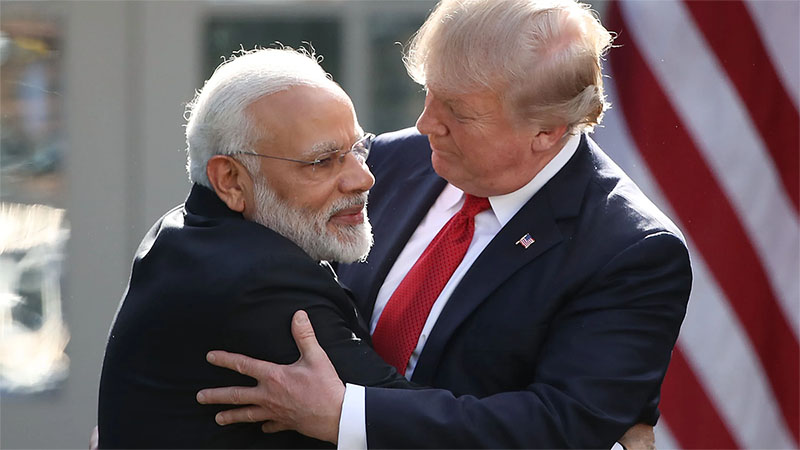
US President Donald Trump signed an executive order on Wednesday to impose an additional 25% tariff on Indian imports. This brings the total tariff on Indian goods imported into the US to 50%, significantly higher than the 30% tariff on China and 19% on Pakistan. The new tariffs will take effect in 21 days, i.e. on August 27. The move was prompted by India’s continued purchase of crude oil from Russia, which the US administration says is indirectly supporting Russia’s war in Ukraine.
Background to the imposition of tariffs
US President Trump last week announced a 25% tariff on India, effective August 1. This time, he has imposed an additional 25% tariff, described as a “punitive” measure against India’s purchases of Russian oil and military equipment. Trump’s executive order states that “India is directly or indirectly importing Russian oil that constitutes an unusual and extraordinary threat to the national security and foreign policy of the United States.”
Trump also noted that India is “not a good trading partner” because it imposes high tariffs on US goods and continues to trade oil and arms with Russia. He claimed that the tariffs would speed up trade deal talks with India.
India’s response
India’s foreign ministry has strongly condemned the move, calling it “unjustified, unreasonable and unacceptable”. A ministry spokesperson said, “India’s oil imports are based on global market conditions and the need to ensure energy security for 1.4 billion people.” He also noted that many Western countries, including the United States, import products such as uranium, palladium and fertilizers from Russia, which are “not essential” for them. India has said it will take all necessary steps to protect its national interests.
Economic impact
The impact of the tariffs on India’s $87 billion export market could be significant. Sectors such as textiles, gems and jewellery, auto parts, and marine products are expected to be hit the hardest. According to the Global Trade Research Initiative (GTRI), the tariffs could reduce India’s US exports by 40-50%. However, sectors such as pharmaceuticals, semiconductors, and key minerals are exempted from the tariffs.
According to a Reuters report, the Indian government’s internal assessment is that the tariffs, along with an additional 10% penalty on Russian oil purchases, could result in a competitive loss in export markets worth about $64 billion. Economists estimate that the tariffs could cut India’s GDP by 0.2 to 0.5% in the 2025-26 fiscal year.
Prospects for trade talks
India and the United States are in talks to sign a bilateral trade agreement (BTA), which is expected to be finalized next fall. India has already cut tariffs on $23 billion in US goods and is continuing talks on sensitive issues such as agriculture, digital services tax, and government procurement. However, India’s commerce ministry has said it will maintain a tough stance on US access to sectors such as agriculture and dairy products.
Global impact
Trump’s tariff policy is having a huge impact not only on India but also on global trade. Different rates of tariffs have been imposed on many countries including China, Vietnam, the European Union. Compared to India, 125% tariff has been imposed on China and 46% on Vietnam. Economists have warned that this tariff policy could put pressure on global supply chains and inflation.
India is now strategically focusing on exploring new markets and increasing domestic production to deal with this situation. However, the outcome of trade talks with the US in the coming weeks will play a key role in mitigating the impact of these tariffs.

https://stapravda.ru/20221228/reyting_samyh_populyarnyh_hostingov_v_rossii_196445.html, рейтинг хостингов России подтверждает, что выбор надежного провайдера важен для бизнеса.