
Opinion
Bangladesh is facing internal tensions and public scrutiny regarding the proposal for a humanitarian corridor to Myanmar’s Rakhine State. Critics argue that the government is making secretive deals by allowing foreign entities to control parts of its territory, and various Islamic parties have voiced their opposition. They have even issued threats, claiming that those who engage in such actions will face consequences.
While the government maintains that Bangladesh has not officially discussed a “humanitarian corridor” with the United Nations or any other organization, statements from top advisers suggest otherwise. The government has acknowledged changes in the border situation, where non-state actors now control much of the area along the Myanmar border. Some reports indicate that logistical supplies for the Rakhine region are already being funneled through the corridor, with hidden stocks of goods, including food, reportedly stored in areas like Shilkhali and Teknaf.
This situation seems to contradict the original promise of returning around 180,000 Rohingyas to Myanmar, as no significant repatriation has occurred. Instead, more refugees have entered Bangladesh. The government faces growing pressure as rumors of military assistance to the Arakan Army against Myanmar’s government circulate, with restrictions on military movement in the region intensifying. The situation is further complicated by the arrival of sensitive military equipment from Southeast Asia.
Adding to the complexity, on April 27, Jamaat-e-Islami proposed the creation of an independent Rohingya state in Rakhine, seeking China’s support due to its close ties with Myanmar’s military government. However, no formal statement has been made by the visiting Chinese delegation.
Following this proposal, the Myanmar government rejected the proposal of Jamaat-e-Islami, stating that it undermined Myanmar’s sovereignty. Myanmar accused Jamaat of seeking political gains by engaging with the CPC.
In March, a member of the Indian state of Mizoram’s parliament visited a group in Chin State called the Chinland Council and urged the border areas under their control to join India.
Meanwhile, another MP from Manipur proposed in the Indian lower house to reclaim the Kabaw Valley in the Sagaing region, urging New Delhi to assess the feasibility of its return or seek compensation from Myanmar.
In response, the Myanmar junta spokesperson Major General Zaw Min Tun warned foreign politicians to refrain from “conspiracies” that could harm bilateral relations (AFP).
On April 13, the Myanmar military junta government officially protested to Bangladesh over its proactive initiative to provide a “humanitarian corridor.” The Myanmar government questioned why Bangladesh maintains communication with the Arakan Army, labeling it a “terrorist organization.” If the junta government eventually escalates its opposition into direct obstruction regarding the corridor, it would not be surprising, as on September 2, 2024, the National Counter-Terrorism Central Committee (NCSCT) declared the Arakan Army, along with the MNDAA and TNLA, as terrorist organizations.
In a message on the 50th Rakhine State Day, General Min Aung Hlaing called on the MNDAA, TNLA, and AA to cease armed conflicts, stating, “They can only resolve conflicts peacefully by coming to the political table, and we urge them to end armed clashes and take the right path.” Responding to this appeal, on December 3, the Myanmar National Democratic Alliance Army (MNDAA) announced its decision to engage in peace talks mediated by China and to cease firing from their positions.
Similarly, on November 25, the Ta’ang National Liberation Army (TNLA) issued a statement expressing respect for China’s mediation efforts to maintain stability at the border and ensure a ceasefire, committing to dialogue to end the conflict.
The “toothless giant,” the United Nations, has so far failed to stop wars anywhere in the world. One of its “key tasks” is to use approximately 30% of American funds to “serve” Western powers based in America. When the UN or America establishes bases, corridors, or passages under the guise of peace, it translates to billions of dollars. Bangladesh may earn millions through the corridor, but the ruling class will primarily benefit, leaving ordinary people with empty plates and the fear of external attacks.
America will send weapons to the Arakan Army under the pretext of humanitarian aid. The corridor will facilitate the transfer of logistics disguised as humanitarian support and weapons. Bangladesh will become a “base camp.” Some 80,000 Rohingya cadres, lightly trained, are already prepared to fight against the junta soldiers. Four major terrorist Rohingya groups have also been armed.
Among the three “terrorist organizations” declared by the junta military, the most lethal is the Arakan Army. This army now views Bangladesh as its “safe haven,” freely engaging in border violations, festivities, and music throughout the day. The Rohingya armed group “ARSA” has been persuaded to form an anti-junta coalition.
America aims to seize Myanmar strategically, breaking it into pieces. Afterward, Buddhist, Muslim, and Christian groups will be left to fight among themselves. If Myanmar fragments, their trade gains will be worth trillions of dollars. However, it’s unlikely that China, Russia, and India will sit idle while witnessing this. If Myanmar is divided, these powers will likely claim their respective shares.
Myanmar, Thailand, and Laos form the infamous “Golden Triangle” for drug trafficking. Similarly, Myanmar, India, China, Russia, and America collectively make this region the “Five Pandavas.” Among these “Pandavas,” the four powers aim to break up military-controlled Myanmar to exploit its minerals.
It’s important to remember that Myanmar ranks 35th in military strength, while Bangladesh ranks 37th. Some may think, “It’s just two steps higher,” but the reality is that the junta military not only seized power four years ago but has also withstood continuous confrontations with opposition groups. Moreover, the Myanmar constitution reserves 30% of seats for the military, or “Tatmadaw,” meaning that Tatmadaw traditionally operates in a state of war.
On the other hand, the Arakan Army, with whom America encourages Bangladesh to flirt, is fiercer and more powerful than the MNDAA and TNLA. Still, they haven’t dared to attack or seize strategic ports like Kyaukpyu, Sittwe, and Dawei.
How dangerous is the chaos in this region?
Suppose deadly weapons reach the Arakan Army under the cover of humanitarian aid escorted by the Bangladesh Army. If they, along with “ARSA and three other Muslim militant groups and CNF,” strengthen themselves and intensify battles to capture strategic ports like Kyaukpyu, Sittwe, and Dawei, what will happen?
Since the “playground” of this fatal war is Bangladesh, a country with no direct experience of war with another nation, the scenario could worsen. Despite being a friend of Bangladesh, America won’t intervene if the country is attacked. Similarly, although China is a friend of Bangladesh, it will bomb Rakhine to maintain its establishment. It’s unlikely that the destruction will remain confined to Rakhine. India, too, is a friend of Bangladesh, but it will attack the America-Arakan Army coalition to protect its jurisdiction over Sittwe Port. However, India won’t prevent an attack on Bangladesh by that coalition. India maintains regular communication and good relations with the Arakan Army. Meanwhile, Russia, a close ally of Myanmar, will drive to protect Myanmar from attacks by the America-based coalition. Supported by China, Russia, and India, Myanmar may launch scorched-earth attacks on the Arakan Army coalition and their corridor.
What is the ultimate outcome? A joint attack by Russia, China, India, and Myanmar will be launched against the alliance led by the U.S.-backed Arakan Army. This alliance partially operates from Bangladeshi territory and receives silent support from Pakistan’s ISI, which provides training and weapons to four or five Muslim militant groups. However, ISI will quietly retreat, as it is already paralyzed by the anticipation of an Indian attack. Eventually, after being crushed by the superpowers, the “last son of Haradhan”—Bangladesh—will face devastating consequences.
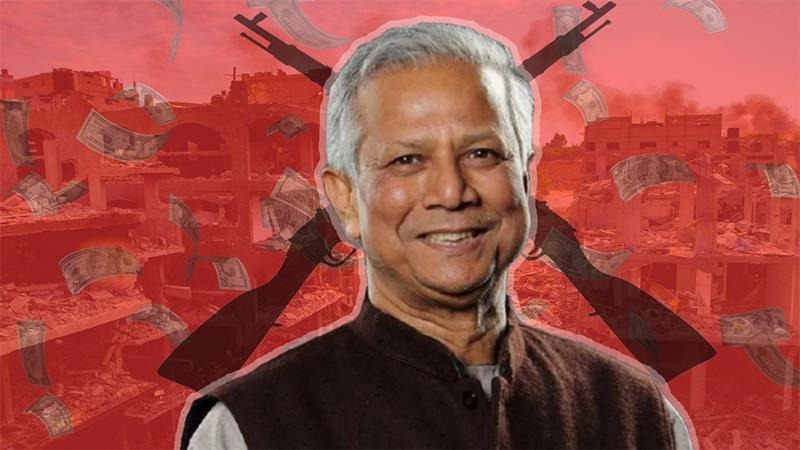
At this moment, the responsibility of major political parties should have been to protect the country by stopping Yunus. However, they have failed to do so. They are meekly complaining, saying, “We should have been informed earlier” or “We want a separate state for the Rohingyas,” without taking a strong stand. They cannot speak firmly because all the benefits of this situation will go entirely to Muhammad Yunus’s government, which, in essence, is their own government.
It does not seem like the advisors in Bangladesh have done their homework on Tatmadaw and its chief, General Min Aung Hlaing. Otherwise, they would have known one of the prevailing narratives about Hlaing—General Min Aung Hlaing is arguably “the most powerful man in the land.” Even foreign governments—including China and the U.S.—appear unwilling to stand in his way!
The fact that a crucial part of the country has been “sold or leased” to foreign powers under the guise of the corridor has not evoked strong responses. Democratic parties led by BNP, Islamist parties under Jamaat’s leadership, and some leftist speechmakers with a “cow without a calf” mentality have failed to present any forceful stance. No party has urged the government to back away from this self-destructive decision. Who knows if another “magician’s game” is secretly at play?
And the common people? For months, they have been disoriented, struggling to buy coarse rice at 70–75 taka per kilogram. Why would such complex puzzles occupy the minds of people living hand-to-mouth? Their primary concern is how to survive tomorrow.
The executive, legislative, and judicial branches of the country have collapsed. Law and order are nonexistent. There is no rule of law. Even if the people learn about these matters, what can they do? When the parties meant to represent them are intoxicated with chants of “election-December-July-August-1400-800-five years-three years-lifetime-mob-reform-constitution,” who cares about the thoughts of the common people?
Monjurul Haque
Senior Journalist and Political Analyst

https://stapravda.ru/20221228/reyting_samyh_populyarnyh_hostingov_v_rossii_196445.html, рейтинг хостингов России подтверждает, что выбор надежного провайдера важен для бизнеса.