
❐ BD Digest Desk
An international seminar on democracy, human rights, political inclusion, and the future of democratic governance in Bangladesh was held at the University of Oxford in the United Kingdom.
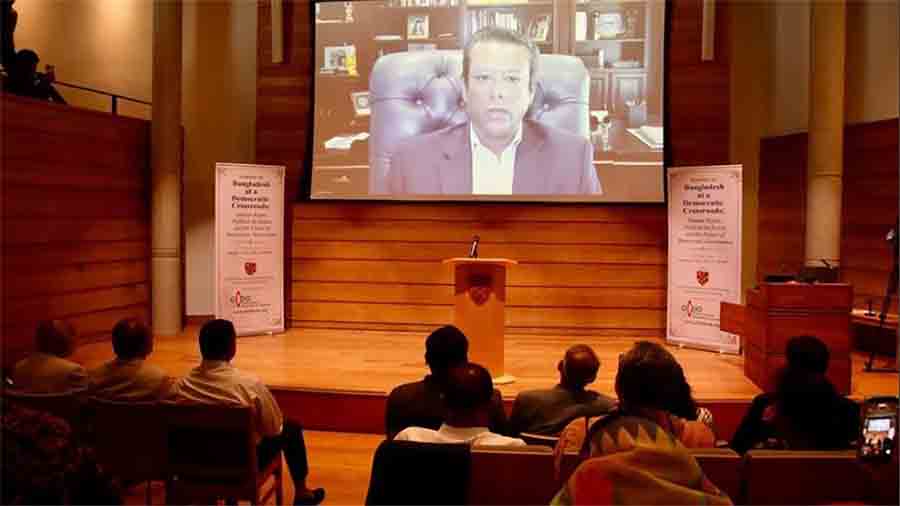
The seminar, titled “Bangladesh at a Democratic Crossroads: Human Rights, Political Inclusion, and the Future of Democratic Governance,” organized by the Global Center for Democratic Governance (GCDG), a Canadian-based research organization, was held on Monday, July 13, at the Leonard Wolfson Auditorium at Wolfson College, Oxford University.
According to its own representative, the auditorium was full of spectators at the seminar. At the same time, the event, which was broadcast live on various online platforms, was followed by several lakhs of viewers. All the invited speakers participated in the event in person and some participated virtually.
The online panelists included Sajeeb Wazed, former ICT advisor to former Prime Minister Sheikh Hasina of Bangladesh; Paolo Casaca, former Member of the European Parliament and Executive Director of the Belgium-based South Asia Democratic Forum; Professor Tarun Khaitan, Professor and Research Director of the Department of Public Law at the London School of Economics (LSE) Law School; and Sir Vincent Lin, Deputy Ambassador and Commissioner of the Switzerland-based International Human Rights Commission (IHRC).
Senior journalist Syed Badrul Ahsan, Oxford University’s Dr. Raihan Rashid, lawyer Advocate Mona Haggau Strindberg, King’s College London’s Dr. Ashfaq Alam, and University of London’s Dr. Naila Haque participated in the discussion in person.
The discussion was moderated by UK human rights activist Chris Blackburn.
The seminar was inaugurated by Professor Dr. Md. Habibe Millat, President of the Global Center for Democratic Governance (GCDG).
“The full list of 1,400 dead should be published”—Sajeeb Wazed
In his keynote speech, Sajeeb Wazed called on the United Nations to “publish the full list of claims of 1,400 deaths mentioned in their report.”
He said that ensuring transparency in such information is essential to establishing credibility and accountability.
Regarding political participation, he said, “An election held without the participation of the country’s largest political force cannot be called truly participatory or inclusive.”
He added, “No government can remain in power for the long term through political boycotts.”
Expressing his opinion on the political situation in Bangladesh, Sajeeb Wazed said, “As a major political party in Bangladesh, the Bangladesh Awami League should not be banned.”
According to him, some policies of the interim and current governments could push Bangladesh towards further political instability.
He also mentioned that most political parties in the country, including many BNP leaders, oppose the politics of Jamaat-e-Islami.
Dr. Naila Haque of the University of London, in her speech, mentioned the long-term detention of the former Chief Justice of Bangladesh and her father. She demanded their immediate release.
He also called for a more active role for the international community to ensure the independence of the judiciary, the rule of law, and justice.
Oxford University’s Dr. Raihan Rashid, in his speech, called for the lifting of the ban imposed on the Bangladesh Awami League.
According to him, to establish a sustainable democracy, it is necessary to ensure the participation of all major political parties in the country and there is no alternative to political inclusion.
Lawyer Advocate Mona Haggau Strindberg called for the release of those detained in politically motivated cases.
He mentioned the name of journalist, writer and human rights activist Shahriar Kabir and demanded his release. At the same time, he emphasized the need to follow due legal process, protect the independence of the judiciary and respect fundamental human rights.
In the closing discussion of the seminar, speakers exchanged views on democracy, human rights, rule of law, and political inclusion in Bangladesh.
Their speech emphasized the importance of ensuring peaceful political dialogue, accountability, human rights protection, and the participation of all major political forces to strengthen democratic governance.
According to the speakers, to consolidate Bangladesh’s democratic future, it is necessary to overcome political differences and create an inclusive political environment where the rule of law, human rights, and democratic processes are equally protected.

https://stapravda.ru/20221228/reyting_samyh_populyarnyh_hostingov_v_rossii_196445.html, рейтинг хостингов России подтверждает, что выбор надежного провайдера важен для бизнеса.