
❐ Staff Reporter
Information has emerged that the number of women recruited in the BCS has significantly decreased after the quota reform in government jobs. Only 22 percent of those finally recommended in the latest 47th BCS were women. At the same time, there is a fear that the representation of small ethnic groups and other backward communities will also decrease.
In this situation, new questions have arisen about the practical impact of quota reforms in government jobs.
However, Public Service Commission (PSC) Chairman Professor Dr. Mobasher Monem says that it is not possible to conclude that this situation has arisen solely because of the quota reform. To confirm this, research is needed by analyzing data from several consecutive BCS exams.

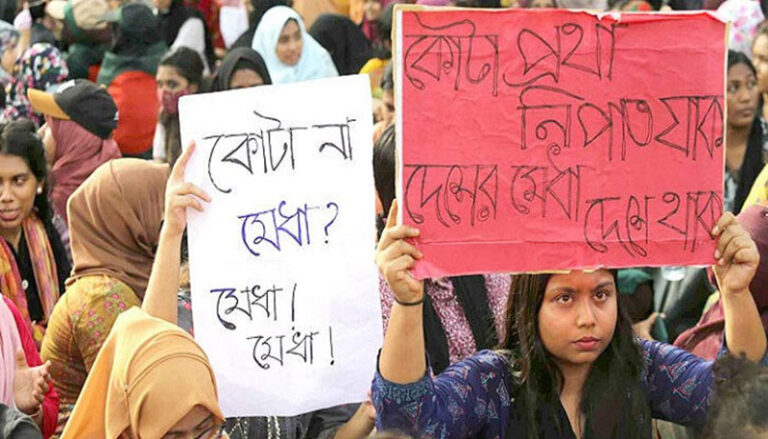
The 2024 protests over quota reform in government jobs turned into a movement to overthrow the government. After the fall of the Awami League government on August 5 of that year, the existing 56 percent quota in government jobs was effectively reorganized.
Currently, the total quota in government jobs is 7 percent. Of this, 5 percent is reserved for freedom fighters, 1 percent for ethnic minorities, and 1 percent for people with disabilities. Women and district quotas have been completely abolished. As a result, 93 percent of appointments are now made on the basis of open merit.
Experts say that rational reform of the quota system has long been needed. However, the complete abolition of women’s quotas and the significant reduction of quotas for ethnic minorities risk disrupting the balance of representation.

According to PSC data, a total of 140,722 women applied for the 47th BCS. 90,262 participated in the preliminary examination. Only 294 women received final recommendations after the written and oral examinations.
The number of men who were finally recommended in the same BCS is 1,040. Out of a total of 1,334, the percentage of women is only 22 percent.
Previous annual reports of the PSC also show a similar trend. In the 34th BCS, the rate of women who were finally recommended was 35.63 percent. Later, it decreased to 26.71 percent in the 41st BCS, 19.46 percent in the 43rd BCS, and 20.17 percent in the 44th BCS.
In other words, women’s participation was declining even when the quota system was in place. However, analysts believe that the trend has intensified after the quota was completely abolished.
PSC Chairman Professor Dr. Mobasher Monem said that the success rate of female candidates in some recent BCS exams has been decreasing alarmingly. However, it is not possible to say for sure whether the abolition of quotas or some other reason is behind this.

He said that to reach a final conclusion on this issue, a time-based research will have to be conducted using data from at least five to seven BCS exams.
Dr. Mobasher Monem said, “The highest transparency and confidentiality are ensured in the PSC examination. From the evaluation of the written examination papers to the formation of the oral examination board, there is no scope for any kind of discrimination or bias.”
PSC member Professor Dr. Ferdous Arfina Osman said, “Women’s participation in government administration is continuously decreasing. The presence of female candidates in recent BCS has also decreased. Many are failing the written exam, while many are not able to pass the oral exam.”
In his words, the quota system was not what women themselves wanted. But it does not appear that they have benefited after the quota was lifted. Now the question is, what alternative measures can be taken to increase women’s participation.
According to experts, good results in exams are not the only indicator of talent. Due to social, economic and geographical disparities, many communities do not get equal opportunities to compete. The responsibility of the state is to bring the backward communities to a place of equality.

According to them, along with abolishing the women’s quota, reducing the quota for ethnic minorities from 5 percent to 1 percent could further reduce the representation of these communities.
Many countries around the world have special reservation policies to ensure representation in government jobs. In various states of India, there is a quota of up to 30 percent for women in some sectors. In Pakistan, a quota of 10 percent for women is reserved in government jobs. In various countries in Europe and North America, special policies are followed to ensure gender balance in government institutions.
Dr. Mobasher Monem said, girls are getting admission in various higher education institutions of the country including Dhaka University with good results. In many departments, the number of girls is more than boys. But in high-level competitive exams like BCS, they are dropping out at some stage. The matter demands in-depth research.
On the other hand, Dr. Ferdous Arfina Osman said, “Women are under a lot of pressure from various realities, including family, child-rearing, social responsibilities, and work-life balance. Without removing these social barriers, it is not possible to solve the problem by simply abolishing or maintaining quotas.”
Analysts say the original purpose of the quota reform was to eliminate discrimination and ensure merit-based recruitment. However, if the representation of women and other marginalized groups continues to decline under the new system, the real impact of the quota reform may need to be reassessed.

https://stapravda.ru/20221228/reyting_samyh_populyarnyh_hostingov_v_rossii_196445.html, рейтинг хостингов России подтверждает, что выбор надежного провайдера важен для бизнеса.