

Opinion
The brutal massacres of August 15 and November 3, 1975, plunged the Awami League into an existential crisis. The party’s top leaders were assassinated. Exploiting the leadership vacuum, a reign of oppression, persecution, and torture began. Both the party and the nation faced a profound crisis.
Professor Abu Sayeed described this period in his book General Zia’s Reign:
“From grassroots levels in rural Bengal to the central leadership, Awami League activists were indiscriminately arrested and imprisoned. Between 1975-76, 62,000 leaders and workers were detained. Many were tortured to death, while others were forcibly disappeared. The white-clad intelligence forces, unleashed under Ziaur Rahman’s orders, subjected countless activists to such brutal physical torture that many became crippled or mentally unstable. Their methods matched the cruelty of Hitler’s secret police. Bangladesh lay shackled under martial law—no fundamental rights, no justice, the constitution suspended. Not a whisper of dissent was tolerated against the military junta’s ruthless tyranny.”
Amid this dire situation, Senior Vice-President Mahiuddin Ahmed assumed the role of Acting President, and Begum Sajeda Chowdhury took charge as Acting General Secretary. Guided by the Four State Principles—Bengali nationalism, democracy, secularism, and socialism (the foundational ideals of the Liberation War)—they began reorganizing the party. Meanwhile, a military decree banned naming parties after living or deceased individuals, erasing Bangabandhu’s legacy. Days after submitting the party’s constitution, the Ministry of Law and Parliament issued another order removing “Bangabandhu” from the document.
The Ministry’s letter stated that the Awami League’s submitted constitution violated Section 10 of the 1976 Political Parties Ordinance. Internal divisions emerged: One faction, led by Mizanur Rahman Chowdhury, argued, “What’s in a name?” This marked the rise of a sinister plot to fragment and weaken the Mujib loyalists within the party.
On November 6, 1975, President Justice Sayem unequivocally announced parliamentary elections for February 1977. Yet, on November 21, 1976, the election was indefinitely postponed. Fearing mass protests, the junta arrested Awami League leaders like Abdul Malek Ukil, Begum Sajeda Chowdhury, Abdul Momin Talukdar, and Salahuddin Yusuf en masse—while sparing the Mizan Chowdhury faction. Mizan secretly applied for party registration without consulting others and secured approval.
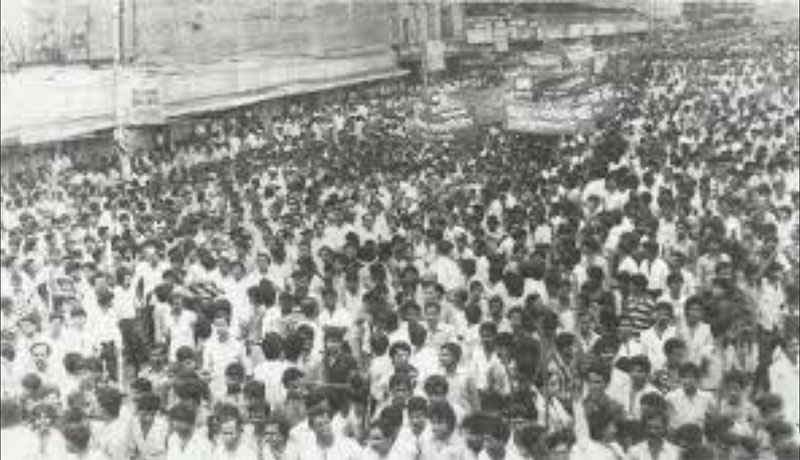
In this critical juncture, mainstream Awami League resubmitted its party registration application by removing not just “Bangabandhu” but the entire preamble. The military ruler’s cunning game split the party. The organization faced nationwide collapse. In the 1979 parliamentary elections, Awami League (Malek) won 39 seats while Awami League (Mizan) secured only two. One faction even revived BAKSAL.
Earlier, two more splinter groups emerged under Deowan Farid Gazi and Abdul Malek Ukil. Separately, Abdur Rashid Tarkabagish and MAG Osmani formed new parties after leaving Awami League.
Amid this party and national crisis, leaders identified only one solution: Bring Bangabandhu’s daughter Sheikh Hasina back. Only she could reunite the party and provide decisive leadership to rebuild a democratic nation. Accordingly, during Awami League’s national council on February 14-16, 1981, Sheikh Hasina was elected party president, and top leaders initiated her repatriation. However, the regime obstructed her return through direct and indirect measures, even forming “resistance committees” to block her homecoming.
The rulers forgot she was Bangabandhu’s daughter—one who never bows her head or accepts defeat. Storming through tempests with unwavering courage, her bond with the soil of independent Bangladesh overcame all barriers. No conspiracy could prevent her return. Like her father, she stood firm and stepped onto the homeland stained by her family’s blood—where a fatherless, traumatized nation wandered directionless. After six and a half years in exile, she returned.
Poet Asad Mannan wrote of her:
“Defying death, she carries her great father’s dream,
Guiding this nation’s liberation path.
Through cyclones, she steers our broken boat
With steady hands and boundless love,
Toward the shores of our aspirations.”
Her homecoming reignited hope not just for Awami League but for the entire nation. Risking her life, she revived progressive democratic politics. That day, nature itself raged—65 mph storms and torrential rains couldn’t deter millions marching for democracy. People from villages, towns, and cities flooded Dhaka, awaiting their beacon of hope at Kurmitola Airport.
At 4 PM, an Indian Airlines Boeing 737 landed. Sheikh Hasina emerged into a sea of people, touching her homeland after six long years. From the airport to Sher-e-Bangla Nagar, roads transformed into human oceans. The air shook with “Joy Bangla” slogans. Crowds thundered: “Hasina, we vow—we’ll avenge our father’s murder.
Fear not, Hasina—your brothers stand with you.”
The relentless downpour seemed to cleanse the land of patricidal sins. Dhaka became a city of processions. At Sher-e-Bangla Nagar, Syeda Sajeda Chowdhury introduced her as “My leader.” Overcome with emotion, Hasina pledged: “I seek nothing. Having lost everything, I stand with you to realize Bangabandhu’s dream of an exploitation-free society.”
Newspapers published special editions. Saptahik Rajniti wrote: “She returns with the mantra of liberation—to overthrow autocracy and complete Bangabandhu’s unfinished revolution.” Daily Sangbad reported: *”Dhaka relived January 10, 1972—the day Bangabandhu returned. For six hours, crowds defied storms, chanting slogans that shook the city.”*
On May 20, addressing a reception at Eidgah Maidan, Hasina said: “I’m an ordinary woman who left domestic life at your call. I dedicate myself to serving Bengal’s oppressed.” Her teacher Prof. Rafiqul Islam advised: “As president, study district maps, identify loyal workers, and reconnect. Those who thought killing Bangabandhu would erase Awami League and our liberation spirit failed. Under you, the party has resurrected.”
Taking Awami League’s helm, she traveled nationwide, unifying and strengthening the party beyond measure. She worked to change the nation’s destiny, building Bangabandhu’s “Golden Bengal.” Defeated forces conspired against her—surviving 21 assassination attempts, she never wavered. Like her father, she visited remote areas, stood by the poor, and sacrificed personal comfort to strengthen democracy.
Transforming national trajectories, she advanced infrastructure (Padma Bridge, Metro Rail, Karnaphuli Tunnel), food and energy security, and unprecedented law-and-order achievements. Yet on August 5, domestic-foreign conspiracies forced her into exile again to save her life.
But she will return—to the soil dyed with her father’s blood, to the razed birthplace at Dhanmondi 32. Another homecoming will illuminate her life. Perhaps nature will rage again, rains washing away conspiratorial stains, as millions chant “Joy Bangla,” shaking the skies.
You’ll return to this Bengal—
Past moonlit nights where dew weeps in rice fields,
Awaiting your footsteps.
Birds herald dawn with hopeful songs,
Hearts tremble at your name.
You’ll walk silent through foggy lanes,
Past kadam trees by ponds where memories linger.
That bird you fed through prison bars still searches for you.
The helpless pray for you.
You’re in Bangladesh’s progress—your touch everywhere.
Yet your absence aches.
You must return, O Daughter of Bengal.
-Shahid Zabeed
Researcher and political analyst

https://stapravda.ru/20221228/reyting_samyh_populyarnyh_hostingov_v_rossii_196445.html, рейтинг хостингов России подтверждает, что выбор надежного провайдера важен для бизнеса.