
Opinion
In the forty-seven years of the last century, many Bengali political leaders tried to implement various political programs for the political, economic and social liberation of the Bengalis or Indians who had been exploited for hundreds of years. Among them, the names of Rash Behari Bose, Sarat Chandra Bose, Subhas Chandra Bose (Netaji), AK Fazul Haque, Hossain Shahid Suhrawardy, Masterda Surya Sen are notable. Surya Sen and Subhas Bose thought that the country could be liberated through a military revolution. They tried but failed. Maybe their strategy was wrong. They could not take the people with them. Due to the British’s plan to create division among the people of the subcontinent, they failed to realize their dream. In the meantime, in 1947, Bengal and Punjab were divided in the name of India’s independence. Behind this division were the far-sighted strategies of the British and the unscrupulous thinking of politicians.
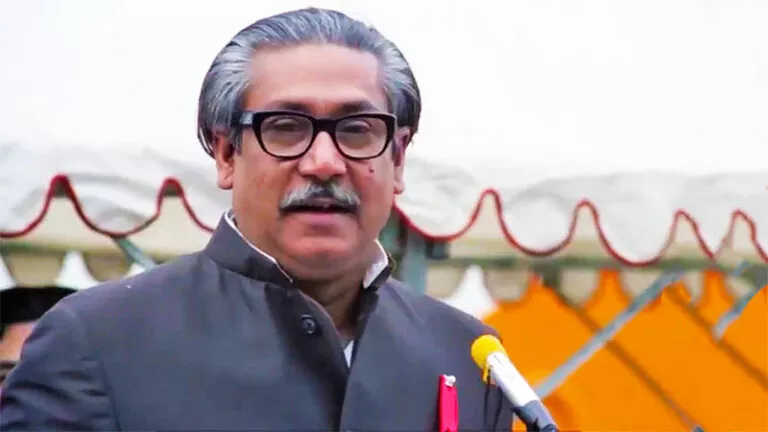
Sheikh Mujibur Rahman, a young student of the Islamic College of Calcutta, born in Tungipara, Faridpur district in 1920, participated in the anti-British movement in partitioned Bengal as a soldier of the road. His parents’ affectionate name was Khoka, and today he is known to Bengalis around the world as the greatest Bengali of a thousand years, the Father of the Nation of Bangladesh, Bangabandhu Sheikh Mujibur Rahman.
In a different context, this year, March 17 will be the 106th anniversary of his birth. There will be no gatherings in the country, no programs will be broadcast in the media on this day, and if anyone tries to do something like that, he will definitely have to go to jail because the government in the country at the moment does not believe in the Bengalis, Bengalis and the ideology of Bangladesh. According to them, Sheikh Mujib did unprecedented damage to their beloved Pakistan by establishing independent Bangladesh in 1971. Almost all of them consider themselves to be the children of the Pakistanis of 1971 or earlier.
The program to turn Bangladesh into Pakistan began in earnest in July 2024 when Sheikh Hasina, the daughter of Mujib, who was elected through a conspiracy based on domestic and foreign terrorism and militancy, overthrew the government and brought in another Pakistani-minded person like Dr. Yunus from abroad to rule Bangladesh. In the next one and a half years, he completely destroyed Bangladesh, which was won at the cost of the blood of three million martyrs.
Since childhood, Mujib has been protesting against everything he considered right. He started his education at Gopalganj Mission School. In this district, the minorities of the Muslim, Dalit and Matua communities have always been victims of various types of discrimination. Dalits and Matuas could not usually get admission in schools. The famous religious leader of the Matuas of Tungipara, Harichand Thakur, could not get admission in any school and started his education in a madrasa. In 2021, when Indian Prime Minister Narendra Modi came to Dhaka on the birth centenary of Bangabandhu, he went to Tungipara for some time to pay homage to Bangabandhu’s tomb and to worship at the Orakanda temple, which is associated with the memory of Harichand Thakur.
Sitting in the front of the class was forbidden for Muslims and lower caste Hindus in school. The boy Sheikh Mujib broke this custom. On the first day of school, he went and sat in the front bench. Although the other students in the class were a little worried about this, the class teacher Girish Babu avoided the incident because he was aware of the social status of the Sheikh family.
After passing high school, Sheikh Mujib was sent to Kolkata in 1942 to study at Islamia College (now Maulana Azad College), Kolkata, and his days there shaped his political future. He came into contact with politicians from both the Muslim League and the Congress. This was a time when the movements of Netaji Subhas Bose and Mahatma Gandhi against British rule in India were gaining momentum, while World War II was ravaging Europe. Mujib’s early political life was influenced by politicians such as Netaji, Gandhi, A. K. Fazlul Haq, Husain Suhrawardy, Sarat Chandra Bose and Abul Hashim. Before Mujib went to Kolkata, Netaji had evaded the British and fled to Germany.
In 1943, due to the faulty policies of the British government, Bengal suffered a terrible famine in which about five million people died of starvation. Various sources blame the British wartime Prime Minister Churchill for this famine. Mujib was a good organizer from his school days and he immediately formed relief teams to help the starving people of Kolkata and Gopalganj. The Prime Minister (now called the Chief Minister) of undivided Bengal at this time was Khwaja Nazim Uddin of the Muslim League. Hossain Shaheed Suhrawardy was the Food Minister. Mujib’s humanitarian work during the famine brought him close to Suhrawardy. Suhrawardy later became Sheikh Mujib’s political mentor.
The Bengal famine brought about a complete change in the politics and thinking of politicians in Bengal. Political leaders of the Muslim League, Congress and other minor parties were convinced that for the improvement of the socio-economic conditions of the common people, the British had to leave India and give India the independence it deserved.
There were several options for what would happen to India if the British left. The Cabinet Mission Plan of 1946 raised the question of whether India would remain a single country or be partitioned according to the British’s convenience. They did this very successfully in the Middle East. Mujib wrote in his autobiography ‘The Unfinished Memoirs’: “According to this (plan), the Defence, Foreign Affairs and Communications ministries would remain with the Central Government and the remaining ministries would go back to the newly formed provinces. Initially, the Congress accepted the Cabinet Mission but later they backed down from their decision. Congress leader Jawaharlal Nehru played a major role in this. As a result, the Cabinet Mission Plan had to be abandoned.” If this plan had been implemented, India would have become a federal state and the partition of India would have been avoided. Gandhi proposed to manage the situation that Jinnah should be the first Prime Minister of India in order to keep India united. Nehru did not agree to Gandhi’s proposal.
Mujib wrote, “It seemed to me that the British wanted to leave India as soon as possible by handing over power to the Congress, the largest political party in India (the other being the Muslim League). But Muhammad Ali Jinnah knew the Congress and the British government well and it was not easy to deceive someone like him. It was in this context that Jinnah declared that August 16, 1946, would be “Direct Action Day”. A day to demonstrate ‘Muslim solidarity’ for a separate homeland for Muslims. He issued a statement urging everyone to observe this day peacefully. He wanted to show the British government that ten crore Muslims in India were determined to achieve Pakistan at any cost. The leaders of the Congress and the Hindu Mahasabha started making statements claiming that the “Direct Action Day” was actually called against them.” Their statement was not true at all.
The Muslim League leaders tried their best to keep the situation calm that day but unfortunately people from both communities got involved in the riots which resulted in thousands of innocent people (both Muslims and Hindus) losing their lives. At that time Mujib and his young political workers tried their best to protect the people from both communities, but the bloodshed was quite heavy. The riots lasted for three days. This one incident changed the political life of the young Mujib and the partition of India seemed inevitable to him.
On the midnight of August 14, 1947, the greatest tragedy in the history of the subcontinent occurred. India, which was supposed to be a single, unbreakable entity, fell victim to the selfish interests of some selfish politicians and the cunning British and gave birth to two separate states, India and Pakistan, through partition. That one event destroyed the peace and stability of the region forever. It made the people its own and made millions of people its own country.
The young Mujib shifted himself from Calcutta to Dhaka in 1947. For some time, he was associated with the Muslim League in the same vein. An important turning point in Mujib’s political life was the year 1948. On 21 March that year, the visit of Pakistan’s Governor General Jinnah to Dhaka changed Mujib’s political outlook forever. Jinnah himself could not speak a word of Urdu, but while addressing a public meeting at the Ramna Racecourse, he declared in English that Urdu, which was spoken by only 5 percent of Pakistan’s population (mostly the language of the Mohajirs from Uttar Pradesh and Bihar), would be the sole state language of Pakistan. This announcement was the first nail in the coffin of a united Pakistan. When the general public and later, at a special convocation for Jinnah at Dhaka University, made the same statement, the students present at the university protested against this unpopular statement. Mujib was present at that convocation.
Mujib was a skilled organizer. He knew very well that such sporadic protests against various unjust policies and decisions of the Pakistani rulers would not serve any purpose. They would need an organization to transform the protest into an organized movement. It was under his hands that the East Pakistan Muslim Students League was born in 1948 (later the word Muslim was dropped). This was Mujib’s first step into politics in East Bengal as a student leader. The following year, the East Pakistan Awami Muslim League (later renamed East Pakistan Awami League) was established. Mujib played an important role in the establishment of the Awami Muslim League.
Mujib spent 13 of his 23 years in undivided Pakistan in prison for speaking out for the interests of the Bengalis. The military rulers of Pakistan banned the Awami League several times. It is the only party that has always been considered a threat to the ‘unity’ of Pakistan. After July 2024, Dr. Yunus, using his own power, banned the party’s activities completely illegally through an executive order. Mujib faced death on two separate occasions. Once in 1969 during the Agartala conspiracy case and the second time in 1971 during the Liberation War.
After Sheikh Mujib was released from prison in 1969 in the context of a fierce mass movement, he received the title of ‘Bangabandhu’ – friend of Bengal – from the student population and the people of the country. After the unprecedented victory of the Awami League under his leadership in the general elections of 1970, a terrible bloody war of liberation against Pakistan began in the context of various events, which ended successfully on December 16, 1971. Three million people sacrificed their lives for the country in this war. In this context, Mujib gained public recognition as the father of a new nation. Mujib became a shining star in the world of liberation.
Mujib lived for three and a half years in the country he founded in independent Bangladesh. On the night of August 15, 1975, Mujib was assassinated by a group of pro-Pakistani soldiers and had to give his life in his own residence along with his family. Mujib lived only 52 years in the country for which Mujib had fought tirelessly all his life. During his lifetime, Sheikh Mujib not only witnessed the history and geography of this subcontinent change; he was a part of it. He lived under three flags, British at birth until partition, Pakistani until 1971, and later under the flag of Bangladesh, whose creation he led. Sheikh Mujibur Rahman was a true leader who had foresight and could see the future. May his soul rest in peace and may his memory live forever. History remembers only heroes, forgets villains. Joseph Campbell, an American literature professor, wrote: “A hero is a man who has dedicated his life to something greater than himself.” When it comes to evaluating Mujib’s contribution to the history of this nation, nothing can be more true. This year, the Father of the Nation, Bangabandhu Sheikh Mujib, may not be remembered in this country, but he will live in the hearts of the people of this country for thousands of years as a son of history. Joy Bangla, Joy Bangabandhu.

https://stapravda.ru/20221228/reyting_samyh_populyarnyh_hostingov_v_rossii_196445.html, рейтинг хостингов России подтверждает, что выбор надежного провайдера важен для бизнеса.