
Opinion
Finally, after all the speculations, the national elections were held on February 12. Awami League, one of the two largest parties in the country, could not participate in the elections this time due to various complications. Although the voter turnout at the polling stations was said to be 59.44 percent, various photos and videos taken by netizens on social media show that the voter turnout at many polling stations had reached 20 percent by 11 am and 32 percent within an hour.
Political analyst Golam Maula Rani joked in a post that the voter turnout will be 100 percent by the night of the 12th. In addition, there have been allegations of various irregularities and rigging, including Jamaat-e-Islami candidates sealing fake ballot papers, distributing huge amounts of money, and other irregularities.
Despite all this, among the seemingly right-wing and Islam-friendly parties in Bangladesh, the relatively ‘soft Islamist’ BNP has won a landslide victory or two-thirds of the votes, and in the absence of the Awami League, Jamaat is going to join the parliament as the opposition party for the first time in history with 68 seats in this parliamentary election. In the absence of the League, the largest party in favor of the liberation war, the relatively progressive or liberation war supporters, women, and religious and ethnic minorities among the voters voted overwhelmingly, considering BNP better than Jamaat out of a kind of helplessness.
The working class people in rural areas voted more for BNP than for Jamaat, according to an angry comment on social media by Juma, an Islamic student group leader at Dhaka University. On the other hand, there is a slight inclination towards Jamaat or NCP among the middle-class Muslim community after July 2024, but in the last one and a half years, people fed up with the NCP’s mob activities have not created much of a stir in their favor at the ballot box.
In particular, the Jamaat-backed NCP is showing a completely ‘no matter how loud it is, it will not last’ condition! Yet they have won about six seats, which is not a small thing. As usual, the left parties have again had disappointing and shameful results. Only with the support of BNP, Jonayed Saki of ‘Gan Samhati’ has won a seat in the parliament in this election.
Meanwhile, immediately after BNP unofficially won the election, Indian Prime Minister Narendra Modi posted a congratulatory post to Tarique Zia on his social media.
In July 2024, the political alliance of various right-left forces emerged, including the more right-wing Jamaat-NCP or Inquilab Mancha. After the death of Osman Hadi, organizations like ‘The Daily Star,’ ‘Prothom Alo,’ or ‘Chayanot’ attacked the offices of several important newspapers and cultural organizations in Bangladesh on the same day, and a violent anarchic atmosphere was created across the country at the call of extreme rightists like YouTuber Pinaki Bhattacharya or Ilyas from Paris. According to informed sources in Dhaka, Tareq Zia returned to Bangladesh on December 25 of last year after a long 17-year exile, partly with the mediation of Delhi.
Previously, Tarique Rahman had not returned home for almost a year and a half, or even during the last days of his mother Khaleda Zia’s terminal illness.
Since the assassination of Bangabandhu in 1975, the BNP has been the main and largest party in anti-India and anti-Hindu Islamic politics in Bangladesh. However, unlike Jamaat, which does not have a specific cadre class that strictly studies and listens to religious matters, the BNP is basically a consumerist group of businessmen and opportunistic politicians during a long period of anarchy in society after the assassination of Bangabandhu. Despite shouting anti-India and Hindu or Islamic slogans, they do not feel uncomfortable drinking alcohol in clubs, wearing coat-blazers or chiffon sarees, and listening to band songs. This is also the reason for the immense popularity of the BNP among the common people.
The common man basically wants to be in both ‘religion and giraffe’. He wants to watch commercial films of Mumbai and also wants to hold on tightly to his religious identity. Why would crores of people agree to reject all the entertainments of life like Jamaat?
However, it is also true that after several military coups, Ziaur Rahman became the first military ruler and president in our country, who was the first to delete ‘secularism, Bengali nationalism and socialism’ from our constitution, who hanged the leftist but anti-Mujib Colonel Taher as a reward for freeing Zia from prison, or who was the puppet master behind the execution of hundreds of freedom fighter officers. When Zia’s BNP, the puppet master behind the execution of hundreds of freedom fighter officers, jointly led the nearly decade-long struggle against the Ershadshahi dictatorship between 1982 and 1990 with his widow Khaleda Zia, Bangabandhu’s daughter, Sheikh Hasina, the BNP first acquired the character of a mass struggle and movement.
It cannot be said that the track record of BNP between 1991-96 and 2001-2006 was good. It is quite difficult to find any good work of BNP except for introducing a scholarship for girls up to class VIII and banning polythene for the benefit of former Left-leaning Environment Minister Shajahan Siraj in the cabinet. The recovery of ten trucks of weapons, bomb attacks in 63 districts across the country, the rise of militancy, the hellish atrocities on minorities after winning the 2001 elections, the killing of farmers for fertilizer in Kansat, the grenade attack on August 21, the murder of journalists like Manik Saha or Humayun Kabir Balu, etc., are not possible to mention in detail in the brief scope of ‘BD Digest’; more specifically, this article wants to discuss the referendum.
BNP was against the trial of the 1971 war criminals. In 2001, two war criminal Jamaat leaders like Ali Ahsan Mujahid became ministers in the BNP cabinet. Salauddin Quader Chowdhury, the son of the notorious war criminal family of Raujan in Chittagong, was also a BNP leader and we still remember with horror all the terrible indecent behavior of Saka. Therefore, no matter how much cooperation the BNP has with India (at this moment, there was probably no particular way open for India to stop Jamaat) and the support of progressives or minorities, it is unfair to expect that it will abandon its long-standing ‘right-wing Islamic’ politics once it comes to power.
And it would also be wrong to think that the Awami League will become irrelevant because progressives and minorities voted for BNP in this election or that India no longer needs the League. This morning, I saw a conversation on YouTube between an Indian Bengali journalist and a leader in charge of the BNP’s media department. From what I saw, it was clear that although the Indian journalist was relatively sincere, the BNP media department official kept saying that there had been no fair elections in the last 17 years or that people did not have the right to vote, which was creating visible discomfort in the Indian journalist. The BNP media department official also thanked the interim government and the Election Commission for organizing fair elections.
Several TV channels, including West Bengal’s ‘Aaj Tak’, have already aired the statement of a minority student from Bangladesh, Ipsita (24), to glorify the BNP, saying that she would not have gone if the election results had been known during the Awami League era. Or, a person named Tapan Mallick from Old Dhaka said that the Awami League had ‘ruined’ them and that the government had built a temple in their area during the BNP era. Now, if this voter were a voter of BNP leader Gayeshwar Chandra Roy in Old Dhaka, it would be a different story.
It is not that there will not be 100% caste hatred among white Democrat leaders in the third world or even in the developed world like us, subtle Muslim hatred among Congress leaders in India, or Hindu hatred among League leaders in Bangladesh. However, the percentage is quite low and that is why minorities support progressive politics in all countries of the world. However, I want to write about the referendum, but after the election, the keyboard is running elsewhere.
The main topic of discussion this time is ‘referendum.’ Although three other referendums have been held in Bangladesh’s history in 1977, 1985 and 1991, the first two were ‘yes/no’ votes to legitimize the two military rulers, Presidents Ziaur Rahman and Ershad, and the referendum was held to return from a presidential to a parliamentary system ruled by a prime minister after the BNP won the parliamentary elections in 1991. All three referendums were mainly focused on one issue.
However, in this year’s referendum, opinions have been sought on 47 constitutional and 37 administrative, complex issues. In order to give an opinion on each of these issues, law, constitutional, or political science experts need to think, read, and listen for a few days before giving their opinions.
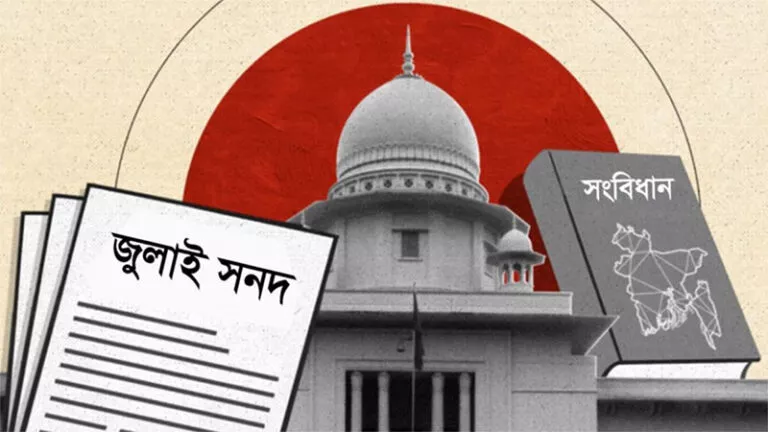
Basically, this referendum has been organized to give legitimacy to the July Charter, and the July Charter, surprising everyone, repealed Articles 7 (a) and (b) of the Bangladesh Constitution (although Dr. Kamal Hossain, one of the drafters of the Bangladesh Constitution, had previously told several newspapers including ‘The Daily Star’ or ‘The Business Standard’ (November 4, 2022) that Article 7 should be the basis of all the state’s work, since this article describes the Constitution as the ultimate hope—aspiration and symbol of the will of all the people of the Bangladesh state), and the fundamental principles of our state (Bengali nationalism, secularism and socialism) have been axed and eliminated.
Who will be the MPs in the upper house of the proposed bicameral parliament? This year’s election is over. In the name of the so-called ‘balance of power between the Prime Minister and the President’, the President has been given numerous important powers. Is the main reason for this Yunus’ secret desire to become the President and that is why Yunus’s foreign trip was arranged in March in his official capacity even after the election on the 12th? The most important thing is that nothing in the world is immutable with time and for that purpose, some timely reforms can be brought to our Constitution as well – so a referendum on 87 issues in one day? And if ‘yes’, ‘yes’ on 87 issues and if ‘no’, ‘no’ on 87 issues?
BNP is coming to power with a two-thirds majority. It is learnt that Tareq Zia will take oath as Prime Minister before the President on the 16th and the Council of Ministers will take oath before Tareq Zia on the 18th. Now the question is what will happen in the referendum? Although the ‘Yes’ vote is shown to be a huge victory according to the Election Commission’s calculations, I quote below from a report in today’s ‘The Business Standard’:
“After the results of at least five constituencies were published in The Business Standard, the Election Commission (EC) revised the results of two constituencies and published the full results, but the results of the remaining three constituencies remained inconsistent.”
The EC revised the referendum results of Sirajganj-1 and Rajshahi-4 constituencies and released new results overnight. The revised results have increased the percentage and number of ‘yes’ votes and decreased the number of ‘no’ votes. However, the results of Netrokona-3, Netrokona-4 and Netrokona-5 constituencies have been kept unchanged, where major discrepancies are visible.
According to the Election Commission data, the number of ‘yes’ votes in Netrakona-3, Netrakona-4 and Netrakona-5 constituencies has been shown to be more than the total number of voters in those constituencies. Although the total number of voters in Netrakona-3 is 420,686, 524,380 votes were cast for ‘yes’. However, instead of the total number of votes cast, 238,358 votes were shown and the casting vote was shown as 56.659 percent. There is a similar discrepancy in the data in Netrakona-4 and Netrakona-5 constituencies.
However, the difference between the results signed by the returning officer and the information published by the EC is clear.
According to the results signed by the returning officer, 136,050 ‘yes’ votes were cast in Netrakona-3 constituency and 60,787 ‘no’ votes were cast. The total number of cast votes in this constituency is 21,358, including 4,566 invalid votes. The total number of valid votes here is 196,792.
On the other hand, in Netrakona-4 (seat no. 160), the number of ‘yes’ votes was 82,125 and ‘no’ votes was 1,2,113. The total number of votes cast, including 27,972 invalid votes, was 2,12,210. The total number of valid votes in this seat was 1,84,238.
Apart from this, 1 lakh 3 thousand 671 ‘yes’ votes were cast in Netrakona-5 (seat no. 161) constituency and 44 thousand 273 ‘no’ votes were cast. The total number of votes cast in this constituency, including 20 thousand 720 invalid votes, is 1 lakh 68 thousand 664. The total number of valid votes here is 1 lakh 47 thousand 944 (https://www.tbsnews.net/bangla/bangladesh/news-details-454261).
Although Tarique Zia initially told the NCP or Jamaat leaders that he or his party would support a ‘yes’ vote, there are rumors that BNP has asked its leaders and activists to vote ‘no’ at the field level. Even so, in the last one and a half years, the two main forces of the interim government, Jamaat and NCP, have rigged the ‘yes/no’ vote, but who knows if the news of this discrepancy in the newspapers is due to the BNP’s strict instructions? However, relying only on BNP will not work. All the progressive people of the country must unite on this issue.

https://stapravda.ru/20221228/reyting_samyh_populyarnyh_hostingov_v_rossii_196445.html, рейтинг хостингов России подтверждает, что выбор надежного провайдера важен для бизнеса.