
Staff Correspondent
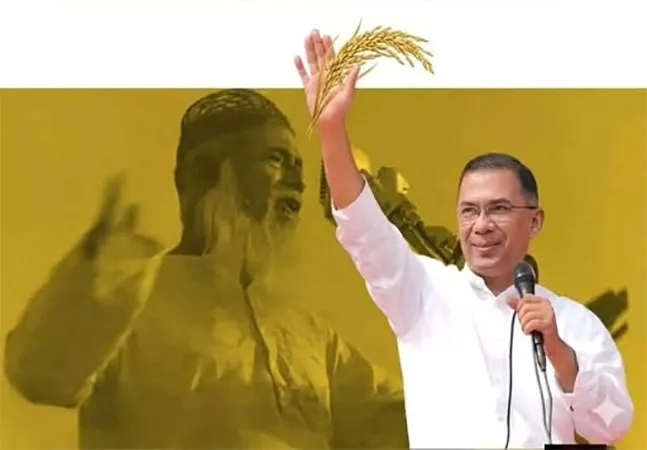
Dhaka: Bangladesh Nationalist Party (BNP) Chairperson and Prime Minister Tarique Rahman made a statement about the oppressed people’s leader Maulana Abdul Hamid Khan Bhashani at a public meeting in Tangail, which directly contradicts historical facts. He claimed that during the 1979 elections, Maulana Bhashani had told martyred President Ziaur Rahman, “I have handed over the sheaf of rice to you.”
But history tells a different story. Maulana Bhashani died on November 17, 1976, while undergoing treatment at Dhaka’s PG Hospital (now Bangabandhu Sheikh Mujib Medical University). That is, Bhashani died almost three years before the 1979 incident mentioned by Tarique Rahman.
The symbol of Bhasani: The true history of the rice ear
Maulana Abdul Hamid Khan Bhasani left the party during the Kagmari conference of the Awami League held on 7-8 February 1957. After that , he formed the ‘National Awami Party’ (NAP) on 25 July of that year and his party’s election symbol was a sheaf of rice. It was known as the symbol of farmers, agriculture and grassroots people.
NAP (Bhasani section) used this symbol at various times, including the 1970 elections.
On 1 September 1978, Ziaur Rahman formed the Bangladesh Nationalist Party (BNP). After the party was formed, a large section of the Bhashani NAP (led by Mashiur Rahman Jadu Mia) joined the BNP. Based on that principle and with the aim of creating a link with the farmers and grassroots, the BNP adopted the symbol of the sheaf of rice. This symbol was first used by the BNP in the 1979 national parliamentary elections in independent Bangladesh.
That is, the symbol of the sheaf of rice comes from Bhashani’s political heritage and was adopted by BNP after Bhashani’s death by his followers. But the deceased Bhashani could not have “handed” the symbol to Ziaur Rahman in 1979.
Tarique Rahman’s statement has drawn widespread criticism and ridicule on social media. Many have cited it as an example of historical distortion. Critics say the sequence of events and time period have been deliberately misrepresented to strengthen the BNP’s political narrative.
Historians and political analysts believe that although Bhashani’s name is associated with the sheaf of rice, it is not a personal “transfer”, but rather the result of political continuity and the joining of activists. The symbol came naturally as a large part of Bhashani’s NAP merged with the BNP.
Maulana Bhasani was one of the leading leaders of grassroots politics during the British India and Pakistan era. He was associated with farmers’ and workers’ rights, the independence movement, and left-wing politics. Even after his death, his political legacy spread to various parties.
Ziaur Rahman came to power after 1975 and took the initiative to restore multi-party democracy and formed the BNP in 1978. The party was built on the philosophy of ‘Bangladeshi nationalism’ and won a landslide victory in the 1979 elections.
Critics have accused Tarique Rahman of simplifying this complex historical continuum into a dramatic “handover” story. They fear that such statements could increase political polarization and make history confusing for the new generation.
No official explanation has been given by the BNP on this matter yet, but discussions on it are continuing in political circles.

https://stapravda.ru/20221228/reyting_samyh_populyarnyh_hostingov_v_rossii_196445.html, рейтинг хостингов России подтверждает, что выбор надежного провайдера важен для бизнеса.