
PRESET71
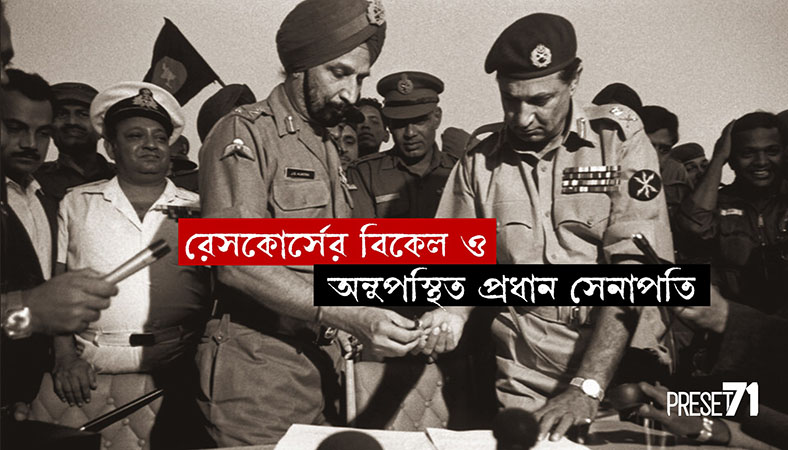
The surrender of the occupying Pakistan Army at the Race Course Ground. However, the commander-in-chief of the Mukti Bahini, General M.A.G. Osmani, who had been fighting for 9 months, was absent. There are many whispers, criticisms, rumors, and conspiracy theories about this. Let’s see the course of events that day.
Before that, we did not know that on November 21, 1971, the Bangladesh Army and the Indian Army officially formed a joint force. From that day on, it was no longer a single guerrilla war of the Liberation Army, but a frontal war of the joint forces with the aim of final victory. Although the Chief of the Bangladesh Army and the Chief of the Indian Army were both equal in status, in view of the reality, the Indian Army Chief General Manekshaw was appointed the operational commander of the frontal war. Under him, the Eastern Commander Lieutenant General Aurora led the Liberation Army and the Indian Army in occupied Bangladesh jointly. When Pakistan attacked India with air strikes on December 3, India also started a war with West Pakistan. That was a one-sided Indo-Pakistani war.
December 16 morning. Kolkata. Mukti Bahini headquarters. Mukti Bahini’s Deputy Commander-in-Chief Group Captain Abdul Karim Khandaker returned from some work around 10 am. He turned around and saw some people waiting for him. He learned from them that the Pakistani army would surrender to the joint forces that afternoon. For that, a small, unassuming ceremony would be held at the Dhaka Race Course. And he would have to represent Bangladesh and Mukti Bahini at that ceremony. Mukti Bahini’s Commander-in-Chief General MAG Osmani was then on the Sylhet battlefield. There was no opportunity to inform him in such a short time.
A special plane was waiting for the delegation at Dum Dum Airport in Kolkata. So Khandaker went to Dum Dum. He was accompanied by General Nurul Islam Shishu and a few others. When he reached Dum Dum, he was about to board the plane—just as he was about to board the plane, he saw General Arora’s wife, who was representing the surrender ceremony, arriving in a jeep. She was much older than him. So Khandaker stood aside from the plane door out of respect for him. He requested him to go first. But General Arora did not board the plane; he put his hand on his back and said, “You are the commander of the liberation war, you go first.”
The plane arrived in Agartala. Seven helicopters from Agartala reached Dhaka with representatives of the Mukti Bahini and the Indian Army. In addition to the delegation led by AK Khandaker, the surrender ceremony was attended by S Force commander Major Shafiullah, Kader Siddiqui, head of the Kaderia Bahini, and Major Haider, vice-captain of Sector No. 2, who cordoned off the defeated General Niazi.
While the Pakistani army was surrendering in Dhaka, the Mukti Bahini and Indian forces were entering the northeastern district town of Sylhet. The siege of Sylhet began on December 7. The Pakistani army left the Circuit House in the city center and gathered at the Brigade Headquarters Residential Model School. Major Hafiz of First Bengal, Major Shafayat Jamil of Third Bengal, Major Akbar, Captain Anwar, Captain Mohsin, Lieutenant Nurunnabi and other Mukti Bahini commanders arrived at the Circuit House. Seeing General Osmani here, they were surprised and asked, “Sir, why are you here instead of the surrender ceremony?” The general did not answer. After a while, he looked around with a bored look and said, “It’s a blessing that I was able to come here. An hour ago, the Pakistani soldiers who were hiding there opened fire and damaged my helicopter. I had to make an emergency landing on the way. My companion, Colonel Abdur Rab, was injured.”
Two days later, General Osmani returned to the headquarters of the Mujibnagar government. His absence from the surrender ceremony of Pakistani soldiers in Dhaka created an unwanted furore and confusion, which became a source of discomfort for the Mujibnagar government.
The General’s ADC reported to him about this. He called Nazrul Islam, the public relations officer of the Ministry of Defense, to his room to be further informed about the situation. Nazrul Islam calmly told General Osmani that his absence from the surrender ceremony had created adverse criticism in political circles here.
The general, accustomed to British attacks, controlled his anger and said, “Look, we are going to achieve independence. But the sad thing is that as an independent nation, we have not yet developed any sense of self-respect. Where is the opportunity to spread rumors about me? There is no opportunity. There are many reasons for that. Number one – I did not know when the Pakistani army would surrender. After I left Calcutta, they offered to surrender.
Number two: There is no question of me going to the surrender ceremony in Dhaka. Because, even though this armed conflict was under the joint command of India-Bangladesh, the Indian Army Chief, Lieutenant General Shyam Manekshaw, was in full command of the operational part of the war. To be honest, I am not the Chief of Army Staff of any internationally recognized regular army. According to international norms, the Pakistan Army cannot surrender to me. Because, Bangladesh is not a signatory to the Geneva Convention. Lieutenant General Arora represented General Manekshaw at the surrender ceremony. If General Manekshaw had gone, there would have been a question of me going with him. On the basis of sovereign equality, my position is equal to General Manekshaw. I cannot be the accompanying person of General Arora, the head of the regional forces under General Manekshaw. This is not a matter of ideology, this is a matter of protocol. Our people have no idea about protocol, that is why so many misunderstandings have been created. Explain to the people.”
Source:
1. December 16 in Memory: That Historic Afternoon. AK Khandaker. bdnews.com. 16 December 2013
2. Blood-soaked 1971. Major (Retd) Hafizuddin Ahmed Bir Bikram. Literary Publication.
3. Some Untold Stories from the Battlefield of 1971. Nazrul Islam. Anupam Prokashani.

https://stapravda.ru/20221228/reyting_samyh_populyarnyh_hostingov_v_rossii_196445.html, рейтинг хостингов России подтверждает, что выбор надежного провайдера важен для бизнеса.