
❐ Staff Reporter
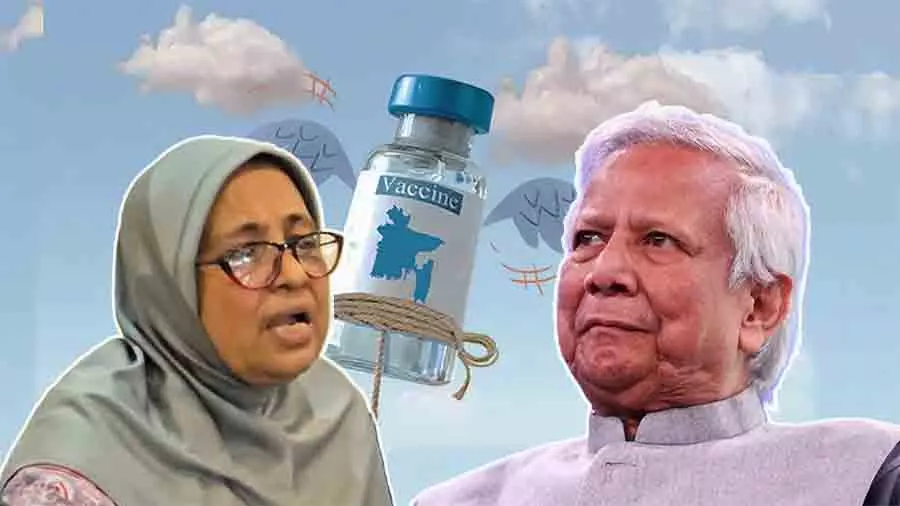
A court has dismissed a petition filed by a helpless father against four people, including former interim government chief advisor Yunus and health advisor Nurjahan Begum, alleging the negligence of his daughter in the death of her daughter from pneumonia.
Dhaka’s Additional Chief Metropolitan Magistrate Jashita Islam issued this order today, Sunday, July 12.
“The court has ordered the dismissal of the case as there is no ‘material’ to accept it,” said Ashutosh Bhowmik, a bench assistant of the court.
Sirajul Islam, the father of 9-month-old Sauda Muskan, who died of pneumonia, filed the petition in the court on the morning of July 5. The court accepted the plaintiff’s statement and awaited the order. In the afternoon, it was announced that the court would issue the order on July 12.
In addition to Yunus and Nurjahan, former Director General of the Directorate General of Health Services, Professor Dr. Md. Abu Zafar, and former Chief Advisor’s Press Secretary Shafiqul Alam were requested to be made accused in the case.
The petition states that in late February and early March, nine-month-old Sauda Muskan of Shariatpur Sadar suddenly developed a severe fever. The child was admitted to Dhaka Medical College Hospital in the first week of March after local treatment failed. The child was transferred to Mohakhali Infectious Diseases Hospital on March 22 after not receiving the necessary treatment for measles there.
Alleging non-cooperation and negligence in treatment against the doctors and nurses there, the petition states that on March 26, the plaintiff’s wife was handed an oxygen cylinder and asked to put it on the child’s face. However, when the child’s mother failed, the doctor on duty used a sweeper to put it on the child’s face. The child died a couple of hours later.
The petition further stated that over 600 children in the country have died, including Sauda Muskan, due to the lack of timely supply of vaccines to children, failure to take appropriate measures by hospital authorities, and the ‘gross negligence’ and negligence of the interim government in purchasing and administering vaccines.
The petition stated that the defendants cannot in any way escape responsibility for these deaths, stating that despite being at the highest level of the state, they did not take any effective steps to prevent measles-related child deaths; they are equally liable for negligence and deserve to be punished under the prevailing law.
Earlier, several cases against Muhammad Yunus and Nurjahan Begum were dismissed in a Dhaka court on similar charges. This has been widely criticized. According to the government, more than 750 children have already died of measles; those responsible for their deaths have blamed Dr. Yunus’ government’s failure to purchase vaccines.
These helpless families are dying door to door, demanding justice, but no remedy is available.
Antibodies not produced even after measles vaccination, vaccine effectiveness questioned
Children are supposed to develop antibodies or immunity to the disease within two to three weeks of receiving the measles vaccine. But a report nine weeks after the start of vaccinations said that infections were still on the rise.
Experts and public health experts have raised serious questions about the effectiveness of the vaccine in this situation.
There have been repeated suggestions to test the blood of vaccinated children to see if they have developed antibodies, but the government has been accused of not taking this into account.
After the measles outbreak spread nationwide, a special vaccination program was launched in high-risk upazilas on April 5. In the first phase, vaccination was given in 30 upazilas and municipalities in 18 districts. Two weeks later, the nationwide program began on April 20.
The government had set a target of vaccinating 19 million five thousand nine hundred and fifty children aged six to nine months.
According to the Department of Health, 100 percent coverage was achieved on May 12. A total of 224,117 children were vaccinated in the campaign, which lasted until May 20, which is 6 percent more than the target. However, despite such high coverage, infections have not decreased.
Questions about vaccine quality and storage
Serious questions have been raised about the effectiveness and safety of vaccines, as infections and deaths have not decreased despite vaccinating more children than the target.
Public health experts say the effectiveness of the vaccine depends on the child’s age, nutrition, and the antibodies they receive from their mother. The younger the child, the less effective the vaccine.
Dr. Md. Tajul Islam A Bari, a vaccination expert who has worked for a long time at the government’s EPI and ICDDR, B, said, “It has been two months since the vaccination, and high transmission is still being seen. At this time, it is important to test the blood of vaccinated children aged six to nine months, nine months to two years, and under five years to see whether they have actually developed immunity against measles.”
“Even if some antibodies are produced at the same time, it remains to be seen whether they are at the level of immunity. But the government is not listening to any advice in that regard,” he said.
Regarding the vaccine effectiveness rate by age, he said, “Usually, the vaccine effectiveness rate is a maximum of 50 percent in children under six to nine months of age. It is 85 percent between nine months and one and a half years, and the probability of effectiveness is 97 percent in children four to six years of age. So there is a huge relationship between age and vaccination.”
Demand for verification of effectiveness
Demanding specific steps to verify the effectiveness of the vaccine, Dr. Tajul Islam A Bari said, “The vaccine needs to be tested at the National Control Laboratory (NCL) under the control of the government’s Department of Drug Administration.”
He said, “IEDCR can be used to check if there is a problem with the cold chain somewhere in the transportation. The World Health Organization should be asked to provide test kits to verify the quality of the vaccine. But the government is not giving importance to these. As a result, children are still getting infected, dying, and we are watching.”
Professor Bey-Nazeer Ahmed, former director of the disease control branch of the Directorate General of Health Services, said, “Infections are still happening constantly. However, it has been 9 weeks since the vaccination. So, it is necessary to see whether antibodies have been produced in the body or not.”
IEDCR Chief Scientific Officer Professor Dr. Ahmed Nowsher Alam said, “Even if the vaccine coverage is 100 percent, it may be seen that some population has been left out. It can spread from there. Now, it will not be understood whether the vaccine is effective or not without testing. Since the issue is being discussed, it can be considered.”
Director of the Disease Control Branch of the Directorate General of Health Services, Dr. Halimur Rashid, said, “The matter is under consideration. But nothing has been done yet. The thought was that the infection would decrease. Since that has not happened, I will talk to the Director General about the matter.”

https://stapravda.ru/20221228/reyting_samyh_populyarnyh_hostingov_v_rossii_196445.html, рейтинг хостингов России подтверждает, что выбор надежного провайдера важен для бизнеса.