
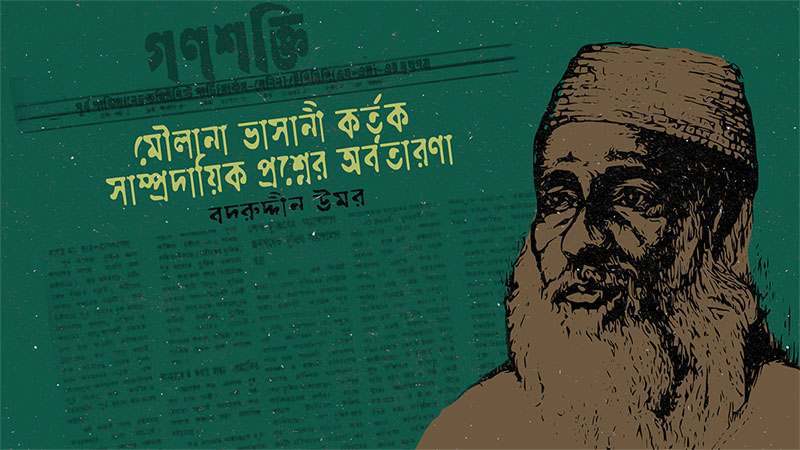
Badruddin Umar
While leaving Dhaka to attend the farmers’ conference of Tobatek Singh of West Pakistan, Maulana Bhasani told reporters at Tejgaon airport that the Hindu leftist leaders in East Bengal, along with their followers and a small number of Muslim workers, were trying to destroy the NAP and the Krishak Samiti. He also said that 99 percent of the population of East Bengal were Muslims, so it was not possible to mislead them in this regard (Daily Pakistan, and Pakistan Observer-22nd March, 1970).
There is no doubt that not only those who have worked with Maulana Bhashani in democratic politics, but also the struggling people of East Bengal will be ashamed and offended by Maulana’s statement. The political objective that Maulana Bhashani is trying to achieve by calling the leftist leaders as Hindus is not different from the objective of the Muslim League Jamaat-e-Islami, but rather complementary to it. Thinking about this, not only are many people feeling ashamed, embarrassed and offended by Maulana’s statement today, but also thoughts have begun to be widely held among progressive activists about his current political character and his current role in the democratic leftist movement of this country.
There are both Hindus and Muslims in the leadership and activists of leftist politics. But that is not relevant at all in today’s political situation. Leftist politics has never been formed on the basis of who belongs to which religion, is not happening now and will not happen in the future. Moreover, the establishment and progress of democratic, progressive and leftist politics in East Bengal, like in other countries, by politically transcending the religious question. It is not that Maulana Bhasani does not know all this. He knows it very well. Yet why did he introduce communal questions so irresponsibly in the leftist political arena today? Is his statement accidental or intentional? To get the answer to this question, we have to compare this statement with the statements of Maulana in the past year.
In March 1969, Maulana Bhasani visited West Pakistan. He established contacts with some circles there. Without going into detail about that, we can mention that during his visit, he very loudly demanded Islamic socialism. Until then, as the head of the non-communal organization NAP and the Krishak Samiti, he had been talking about socialism. Although there were many mistakes in his own statements about socialism, the people generally responded to his propaganda and the vested interests and their representatives, Jamaat-e-Islami and other political organizations, were alarmed and started opposing him. Faced with this opposition and attack, Maulana added Islam to the prefix socialism and raised the slogan of Islamic socialism. When he presented this distorted statement of socialism in West Pakistan, widespread criticism began in the democratic circles of East Bengal. When he returned to East Bengal after the tour, his attention was drawn to this issue. But he ignored all that and abandoned socialism and devoted himself entirely to promoting Islamic socialism.
Everyone surely remembers that just before the farmers’ rally in Shahpur, Maulana Bhashani, through a statement from Pabna, called for observing a day on October 3rd in protest against the communal riots in Ahmedabad, India, by hoisting black flags, holding meetings, etc. The communal situation in East Bengal was already deteriorating to a great extent. After Maulana’s statement, the situation took on a more serious form. Communal tension increased greatly in Dhaka, Narayanganj and other places in the province. Seeing this situation, many other leaders, including the leaders of the Farmers’ Association, issued statements opposing Maulana Bhashani’s call for observing the day in order to protect the people of East Bengal from communal riots. On behalf of the Farmers’ Association, through a statement by the Office Secretary Syed Jafar, the workers of the Farmers’ Association were prohibited from observing that day. When a nationwide movement began against the observance of Maulana’s protest day in this way, he was finally forced to withdraw his call.
Although this communal effort of Maulana Bhasani was widely condemned by the general working class, his blind supporters found considerable ‘political wisdom’ in his call to observe this day and went on to say that the role of Maulana was right. Incidentally, it is noteworthy that such supporters of Maulana Bhasani are the ‘captains’ and ‘pandas’ of the farmers’ rallies in Shahpur and Santosh.
Maulana Bhasani also said many things and raised many demands in the farmers’ rally of Tobatek Singh in West Pakistan. But among these, his main point and main demand is ‘Islamic socialism’. He demanded from the military government to hold a referendum in support of Islamic socialism. He also threatened to do many things if this referendum was not held. As a result, the question naturally arises in the leftist progressive circles today, on what basis did he raise this demand as the head of the completely non-communal organization NAP and Krishak Samiti?
From the above discussion, it is easy to understand that the statement that Maulana Bhashani made to the journalists at Dhaka Airport on March 21st was not accidental or without purpose. In fact, although he is associated with left-wing progressive politics, he has been leaning towards communal politics quite well for the past one year. And as a result of this inclination, he has been creating various confusions in the democratic movement of East Bengal.
The democratic movement of East Bengal was inaugurated by freeing politics from communalism. Starting from the Language Movement of 1948, the people of East Bengal, through much sacrifice and bloodshed, have largely freed the politics of this country from the poisonous atmosphere of communalism and have established it on a democratic foundation today. If any individual, party or group tries to inject the poison of communalism into the politics of East Bengal again by denying this sacrifice and bloodshed, then the people will confront it with their own strength. No individual, party or interest-seeking group will be able to stand against that mass power.
Maulana Bhashani’s anti-China rhetoric has recently started with his communal statements. Although he has spoken about preserving China’s friendship with Pakistan in the assembly, he has attacked China in the bulletin of the Hakkul Ibad Mission. Although many see a lack of consistency in all these statements of Maulana, the real matter is different. Although his statements seem inconsistent at first glance, an underlying connection between them can be easily detected if you pay a little attention to them. Although this connection seems a bit unclear to the public so far, it seems that it will become much clearer in the near future.
[This article was written by Badruddin Umar, acting editor of Ganashakti, in the mouthpiece of the Communist Party of East Pakistan (Marx-Lenin) / EPCP (M-L) ‘Ganashakti’ on March 29, 1970]

https://stapravda.ru/20221228/reyting_samyh_populyarnyh_hostingov_v_rossii_196445.html, рейтинг хостингов России подтверждает, что выбор надежного провайдера важен для бизнеса.