
❐ Redwan ibn Saiful
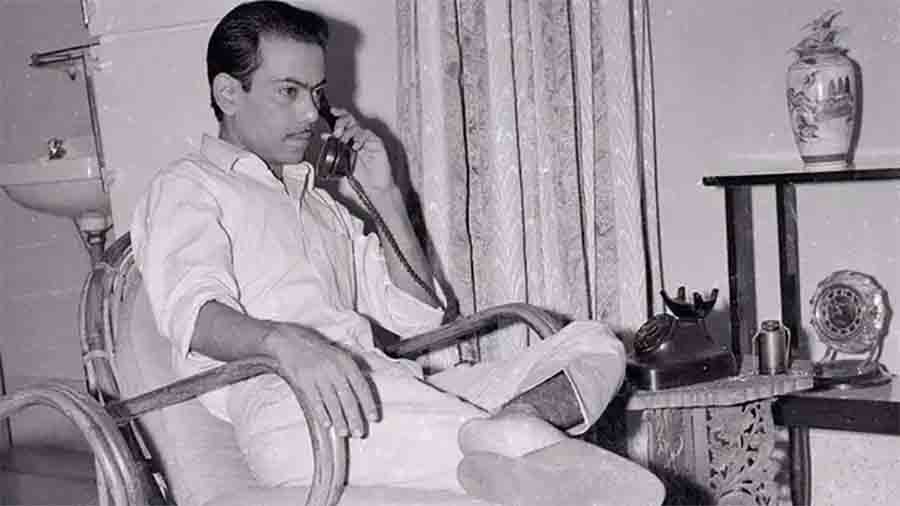
Mohammad Zahirullah Khan, popularly known as Zahir Raihan, was born on August 19, 1935 in Feni. He was a renowned filmmaker, writer and active freedom fighter. During the Bangladesh Liberation War, his documentaries like ‘Stop Genocide’ and ‘A State is Born’ portrayed the horrific images of the genocide in Bangladesh worldwide, which played an important role in shaping international public opinion. In addition, he was an active participant in the language movement and wrote remarkable novels and short stories based on this historical context.
He suddenly disappeared on 30 January 1972, just a month and a half after independence. His disappearance has long been considered one of the unsolved mysteries in the history of Bangladesh. Initially, he was considered ‘missing’ and newspapers began to publish reports searching for him. However, later evidence revealed that he was actually shot dead. Various theories and rumors have been spread about his disappearance at different times, which still generate controversy and complicate the discovery of the true truth of this incident.
ahir Raihan’s disappearance was long viewed as simply ‘missing’, this perception changed fundamentally after the discovery of a massacre site in Mirpur in 1999 and eyewitness accounts. This was not just a change of information, but rather indicated a deeper shift in the nature of the incident and the uncovering of the truth behind it. The word ‘missing’ carries an uncertainty, a faint glimmer of hope, which often leads to a lack of investigation and political debate. But when eyewitnesses like Naik Amir Hossain reported seeing Zahir Raihan shot dead and the massacre site was discovered, the word ‘killed’ indicated the finality of the event. This change helped to reach a firm conclusion about what happened to Zahir Raihan, although debate remains over who the killers were. This new information opens up new avenues for historical research and challenges previous assumptions.
The context of the disappearance: War-torn Bangladesh and the Mirpur campaign
January 1972 was a turbulent time for the newly independent Bangladesh. Although Bangladesh gained independence on 16 December 1971, the law and order situation in the war-torn country was extremely fragile. The then government formed the National Guard on 7 March 1972 to prevent smuggling, armed robbery and various crimes. During this period, a leftist rebellion was going on in Bangladesh from 1972 to 1975, which is considered one of the reasons for the fall of Sheikh Mujibur Rahman’s government. Various political assassinations also took place in this turbulent environment.
The Mirpur area was highly sensitive at the time of Zahir Raihan’s disappearance. Mirpur was under siege until 30 January 1972, when the defeated Pakistani forces and non-Bengali Razakars established impregnable bases there. Mirpur is considered the last battlefield of the Liberation War, which was liberated on 31 January 1972. On 30 January, the day Zahir Raihan disappeared, intense gunfire broke out between the Bihari and Bangladeshi armed forces stationed in Mohammadpur and Mirpur.
In this turbulent situation, Zahir Raihan embarked on an important task. After independence, upon returning to Dhaka, he formed the ‘Intellectual Murder Investigation Committee’ to investigate the information on the killings and genocide of intellectuals and to catch the murderers. The investigation of this committee revealed the identities of the people who ordered and implemented the genocide and the local Al-Badr and Razakars involved in it, as well as numerous secret information and documents. Zahir Raihan publicly announced at a press conference, “We have a lot of information and evidence that if published will unmask many people. I will publish everything one by one, knowing the time.”
The work of Zahir Raihan’s Intellectual Murder Investigation Committee and the sensitive information he had access to could be considered a possible root cause of his disappearance. His disappearance occurred shortly after this investigation was initiated. This sequence suggests a strong causal relationship. If Zahir Raihan did indeed have information that could have exposed influential individuals, his disappearance may not have been a coincidence. Rather, it indicates a well-planned assassination or disappearance, the purpose of which was to prevent the disclosure of that information.
Jamaat-e-Islami leader Matiur Rahman Nizami also raised this issue and questioned why the investigation was closed and why Zahir Raihan was disappeared. These questions indicate that his death was not simply a result of the military conflict in Mirpur, but that there may be deeper political or vested interests behind it.
January 30, 1972: A tragic journey on the way to Mirpur
Eyewitness accounts of the death and the search for the killing site:
The main reason for Zahir Raihan to go to Mirpur was to search for his elder brother Shahidullah Kaiser. Zahir Raihan decided to go there after receiving news that Shahidullah Kaiser was being held captive in a place at No. 12 in Mirpur.
The catalyst for this journey was a telephone call from an unknown person named “Rafiq”. Five days after a press conference on 25 January 1972, on the morning of 30 January, a man named Rafiq called Zahir Raihan’s house in Kaittuli. Rafiq was a former acquaintance of Zahir, who worked at the USIS. Zahir was told over the phone that his elder brother was imprisoned at Mirpur 12 and only he could save him. Upon receiving this call, Zahir Raihan set off for Mirpur in two cars, accompanied by his younger brother Zakaria Habib. Zahir Raihan was advised to trace the phone call to the police station, but he angrily left the place and was never found again.
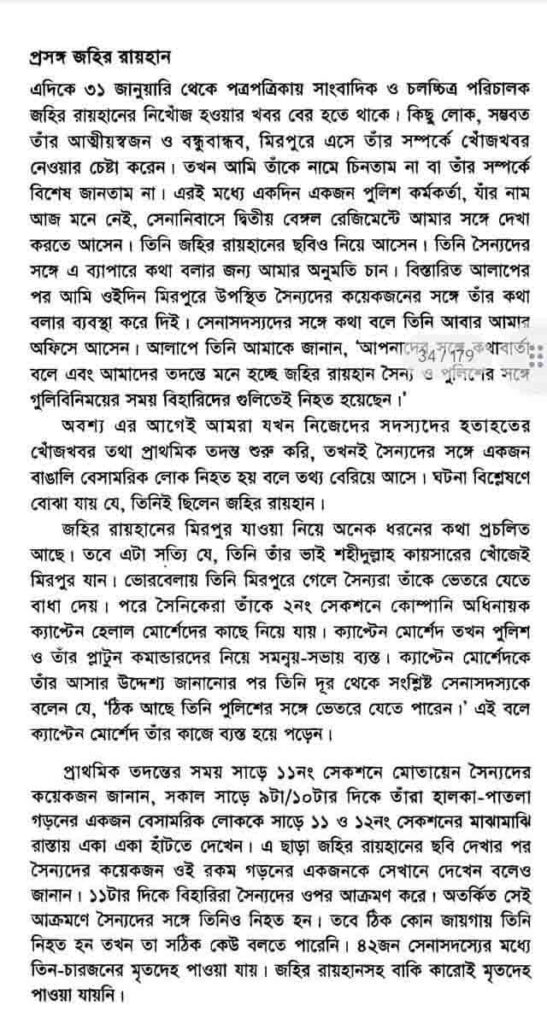
On 30 January 1972, the war was going on to liberate Mirpur from the Pakistani invaders. It was an unequal and unexpected battle, in which 42 soldiers were killed. That morning, 42 soldiers were killed in an unexpected attack by non-Bengalis. Captain Morshed and Naik Amir were among those injured. An eyewitness said that a journalist (Zahir Raihan) was dragged by 6-7 non-Bengalis by the arms, neck and waist to the west side of the water tank. In 1999, it was confirmed from the statement of Naik Amir Hossain that Zahir Raihan died in the Mirpur battle. He identified Zahir Raihan as a ‘journalist’ who had gone there under that identity.
Rafiq’s phone call was the main catalyst for Zahir Raihan’s trip to Mirpur. “Only you can save him if you go” – this sentence pressured Zahir Raihan to go to Mirpur personally. Mirpur was still a dangerous area controlled by pro-Pakistani Biharis. If Rafiq’s intention was simply to pass on information, he could have advised Zahir to take action through the police or some other safe means. Instead, he persuaded Zahir to go directly to the dangerous place. This indicates that Rafiq’s call could have been a well-planned trap, intended to drag Zahir Raihan into the conflict in Mirpur, where he was likely to die or disappear. Who was behind this trap is a deeper question that remains unresolved to this day.
A significant turning point in the mystery of Zahir Raihan’s disappearance came in 1999. In July of that year, human remains, bullet-riddled bones, and a skull were discovered during excavations for the construction of the Noori Mosque in Muslim Bazaar, Section 12, Mirpur. Experts confirmed that it was a massacre site from 1971. The discovery of this massacre brought the events of January 30 to the fore and added a new dimension to the search for what happened to Zahir Raihan.
Zahir Raihan’s son Anol Raihan wrote an investigative report ‘In Search of the Restless Father’ to unravel the mystery of his father’s disappearance. In it, he says, ‘The Indian and Bangladeshi army officers present there were very annoyed to see the civilians. Civilians were not allowed to enter the area. Everyone was asked to leave. Finally, Zahir Raihan was allowed to stay alone. Everyone else, including Shahriar Kabir, returned. Zahir Raihan’s car was left behind. The car was mysteriously found in front of Ramna Park a day later.
Zahir Raihan was the only civilian in the army operation in Mirpur. Several people were able to identify Zahir Raihan. One of them was Mokhlesur Rahman, the then commander of the army’s 12th platoon. He did not know Zahir Raihan until January 30.
After Zahir Raihan arrived, the commander of the operation, Colonel Mainul Hossain Chowdhury, introduced Zahir Raihan to Mokhlesur Rahman in front of water tank number 12. Colonel Mainul had said that two soldiers would be with Zahir Raihan at that time. Mokhlesur Rahman then asked Sepoy Akram and Sepoy Amir Hossain to stay with him. Mokhlesur Rahman then took his forces and left for the eastern beel.
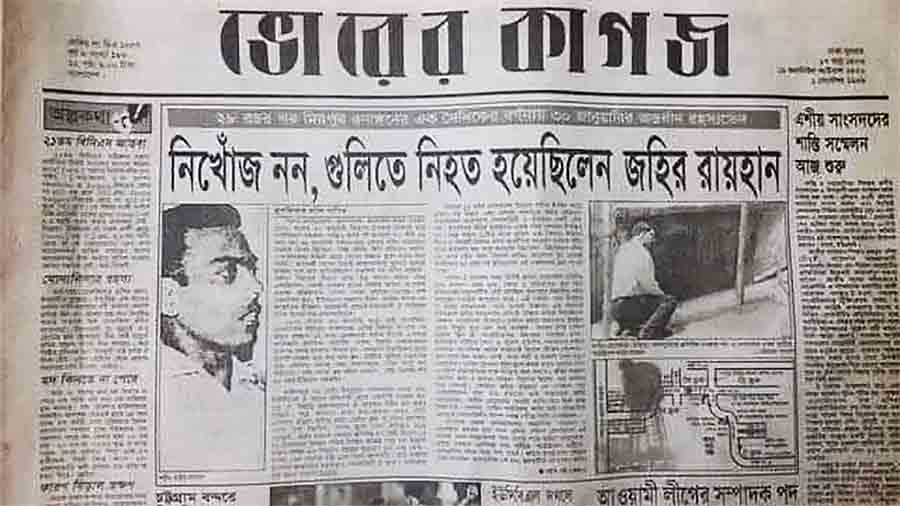
Twenty-eight years after the war, in 1999, Nayek Amir Hossain, who was wounded that day, was found in Brahmanbaria. He had seen Zahir Raihan with his own eyes, wounded in a bullet wound, and the description of the clothes that Zahir Raihan had worn matched Amir Hossain’s description. On 1 September 1999, the daily Bhorer Kagoj published a report titled ‘Zahir Raihan was not missing, but killed in a gunshot’, which was based on Amir Hossain’s statement.
There, Zulfikar Ali Manik wrote, ‘Zahir Raihan did not know this soldier (Amir Hossain) by name. However, a senior officer (Moklesur Rahman) showed him Zahir Raihan at the scene and introduced him as a journalist. That day, his position was some distance from Zahir Raihan’s position. They were instructed to guard the journalist and others. Outside the uniformed army and police members, journalist Zahir Raihan was the only one in plain clothes. Amir Hossain first saw him at the scene talking to the army and police officers…’
Amir Hossain said about his memories of that day, “I first saw the journalist at around 9:30 in the morning. He was standing in an empty space next to the water tank and talking to two police officers. There were about a hundred policemen next to them. At around 11:00, I heard the sound of a few crazy bells ringing. Immediately after that, I heard gunshots from the south. Immediately, I looked to my left and saw many policemen lying on the ground. I took a position behind a pile of bricks there. Looking up, I saw that the journalist’s body was lying next to the wall of the water tank, near where the police were standing and talking. He was lying on the ground, kneeling on the wall. I saw blood stains all over a large part of the journalist’s shirt. Before that, gunfire had also started raining down from the north.”
Amir Hossain had no idea that there would be a shooting. The Biharis were led by Mirpur’s butcher Akhtar Goonda. The Biharis opened fire through gaps in the nearby tin huts.
Seeing the rain of bullets and everyone falling to the ground, Amir Hossain realized that the situation was dire. So he took cover and aimed the LMG in his hand. After the policemen dispersed in the firing, after the firing suddenly stopped, more than a hundred Biharis started running from the south with various indigenous weapons. They were cursing in Urdu and shouting that no one would be spared. The policemen who were lying on the ground injured started beating them with their sharp weapons. At this time, 6/7 Biharis grabbed the journalist by the neck and waist and dragged him to the west of the water tank. Amir Hossain somehow managed to escape from there that day.
Helal Morshed, who participated in the Mirpur battlefield, was also almost certain that Zahir Raihan had died in the Mirpur battle. He had told this to Zahir Raihan’s wife Suchanda. General Mainul Hossain Chowdhury also mentioned that their initial investigation revealed that a Bengali civilian had been killed along with the soldiers and that the analysis of the incident indicated that it was Zahir Raihan.
Mirpur Additional SP Ziaul Haque Lodi went missing on the same day as Zahir Raihan.
Platoon No. 12 commander Mokhlesur Rahman said in his memoirs, “At around 9:30 in the morning, the Biharis rang the crazy bell and started firing simultaneously. Upon hearing the news of the Biharis’ attack, he quickly came in front of the Kalapani tank No. 12 with a team. Then he saw the bloody body of Zahir Raihan in front of the water tank. It was on the front wall. On the opposite side of the wall were the bodies of Mirpur’s Additional SP Ziaul Haque Khan Lodi, more than a hundred police and army officers and soldiers. Then they saw that the situation had gone out of control. The Biharis saw them and started firing again.
After that, Zahir Raihan’s body was never found. Since Amir Hossain said that the Biharis dragged him to the west of the water tank, many believe that Zahir Raihan’s body was thrown into the well adjacent to the Nuri Mosque in Mirpur Section 12. This abandoned well was found after a long 28 years in July 1999. That was the incident of July 27.
The mosque expansion work was going on in the vacant lot adjacent to the Noori Mosque in Section 12. While constructing a new pillar, the construction workers discovered an abandoned well underground. The mouth of the well was covered with a concrete slab. When the construction workers removed part of the slab, they found three skulls and several bones from the well’s mouth. The next day, another skull and some bones were found during excavation. The mosque committee tried to keep the matter secret, but it spread. An organization called the Ekattorer Smriti Parishad collected the skulls and bones from there and gave them to the Liberation War Museum. Three days later, on July 31, the Liberation War Museum officially started excavation work in the abandoned well. The army was deployed on August 12. During the excavation from July 31 to September 8, an unknown massacre site, the Muslim Bazaar Massacre, was discovered 28 years after independence. 5 skulls and more than 600 bones were found in this well. But there is no trace of this massacre site. A black tiled pillar standing between white tiled pillars inside the mosque indicates its existence. The abandoned well was located in the same place as the pillar in the southwest corner of the mosque.
It is proven that the Biharis shot and killed Zahir Raihan and hid his body. It is true that Zahir Raihan was brutally murdered by the Biharis. Yet, various conspiracy theories are being created day after day. People are being misled.
The discovery of the massacre and the eyewitness accounts changed the conventional view of Zahir Raihan as ‘missing’ to ‘murdered’. The disappearance of Zahir Raihan, which had been a national mystery for nearly 28 years, took a new turn with this discovery in 1999. The evidence obtained at this late stage not only provides a definitive idea of the circumstances of his death, but also highlights the limitations of uncovering the truth in the political and social conditions of the time. If this evidence had been found earlier or actively sought, the mystery might not have lasted so long.
Various conspiracy theories behind the murder:
There are various theories about the reasons behind Zahir Raihan’s murder and the parties involved, which are part of the political and social debate in Bangladesh.
A. Murder by Biharis/Rajakars: According to this theory, Zahir Raihan was killed in an ambush by non-Bengali/Pakistani pro-Biharis and Razakars during the Mirpur operation. Mirpur was still in the hands of pro-Pakistani Biharis. On 30 January 1972, 42 army personnel including Zahir Raihan were killed in an ambush by non-Bengali during the Mirpur liberation operation. An eyewitness has stated that a journalist (Zahir Raihan) was dragged by 6-7 non-Bengali men by the arms, neck and waist to the west side of the water tank. The supporters of this theory are certain that Razakar Al Badr killed Zahir Raihan. They feared that if Zahir Raihan was alive, he would prepare important documents about the killing of intellectuals.
B. The aftermath of the investigation into the killing of intellectuals: Zahir Raihan formed the committee to investigate the killing of intellectuals and was the chairman of that committee. This committee revealed the identities of the local Al-Badr and Razakars who ordered, implemented and were involved in the genocide and the killing of intellectuals, as well as numerous secret information and documents. The main point of this theory is that the Razakars killed him for fear of revealing the sensitive information he had.
C. Other unconventional or controversial theories: According to some theories, some members of the Pakistani occupation forces secretly captured him, killed him and disappeared him. Some cite Zahir Raihan’s desire to make a documentary about the looting of the Indian forces or the “evil deeds” of Tajuddin as the reason for his murder.
However, these theories are not well supported by mainstream research or eyewitness accounts and are often considered politically motivated. The presence of multiple theories as to the cause of Zahir Raihan’s murder does not simply indicate the lack of a single cause, but rather indicates a complex, multi-layered murder in which different parties may have been involved or had their interests protected. Some of these theories support each other (e.g., the killing by Biharis/Razakars and the result of the investigation into the killing of intellectuals – as the Razakars were involved in the killing of intellectuals).
Zahir Raihan was shot dead in an ambush by Bihari/Rajakars during the Mirpur Liberation Campaign on 30 January 1972. His death was probably due to his having fallen into the trap of an unknown caller named “Rafiq” who had gone to Mirpur in search of his elder brother Shahidullah Kaiser, which was a well-planned trap.

https://stapravda.ru/20221228/reyting_samyh_populyarnyh_hostingov_v_rossii_196445.html, рейтинг хостингов России подтверждает, что выбор надежного провайдера важен для бизнеса.