
History Desk
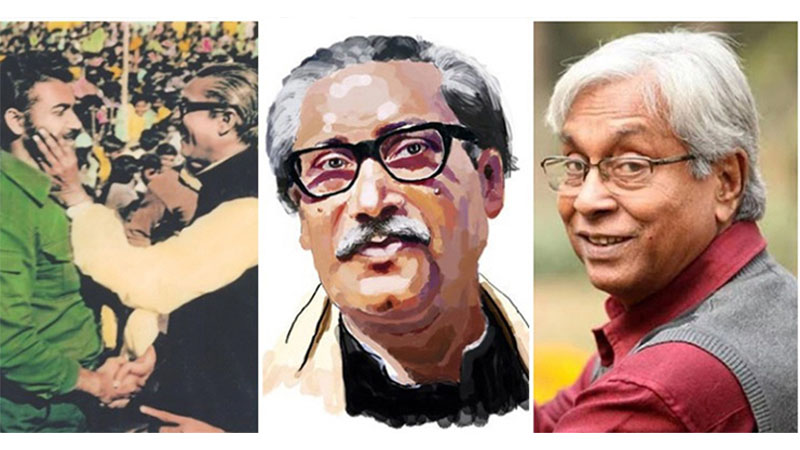
While the world knows Bangabandhu Sheikh Mujibur Rahman as a politician, his identity as an actor remains largely hidden from public view. In 1973, filmmaker Chashi Nazrul Islam was planning to make a film based on the Liberation War, titled *Sangram*, starring actor Khosru.
In the newly independent country, the film would depict the Liberation War, showing the military saluting Bangabandhu Sheikh Mujib, the hero of Bangladesh’s independence struggle. However, Chashi Nazrul Islam was uncomfortable with the idea of someone else portraying Bangabandhu.
Pondering how to capture this scene, the director and actor Khosru decided to take a bold step. Khosru, a freedom fighter and former activist of the Chhatra League, approached Bangabandhu with the proposal to act in the film. Initially reluctant, Bangabandhu eventually agreed after Khosru sought the intervention of then Home Minister Abdul Mannan.
In Chashi Nazrul Islam’s direction, *Sangram*, starring Suchanda, Khosru, and Bangabandhu, was released in 1974.
Chashi Nazrul Islam once described his conversation with Bangabandhu in an interview:
**Khosru:** “I’ve come to ask for your help with something.”
**Bangabandhu:** “What is it?”
**Khosru:** “We’re filming a scene of an army march-past. You will receive the salute.”
**Bangabandhu:** “No, I won’t act in films.” (in a stern tone)
**Khosru:** “This isn’t acting.”
**Bangabandhu:** “What do you mean it’s not acting? Get out of here.” (again sternly)
**Khosru:** “You have to do it. We can’t finish the film without you.”
**Bangabandhu:** “Call Mannan.” (referring to Home Minister Abdul Mannan)
After briefing Home Minister Abdul Mannan, Khosru and Chashi Nazrul Islam brought him to Bangabandhu.
**Khosru:** “Bangabandhu has to act.”
**Abdul Mannan:** “Bangabandhu acting? Is that even possible?”
**Khosru:** “If it’s not possible, I’ll make you act instead. Just tell him acting is okay.”
With the Home Minister’s assurance, Bangabandhu finally agreed, saying, “Alright, I’ll do it.”

The shooting took place at Pilkhana under the supervision of the army. Rehearsals continued for several days, as the shot had to be perfect in one take.
On the day of the shoot, Bangabandhu stood on the stage. Behind him were top army officials, including Ziaur Rahman, KM Shafiullah, and Khaled Mosharraf. In front, a well-decorated army unit paraded and saluted. Following the director’s instructions, Bangabandhu stood with his hand on his forehead, receiving the salute. After a while, he grew impatient and said:
**Bangabandhu:** “How long do I have to keep my hand like this?”
**Chashi Nazrul:** “Just a little longer.”
**Bangabandhu:** “Come on, hurry up!”
This is how the greatest Bengali of all time became part of a film. *Sangram* was released in 1974.
Bangabandhu Sheikh Mujibur Rahman had a deep connection with art and culture. The institutional journey of Bangladeshi cinema began under his leadership. On April 3, 1957, during the final session of the Provincial Assembly, Bangabandhu presented the bill for the East Pakistan Film Development Corporation. After some amendments, the bill was passed unanimously.
To commemorate this event, April 3 is celebrated as National Film Day in Bangladesh every year since 2012.
Initially known as the East Pakistan Film Development Corporation, it later became the Bangladesh Film Development Corporation (FDC).

https://stapravda.ru/20221228/reyting_samyh_populyarnyh_hostingov_v_rossii_196445.html, рейтинг хостингов России подтверждает, что выбор надежного провайдера важен для бизнеса.