
Jamil Akhter
Electricity and Energy Expert
Minister of Power, Energy and Mineral Resources Iqbal Hassan Mahmud Tuku claimed in Parliament that “no gas well has been drilled in the country in the last 17 years,” which is a “blatant untruth.”
The minister has actually repeated this statement on several occasions and in Parliament. For example, in response to a supplementary question from Brahmanbaria-2 MP Rumin Farhana during the budget session of the National Parliament on June 7, the minister said that no well has been dug in the last 17 years and that his government was the first to start drilling.
Even after this response, as the previous promise of gas supply to the Ashuganj Fertilizer Factory (from May 1) was not implemented, Speaker Hafiz Uddin Ahmed reminded the minister that he had spoken in Parliament about gas supply from the 1st, which was not implemented, and advised him to thoroughly examine the matter before making any future promises.
In a separate event, the minister said that for the past 17 years, a ‘fascist’ government was in power in the country, which neglected domestic resources and arranged for energy imports from abroad.
In other words, the minister’s statement is not a sudden, off-the-cuff remark, but rather a consistent political position—one he has repeated multiple times. It is “conscious distortion of information.”
Let’s discuss in detail the overall situation of gas in Bangladesh over the past two decades:
1. BNP government ( 2001 – 2006 )
In 2001, daily gas production in Bangladesh was around 1,000 million cubic feet (MMCFD). By 2006, it had increased to around 1,400-1,500 MMCFD per day. At that time, daily demand was higher than production, but the deficit was relatively small (around a few hundred million cubic feet).
BNP government’s activities in gas exploration and supply
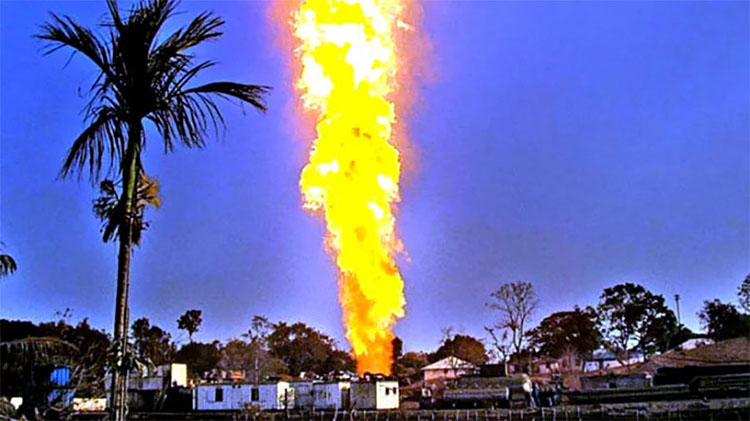
During this period, a joint venture agreement (2003) and a gas purchase and sale agreement (2006) were signed with Niko Resources for the Chatak (Tengratila) and Feni gas fields. However, in 2005, two major explosions at Tengratila resulted in a huge gas leak and allegations of corruption. No new major gas field discoveries or significant progress in extensive exploration were made.
As a result, the growth of domestic gas production was limited and the basis for import dependence was created. The decisions at this time were later controversial due to allegations of corruption and losses.
Iqbal Hasan Mahmud Tuku was the State Minister for Power, Energy and Mineral Resources during the BNP-led government from 2001 to 2006. During this time, a joint venture agreement (2003) and a gas purchase and sale agreement (2006) were signed with Canadian company Niko Resources. Niko was given the responsibility of developing the Chatak (Tengratila) and Feni gas fields. In 2005, two major explosions in Tengratila caused a huge gas leak and environmental damage. The loss to Bangladesh is estimated to be more than one billion dollars.
Niko was accused of bribery (the company pleaded guilty in a Canadian court and paid a fine) and the Bangladeshi courts declared the contracts illegal as obtained through corruption. Corruption allegations were raised at the International Court of Arbitration (ICSID). The decisions at this time marked a controversial chapter in corruption and damage in the energy sector.

Minister of Power, Energy and Mineral Resources Iqbal Hassan Mahmud Tuku
2. Awami League Government ( 2009 – 2024 )
The country’s daily gas demand has been steadily increasing during the Awami League government’s rule. In 2009, the demand was around 2,000-2,500 MMCFD. But due to economic growth, power generation, industrialization, and population growth, the demand has gradually increased and reached a peak of 3,800-4,000 MMCFD (about 4 billion cubic feet) by 2024.
Towards the end (2023-2024), demand remained stable at around 3,800+ MMCFD, with supply coming close to demand, with domestic production and LNG imports combined, but a gas supply deficit remaining.
When the Awami League government took office in 2009, domestic gas production was only 1,744 MMCFD. Over the next 15 years, production increased through a combination of domestic exploration, well drilling, and imports. In the pre-COVID period, it reached about 2,750 MMCFD.
The total supply capacity increased to 3,500+ MMCFD after the addition of two floating LNG terminals (FSRUs) in 2018. During this time, 155 wells were drilled, six new gas fields were discovered, extensive seismic surveys and offshore exploration were conducted.
3. Specific plans to address future deficits
150 wells drilled/workover, third FSRU at Maheshkhali (600 MMCFD, signed with Summit Group on March 30, 2024), fourth FSRU at Payra, land-based LNG terminal and international joint ventures to add an additional 985 MMCFD by 2026-28.
By August 2024, 50 wells were under construction, with significant gas additions expected in 2025-28. These planned initiatives were a significant step towards self-reliance in the energy sector.
Third floating LNG terminal
The contract for the third FSRU (Floating LNG Terminal) project in Maheshkhali was signed with Summit Group on March 30, 2024.
It was planned as Bangladesh’s third and Summit’s second FSRU project, with a capacity of 600 million standard cubic feet per day and a 15-year operation period.
After the agreement, Summit Group made some progress in implementing the project, such as investing about $15-20 million (long lead items, studies, etc.). However, after the interim government took power after August 5, Petrobangla canceled the agreement in October 2024 (later officially in January 2025).
The government’s failure to meet the terms of the agreement (such as the performance bond) and the repeal of the 2010 special law were cited as reasons, although the Summit Group called it unfair and requested a review and took legal action. This incident has had a significant impact on the country’s LNG capacity expansion process.
The project was scheduled to be operational by 2026. As per the agreement (30th March 2024), this second FSRU of Summit Group (Bangladesh’s third) was planned to be commissioned in the first half or mid-2026.
According to the relevant LNG Supply Agreement (SPA), annual supplies of 1.5 million tons of LNG were scheduled to begin from October 2026.
Tengratila gas field explosion
Long-term LNG import agreement from Qatar
The long-term LNG import agreement with Qatar during the Awami League government was an important step in the energy sector.
In September 2017, a 15-year agreement was signed with Petrobangla and Qatar Energy (then RasGas) to import 1.8-2.5 million tons of LNG annually. Then, in June 2023, another 15-year agreement was signed, under which an additional 1.8 million tons of LNG was to be supplied starting from 2026.
These agreements strengthened Bangladesh’s LNG supply security and helped manage import dependence, despite declining domestic gas production.
These long-term contracts were part of the Awami League government’s plan for energy diversification and supply stability.
4. Yunus ‘s interim government ( August 2024 to February 2026 )
After the change of power in August 2024, many ongoing and planned projects of the Awami League government were canceled or stalled during the interim government’s tenure.
The contract for the third FSRU in Maheshkhali (which was scheduled to be operational by 2026 and in which Summit Group had already made some investments) was cancelled in October 2024.
Similarly, progress on other FSRU, well drilling and infrastructure projects was hampered, resulting in the loss of the potential for additional 1,000+ MMCFD of gas addition.
5. BNP government tenure (from 2026)
The Iran War exacerbated the gas crisis after the BNP government took power in February 2026. The policy of importing LNG at high prices instead of domestic exploration to address the gas crisis has become a significant topic of discussion in Bangladesh’s energy sector.
At the highest levels of the BNP government, initiatives were taken to purchase LNG from the United States and sign 13-year contracts with 13 American companies (including Gabnor/Ganbar) at a price of about $22 per unit.
Without due emphasis on drilling and exploring new wells in domestic gas fields, excessive dependence on high-priced imports has been created, which has led to increased energy costs and foreign exchange pressure in the long run.
However, all of the new wells from which initiatives have been taken to extract gas are wells that were surveyed, investigated, and prepared during the previous Awami League government.
For example, BAPEX is conducting the drilling of the ‘Sundarpur-4’ gas well, which has officially begun in Senbagh Upazila of Noakhali. The well is expected to produce 5 to 7 million cubic feet of gas per day.
The current government is getting gas extraction facilities from the wells that were under construction (i.e. 50 wells by August 2024) in addition to the 155 wells drilled during the Awami League era. These wells were expected to add an additional 985 MMCFD of gas in 2025-28, which is a continuation of the previously planned initiatives.
This contrast further highlights the lack of long-term planning in the energy sector and the risks of import dependence.
6. Latest situation
Currently, daily supply has come down to around 2,100-2,200 MMCFD, where demand is much higher. The shutdown of an FSRU in Maheshkhali has led to severe shortages in the industrial, power and residential sectors. Although some new initiatives (such as G2G FSRU with China) have been taken, they are still in the initial stage and will take time to implement.
These decisions disrupted the continuity of previous plans and made the crisis long-term. Half of the country’s industrial areas have been practically closed due to the gas crisis. Fertilizer factories have been unable to operate at full capacity for more than two years due to the lack of gas.
In addition, there has been a sharp demand for gas for households and CNG-powered vehicles across the country.
7. Qatar started exporting LNG after the war
Qatar’s LNG production and exports were temporarily disrupted due to tensions in the Middle East, triggered by the Iran-Israel war. However, Qatar has now resumed full production and exports, and supplies to the international market have returned to normal.
However, despite the opportunity to import LNG from Qatar at a relatively low price under a long-term agreement signed during the Awami League government in Bangladesh, the current government is going a long way and purchasing LNG from the United States at a much higher price.
This decision risks increasing fuel costs and wasting foreign exchange, which is adding to the pressure on the country to deal with the gas crisis.
8. New agreement with China on third terminal in Maheshkhali
The third FSRU project at Kutubjom in Maheshkhali (Cox’s Bazar) is progressing on a G2G (Government-to-Government) basis with China. The Cabinet Committee on Economic Affairs (CCEA) gave in-principle approval on 28 July 2026 based on the proposal of China National Energy Engineering and Construction Company Limited (CNEE).
It is under process under the Public Procurement Act. Current status and schedule: Final contract has not been signed yet. It is at the initial approval stage.
Once negotiations, detailed agreements, feasibility studies, and other processes are completed, work will likely begin in the latter half of 2026 or early 2027. It is not possible for gas from this floating terminal to be connected to the national grid before 2028.
9. The future is more challenging
Energy infrastructure projects usually take several years to implement. The projects that were ongoing or planned during the Awami League government have been stopped or delayed, which has lost the potential to add an additional 1,000+ MMCFD of gas. As a result, the crisis is not only present, but also risks continuing for several years to come.
Although some new initiatives (such as the G2G FSRU with China) were taken during the BNP government, they are still in the initial stages and implementation will be delayed.
In this context, the statement made in Parliament by State Minister for Power, Energy and Mineral Resources Iqbal Hassan Mahmud Tuku — “No gas wells have been drilled in the last 17 years” — is a clear example of distortion of information.
In fact, there are hundreds of wells drilled and new fields discovered in government records. Tuku himself was a state minister in the same ministry from 2001-2006 and was associated with the period of the NICO agreement (where corruption allegations surfaced and Bangladesh suffered huge losses). Now he has been criticized for trying to evade responsibility by denying the achievements of the previous government.
Finally
Despite the planned projects and infrastructure development of the Awami League government, the current gas crisis has intensified as they were canceled or hindered during the interim government’s tenure. The impact of the decisions in the energy sector is long-term. If planned development is not based on accurate information, the crisis may deepen in the future. This is not only a problem for the present, but also a big challenge for the next generation.

https://stapravda.ru/20221228/reyting_samyh_populyarnyh_hostingov_v_rossii_196445.html, рейтинг хостингов России подтверждает, что выбор надежного провайдера важен для бизнеса.