
By Raudra Rudra, Political and Security Analyst
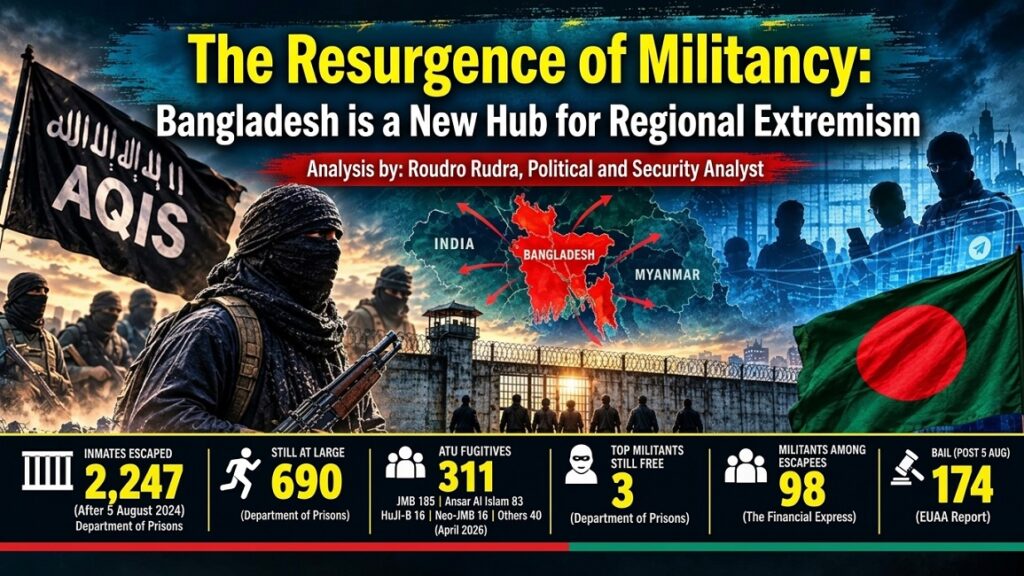
After the political collapse of 5 August 2024, thousands of prisoners broke out of jails, Al-Qaeda in the Indian Subcontinent (AQIS) resurfaced, and extremist forces were politically rehabilitated. As a result, the security of Bangladesh and South Asia now faces deep concern.
Extremist networks that had been cornered by nearly two decades of operations are organising again. The release of extremist detainees, a rush of bail grants, and sleeper-cell activity that ignores international warnings pose a major challenge to national and regional security.
The Statistical Picture at the Centre of the Concern
The figures for the period after 5 August 2024 show clearly how militancy is raising its head.
- Mass escape: A total of 2,247 prisoners escaped by breaking out of jails (Source: Department of Prisons).
- Fugitive prisoners: 690 are still beyond reach (Source: Department of Prisons).
Updated information from the ATU (Anti-Terrorism Unit):
As of April 2026, at least 311 members of banned militant organisations are on the run. Of these, 185 are from JMB, 83 from Ansar al-Islam, 16 from HuJI-B, 16 from Neo-JMB, 9 from Allahar Dal, 1 from Jamatul Ansar Fil Hindal Sharqiya and 1 from Imam Mahmud’s Kafela. A further 59 members of Hizb ut-Tahrir are also on the run (Prothom Alo, 1 July 2026; SATP, 2 July 2026).
- Top militants still at large: Although some of the escapees have been recaptured, 3 accused in top militancy cases are still on the run (Source: Department of Prisons).
- Militants’ escape: According to prison authorities, about 98 of the escapees were militants (The Financial Express).
- Bail: In the months after 5 August, a significant number of top terrorists and militants walked out of jail on bail (The Financial Express).
- International warning: According to an EUAA report, in the months following 5 August 2024, 174 militancy-linked detainees were granted bail and rejoined extremist activities.
Extreme Risk to National Security: Militant Resurgence and the Spread of Sleeper Cells
Taking advantage of the escape of 2,247 prisoners and the 690 who remain at large, organisations such as JMB, Neo-JMB, Ansar al-Islam and HuJI-B are becoming active again.
These domestic groups are reorganising themselves through links with the international network AQIS. Fugitive militants and accused persons released on bail have activated sleeper cells across the country, and they are inspiring young people toward extremism through encrypted apps and cyber propaganda.
It is important to look at three separate layers of this risk. First, because experienced and trained members have not been caught, the organisations are able to retain leadership and tactical skill. Second, without effective surveillance of those released on bail, they can easily restore old contacts. Third, recruiting young people through online propaganda is easy, but identifying them is difficult.
If these three work together, a reorganised network can stand up quickly. This puts the security of the whole of South Asia at risk.
Shadow of the Past: The Blood-Soaked Haven of Extremism (2001–2006)
Notable attacks during the BNP-Jamaat alliance government of 2001 to 2006:
- 21 August 2004: Grenade attack on an Awami League rally at Bangabandhu Avenue, killing at least 24 and injuring about 300.
- 27 January 2005: Five people, including former finance minister Kibria, were killed in Habiganj.
- 17 August 2005: JMB set off 459 bomb blasts simultaneously across 63 districts.
- 14 November 2005: Two judges were murdered in Jhalokati.
- 29 November 2005: Suicide attack at a court premises.
- 8 December 2005: A suicide attack in front of the Udichi office in Netrokona killed 6 people.
According to Human Rights Watch (HRW), religious extremist attacks in this period killed 181 people and injured more than 1,170. This history shows that in an environment of political tolerance or laxity, militancy spreads quickly and gains the capacity to carry out attacks across the country at the same time.
Success of the “Zero Tolerance” Policy against Militancy in the Past
During the previous Awami League government, Prime Minister Sheikh Hasina declared a “zero tolerance” policy against militancy. Through coordinated action by law enforcement agencies and specialised units, the organisational capacity of domestic and international militant networks was almost broken.
During this time, the territory of Bangladesh was not used as a transit route for transnational terrorism. As a result, the risk of border terrorism in South Asia, including India, was reduced considerably. This experience proves that sustained political will and coordination among agencies are the most effective tools against militancy.
Long Disappearance of AQIS’s Second-in-Command: Leadership Reorganisation and Open Threats
Maulana Ikramul Haque, alias Abu Talha, the second-in-command of AQIS, faces at least 10 cases in India and is “most wanted” there (CTTC information; The Economic Times).
After he came out on bail following 5 August 2024, his exact whereabouts have not been confirmed to date. There are serious allegations against him of using multiple aliases and obtaining passports under different identities.
The prolonged evasion of such a top militant leader is a warning signal for South Asia’s counterterrorism system. The allegations of using false identities and passports further show that weaknesses in border and identity-verification systems may give this network the opportunity to move across borders.
AQIS, Cross-Border Threats and Geopolitical Change: International Concern over Regional Security
Reports by the UN Security Council monitoring team and the European Union have repeatedly warned about the resurgence of AQIS and its attempts to create safe havens.
After 5 August, geopolitical equations changed and regional security became more complicated. With Bangladesh turning into a transit corridor for extremists, sleeper-cell activity has increased along the border, including in India’s West Bengal and north-eastern states.
On 31 March 2025, in an operation by the Delhi Police Special Cell and central agencies, 8 members of a Lashkar-e-Taiba module were arrested, 7 of whom were Bangladeshi nationals (NDTV and The Times of India).
The module’s mastermind, Shabbir Ahmed Lone of Kashmir, had been hiding in Bangladesh for a long time and was running the cell from a hideout near Dhaka.
The international community has also expressed diplomatic concern over reports of militant financing through hundi or anonymous channels. This informal flow of money is difficult to track, so it is one of the main foundations for keeping the network alive.
Continued Extremist Activity and the Spread of Sabotage in 2025–26
Notable incidents at various places in the country:
- 26 December 2025: Madrasa explosion in Keraniganj.
- 1 February 2026: Weapons and grenades recovered in Jashore.
- 21 February: Attack on a police checkpoint at Kutubkhali, Jatrabari.
- 7 March: Bomb attack on a temple in Cumilla.
- 12 March: A member of a minority community was killed in Feni.
- 25 March: Pipe bomb explosion at Janapad Mor, Jatrabari.
- 22 June: Bomb attack targeting intelligence officers in Dakshinkhan.
- 24 July: Bomb recovered under Motijheel Metro Rail station.
- 30 July: Pressure cooker bomb recovered in Ashulia.
(Source: Prothom Alo)
The targets of these incidents are police, intelligence officers, religious minorities and public transport. In other words, the tendency to strike at state authority, at division within communities, and at the safety of ordinary people, all three, is clear.
The BNP Government’s Appeasement Policy and the Alarming Resurgence of Extremism
After 5 August 2024, extremists were rehabilitated under the very watch of intelligence agencies and law enforcement. In this context, several questions have come before security analysts and the people of the country:
▫️ Why has there been no visible large-scale operation to catch the militants and terrorists who escaped from jails?
▫️ Why are the state’s lawyers and the Home Ministry silent while the accused in militancy cases get bail one after another?
▫️ Why did digital tracking and physical surveillance of extremists released on bail collapse?
▫️ What is the relationship between the political interests of the BNP-Jamaat circle and the rise in the activities of religious extremist groups, and the role of the administration in it?
Final Word: A Supreme Breakdown of National Security and the Inevitable Risk of Becoming a New Centre of Regional Extremism
The escape of 2,247 prisoners, the 690 who remain at large, the spread of sleeper cells, and the disappearance of an AQIS leader have exposed a deep security vacuum after 5 August 2024. Serious questions also remain about judicial oversight of the bail process and about the capacity of security agencies to detect re-activated organisational activity.
The indifference of the state machinery, together with the direct appeasement and patronage of the BNP-Jamaat clique, has brought the country to the edge of a great catastrophe through the rehabilitation of extremists. The government has no will to stop this spread. Instead, taking advantage of administrative silence, the roots of extremists are being planted at every level of society.
Because of Bangladesh’s borders with India and Myanmar and its geographical position, any lasting expansion of international militant networks will have a wider impact on the security of South Asia.
Before a great bloodshed happens, the country must turn back from this suicidal path. Otherwise, Bangladesh will completely lose its internal security and become a permanent centre of extremism. This will bring great catastrophe to the whole of South Asia, including India.

https://stapravda.ru/20221228/reyting_samyh_populyarnyh_hostingov_v_rossii_196445.html, рейтинг хостингов России подтверждает, что выбор надежного провайдера важен для бизнеса.