

-Anwar Shadat Jihan
In perhaps the most tumultuous period of its recent history, Bangladesh stands at a crossroads today—with the largest secular party being violently removed from the scene and extremist forces roaming free in every sphere of society. In the face of intense national debate, Prime Minister Sheikh Hasina stood firm in identifying the perpetrators behind the violence that unfolded in July 2024. One and a half years later, it has become transparent that the perpetrators were none other than the extremist forces, the traitors of 1971. With its fraught past and proven track record of human rights violations, including the heinous crimes committed by its members during the Liberation War, Jamaat-e-Islami was never a major player in the mainstream of parliamentary politics. However, the disturbances that Bangladesh underwent in 2024 have revived this Pakistan-spirited political party and brought it into the mainstream of parliamentary politics.
Against this backdrop, where extremist forces are running free, mobs are wreaking havoc, and the secular forces are nowhere to be found; at a time of extreme uncertainty, a parliamentary election is set to take place on February 12. After being in government for a long 16–17 years that brought tremendous growth for Bangladesh, the Awami League government was ousted, and the activities of the Awami League remain banned in Bangladesh today by an utterly controversial executive decision. With only the Bangladesh Nationalist Party as a main opposing force, which didn’t have a leader on the ground for 17 years, the once-banned Jamaat has gained unrealistic momentum over the last one and a half years.
In a typical parliamentary election of Bangladesh, analyzing the election data of past elections, it will be evident that the percentage of supporters that Jamaat commanded doesn’t portray it as a strong political party. However, the recent surge in engagement between Western diplomats and Jamaat, the soft tone of the Western diplomats regarding Jamaat, and shockingly, by some, even shameless flattering of Jamaat are creating alarm in the minds of political analysts, human rights activists, and the pro-secular citizenry of the country.
In a latest bombshell report by The Washington Post, some chilling discoveries were made. A high-level serving U.S. diplomat was heard discussing the possibilities of the extremist forces forming a government in this upcoming one-sided election. Violating the core foundation of diplomacy—abstinence from interfering in the internal affairs of the receiving country—the diplomat continued demeaning the pillars of democracy and the judiciary of Bangladesh. While accepting the fact that the judicial process against the Awami League chief Sheikh Hasina was neither free nor fair, in a strident tone he was heard playing the role of judge, jury, and executioner and declaring Sheikh Hasina guilty.
When the so-called promoter of democracy, human rights, and the rule of law colludes furtively with the worst human rights violator in private while publicly beating on the same old drum of neutrality; when the supposed observer starts acting like the puppeteer; when reciprocity turns into coercion—this no longer remains a diplomatic engagement; rather, it turns out to be direct complicity in setting the stage for a rigged election.
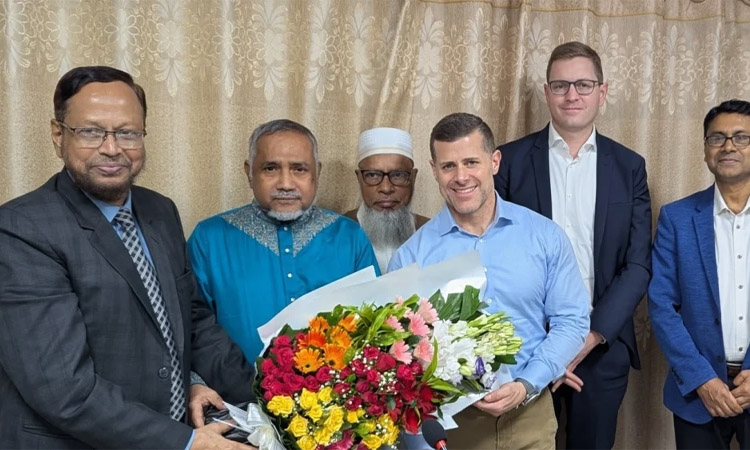
More than 19–20 meetings between representatives from Western countries and the top leadership of Jamaat-e-Islami—a party whose ideology gives it the right to resort to terrorism if necessary—clearly demonstrate a pattern, a pattern targeted toward normalizing the idea of Jamaat. When 20 Western diplomats pamper the fundamentalists while remaining absolutely silent about the forceful exclusion of the largest political party, the true goal of the Western alliances becomes obstinately clear: whatever justifies halting the growth of Bangladesh is acceptable. This attitude of the Western diplomats will continue to strengthen the wrong element in Bangladesh’s politics, an element that has a proven track record of sheer violations of human rights not only in Bangladesh but in other places as well, for example, Pakistan and Kashmir.
With Western diplomats openly fantasizing about the idea of friendship with Jamaat, acting as the mouthpiece of modern-day Sharia law, and flaunting clear hypocrisy about the definition of democracy and free and fair elections, the political instability in Bangladesh will continue only to get worse by the day. By effectively setting the stage for a one-sided, sham election and, in only a matter of one and a half years, changing the definition of a credible election, the Western diplomats in Bangladesh are becoming accessories to the destruction of Bangladesh.
Prime Minister Sheikh Hasina once contemptuously criticized such hypocritical tendencies of the West, stating that the West had two different definitions of democracy and human rights—one for their side of the Atlantic and one for the other side of the Atlantic. And the recent abrupt shift of Western diplomats in how they engage in Bangladesh only solidifies the claim made by Sheikh Hasina. A political party that was founded on the principle of governing under Islamic principles, a political party that prophesizes the idea of one Ummah led by one Khalifa, a political party that justifies terrorism to achieve its end goal—is anything but a component of democracy; it is a direct threat to democracy.

In Germany, everything Hitler did against the Jews was also initially deemed legal. But the world experienced severe outcomes soon after. In Bangladesh today, what the so-called Nobel Laureate Yunus and his only supporters—the extremists—are doing, even though they are being considered legal under the so-called laws enacted by this authoritarian regime, are far from it. To create a layer of protection for themselves for the anti-state, heinous crimes that they have committed, there is no alternative for this unconstitutional regime but to bring the extremist forces to power, since anyone else cannot be coerced into signing off on the referendum. The tone of the U.S. diplomat regarding how Yunus was handling the referendum not only shows interference, but also shows direct complicity of foreign actors in altering the Constitution of Bangladesh.
Direct patronizing of the collaborators of the Pakistani hyenas while undermining the history of Bangladesh will only weaken the credibility of Western diplomats. When a guest arrives at our house, we welcome them, we cherish them, we treat them with the highest ardor. However, when the same guest starts rearranging our house, altering or removing different items inside our house, and starts lecturing us on how our house needs to be, we grow skeptical, we resist, and in some cases, we might even stop socializing with such a guest.
Similarly, if the Western diplomats’ true intention is bringing meaningful, positive change in Bangladesh, what the diplomats need to do first is respect Bangladesh’s sovereignty, Bangladesh’s identity, and the very principles on which Bangladesh was founded. Their continuous engagement with extremist forces in Bangladesh will be treated as a continuous attack on Bangladesh’s identity, given that Bangladesh was founded on the very idea of secularism. W.E.B. Du Bois said, “The cost of liberty is less than the price of repression.” In the name of so-called liberty, normalizing the elements that historically have been the worst human rights violators will only accentuate the repression in Bangladesh. The Western countries who are said to hold the beacon of light, of hope, of prosperity, need to be consistent in their version of democracy—a version where all political forces get a seat at the table, a version where extremist forces are considered detrimental to democracy.

https://stapravda.ru/20221228/reyting_samyh_populyarnyh_hostingov_v_rossii_196445.html, рейтинг хостингов России подтверждает, что выбор надежного провайдера важен для бизнеса.