
Editorial
The Man Who Dreamed of Bangladesh Before Its Birth Was Denied State Honors Even in Death — Whose Shame Is This?
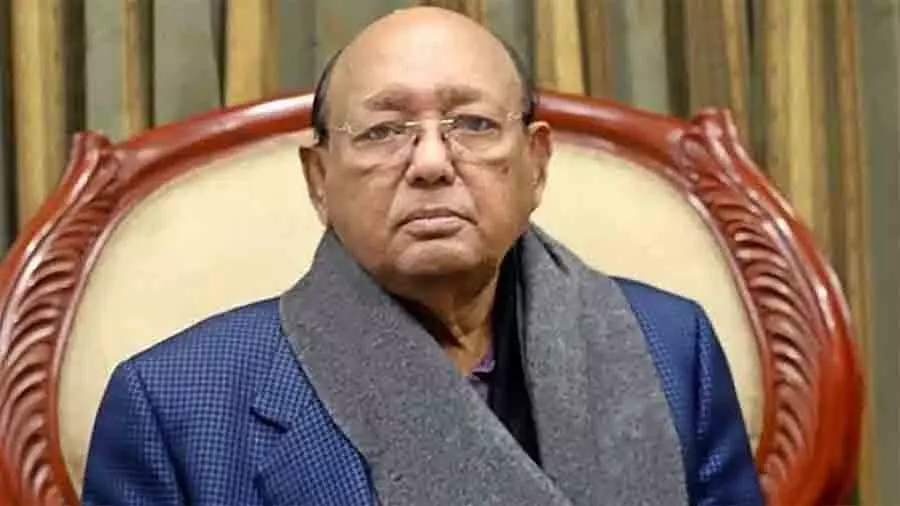
Bangladesh remains trapped in a cruel cycle of historical denial. That reality was once again demonstrated last week when the government, which came to power through what the author describes as an undemocratic and incomplete election in February this year, displayed what he calls indifference following the death of veteran Awami League leader Tofail Ahmed. According to the author, this was not merely ingratitude but an open betrayal of history.
No official condolence message was issued by the state. Civic efforts to take his body to the Central Shaheed Minar were reportedly obstructed by those in power. When chants of “Joy Bangla” were raised during his funeral prayers, police allegedly intervened and arrested several individuals without cause. Former minister Saber Hossain Chowdhury was reportedly taken away in a vehicle immediately after the funeral under the pretext of “security.” In Bhola, Tofail Ahmed’s home district, groups aligned with the BNP allegedly attempted to prevent the funeral prayers from taking place.
The author argues that a man who helped unite Bengali youth during the mass uprising of 1969 was not accorded proper respect by the state even after his death. In the author’s view, this represents not only a loss for one family but a loss for the soul of the nation.
Yet, the author contends, none of these actions diminish Tofail Ahmed’s national stature. Any impartial assessment of Bangladesh’s history, he writes, will place Tofail Ahmed among its leading figures because he was not merely a witness to history but also one of its makers.
In the late 1960s, when a powerful mass movement emerged against the military-bureaucratic rule of Ayub Khan, Tofail Ahmed became one of its most prominent voices. He linked student activism in East Pakistan’s universities with the demands for Bengali autonomy and the release of the imprisoned Sheikh Mujibur Rahman. During those turbulent years, he became a symbol of the aspirations of Bengali youth challenging authority in Rawalpindi.
On Feb. 22, 1969, when the Agartala Conspiracy Case was withdrawn and Sheikh Mujibur Rahman was released from prison, the historic responsibility of presenting him before the nation fell to Tofail Ahmed. According to the author, it was Tofail Ahmed who first formally bestowed upon Sheikh Mujibur Rahman the title “Bangabandhu” — Friend of Bengal. The author argues that this single moment alone secured his place in Bangladesh’s history.
The author further notes that Tofail Ahmed actively participated in the Liberation War, served as Bangabandhu’s political secretary, endured imprisonment during the rule of Hussain Muhammad Ershad, and spent 33 months in prison under Ziaur Rahman. Throughout these trials, he remained committed to his political ideals, even as many of his contemporaries changed parties or abandoned their principles.
“Why aren’t you speaking to me in Bangla?” Tofail Ahmed once reportedly asked a young man in Quetta. The author writes that he spent his entire life fighting for the Bengali language and identity.
The article recalls a live television program several years ago in which Tofail Ahmed challenged what he described as a false claim made by a BNP leader. The leader had alleged that collaborator Shah Azizur Rahman accompanied Bangabandhu to the 1974 Islamic Summit in Lahore. As a member of that delegation, Tofail Ahmed publicly rejected the claim, pointing out that the individual in the photograph was actually Fazal Elahi Chaudhry, not Shah Azizur Rahman. The author portrays this defense against historical distortion as one of the final battles of Tofail Ahmed’s life.
Tofail Ahmed is gone, the author writes, but his place in history is secure. He argues that the story of Tofail Ahmed and others of his generation must be passed on to younger generations, especially at a time when, in the author’s view, there are renewed efforts to reverse historical progress through political illegitimacy, referencing the periods from 1975 to 1996 and developments after 2024.
The article concludes with a warning: a nation that forgets those who helped build it ultimately forgets itself. In the author’s words, forgetting Tofail Ahmed would mean forgetting Bangladesh itself.
–Syed Badrul Ahsan | Senior Journalist

https://stapravda.ru/20221228/reyting_samyh_populyarnyh_hostingov_v_rossii_196445.html, рейтинг хостингов России подтверждает, что выбор надежного провайдера важен для бизнеса.