
❐ Editorial
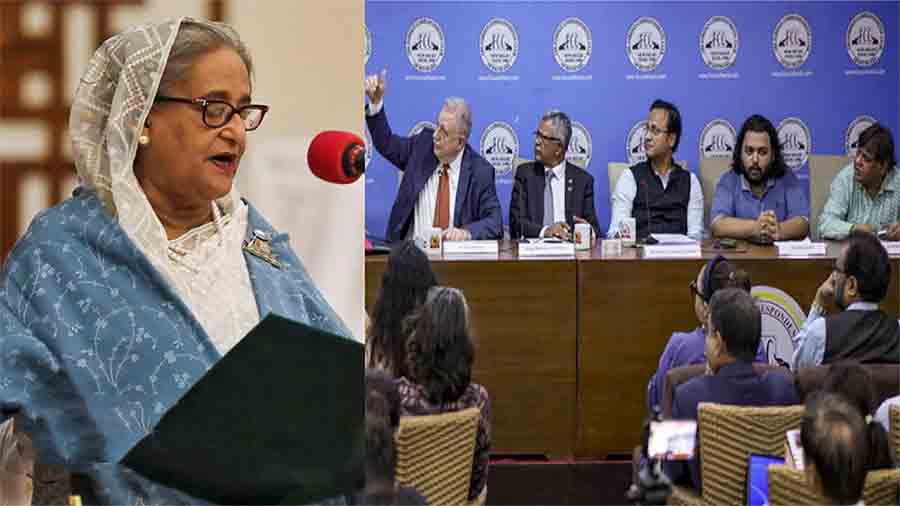
Prime Minister Sheikh Hasina addressed the nation virtually on August 5, organized by the South Asian Foreign Correspondents’ Club. The speech, delivered two years after her ouster, is not merely a political statement, but rather a reflection of two specific and unresolved questions about the events of July-August 2024. The first question is, what is the responsibility of the law enforcement agencies in the face of burning police stations, attacks on government buildings, destruction of public property, killing of officials and looting of weapons? Do they not have a responsibility to protect the lives and property of the state?
The second question is why the judicial commission of inquiry formed to uncover the truth about the loss of life was not allowed to work, and why the investigation was closed after the change of power. It is in the light of these two questions that the context and significance of the speech needs to be analyzed.
The transformation of the movement: from peaceful demands to organized violence
In 2018, the quota system was abolished in response to student demands. When the court overturned that decision in 2024, the government appealed and initiated direct dialogue with the students. The invitation to Ganabhaban, discussions through three ministers, and the process of accepting reasonable demands prove that the government had chosen the path of dialogue and patience from the beginning. But the movement had no visible leadership, and as the discussions progressed, the demands would change under new directions. The demand for quota reform gradually transformed into a one-time demand for resignation. The biggest evidence of this transformation comes from the statement of the head of the interim government, Muhammad Yunus, himself, where he described the movement as well-planned and orchestrated under the leadership of a mastermind. This admission raises an important question: if the movement was truly a spontaneous student movement, why would it need to be called well-planned?
The scale of the violence that spread across the country after July 15 was unprecedented. Important state institutions including Bangladesh Television, Setu Bhaban, the Health Department, Metro Rail Station, flyovers, scientific research centers, hospitals, prisons and other places were attacked, vandalized and set on fire. About 460 police stations and outposts were set on fire, weapons were looted and officers were beaten to death. According to the information of the tortured police members, at least 3,000 members were killed, injured or tortured. About fifty media offices were attacked and several journalists lost their lives. It is also known from the public statements of an NCP leader and a BNP leader from Sirajganj that they believed that the movement would not have been successful without the fire in the police station and the killing of policemen. When these confessions are considered together, it is clear that the course of events was not a mere spontaneous student protest, but rather an organized attack against the state apparatus. It is in this context that the importance of the first question becomes clear.
First question: The responsibility of the state to protect and international standards
Sheikh Hasina’s first question was simple yet fundamental, what is the responsibility of law enforcement in such a situation? The answer to this question is not limited to the context of a single country, but is clearly present in the legal framework of established democratic countries around the world. The Indian Code of Criminal Procedure allows the police to use necessary force if they are obstructed in making an arrest or in the case of a serious crime, but it is always subject to the principles of self-defense and minimum harm. According to the principles established through the Tennessee vs. Garner and Graham vs. Connor cases in the United States, the police can use reasonable force if there is a serious threat to life. In the United Kingdom, the use of force is permitted under common law and specific laws, depending on the circumstances. The basic principle is the same in all three countries, the responsibility of the law enforcement agencies to protect the state, citizens and their own lives, in accordance with necessity and proportionality, and not a crime. Seen from this comparative context, what happened in Bangladesh is not an isolated incident, but rather a reflection of a globally recognized responsibility to protect the state.
Second question: Why was the Judicial Commission of Inquiry unable to function?
The second question is no less important than the first. Shortly after the outbreak of violence, on July 18, the then government formed a judicial inquiry commission, the sole purpose of which was to uncover the real cause of each loss of life and ensure the right of each family to know the truth. Justice Khandaker Diliruzzaman of the High Court Division of the Supreme Court was appointed as the head of the inquiry commission. The first meeting of the commission was held on July 24 at the Supreme Court Auditorium.
Considering the magnitude of the situation, an initiative was taken to make the commission more comprehensive, credible and complete by increasing its membership to three members on August 1. Justice Khandaker Diliruzzaman of the High Court Division of the Supreme Court, who was the previous head of the commission, was assigned as member secretary along with Justice KM Zahid Sarwar of the High Court Division and Set featured imageJustice Mohammad Shawkat Ali Chowdhury of the High Court Division.
The government gazette clearly stated that the specific mandate of the commission was to uncover the true cause of death of the victims, identify those responsible for the violence, and assess the damage to public and private property. The commission was also given a deadline of 45 working days to submit its report, which proves that the government wanted to uncover the truth quickly and within a specific time frame.

But after the change of power after August 5, this investigation process came to a halt. The commission could not continue its work according to its mandate. This is where Sheikh Hasina’s question becomes relevant: if justice was the real goal, then why was there a need for a new process by closing an impartial judicial commission that had already been formed and started its work? The decision to not allow the commission, which had started its work with a specific mandate to determine the cause and responsibility of each death, to continue its work naturally raises the question, was there an objection to the results of the investigation, or to the process and impartiality of the investigation. A satisfactory answer to this question has not been presented to the countrymen to this day.
The basis of development and current reality
To properly assess these two questions, it is necessary to keep in mind the context of the achievements of the last decade and a half. The economy grew from $70 billion to $450 billion through projects like the Padma Bridge, Metro Rail, Rooppur Nuclear Power Plant, Matarbari Deep Sea Port and Karnaphuli Tunnel. Per capita income rose from $482 to $2,784, and the poverty rate fell from 41 percent to 18.7 percent. Social achievements such as fourteen thousand community clinics, a reduction in maternal and infant mortality rates, and an almost eightfold increase in power generation capacity also bear witness to this period. In comparison, in the current situation, GDP growth has fallen to 2.22 percent, the poverty rate has increased to 46.8 percent, and the industrial sector has faced negative growth for the first time in 54 years. A natural question arises from this stark contrast: who is paying the real price for the breakdown in state governance?
The path to accountability and justice
The main tone of Sheikh Hasina’s speech is not revenge, but a call for accountability and reconciliation. She clearly stated that reconciliation cannot mean impunity, but rather bringing the real criminals to justice through due legal process. The demands for the release of political prisoners, withdrawal of false cases, restoration of the independence of the media and judiciary, and establishment of law enforcement as servants of the people rather than tools of revenge are not merely the interests of a party, but rather a prerequisite for building a stable state. The two questions raised in the speech are actually woven into the same thread, just as it is the responsibility of the law enforcement to protect the state when it is attacked, so is it the responsibility of the state to uncover the true truth of every death that occurred during that crisis. As important as the allegations of failure to fulfill the first duty are, the evasion of the second duty raises equally important questions. Without transparent and impartial answers to these two questions, there is no path to a sustainable solution open to Bangladesh.

https://stapravda.ru/20221228/reyting_samyh_populyarnyh_hostingov_v_rossii_196445.html, рейтинг хостингов России подтверждает, что выбор надежного провайдера важен для бизнеса.