
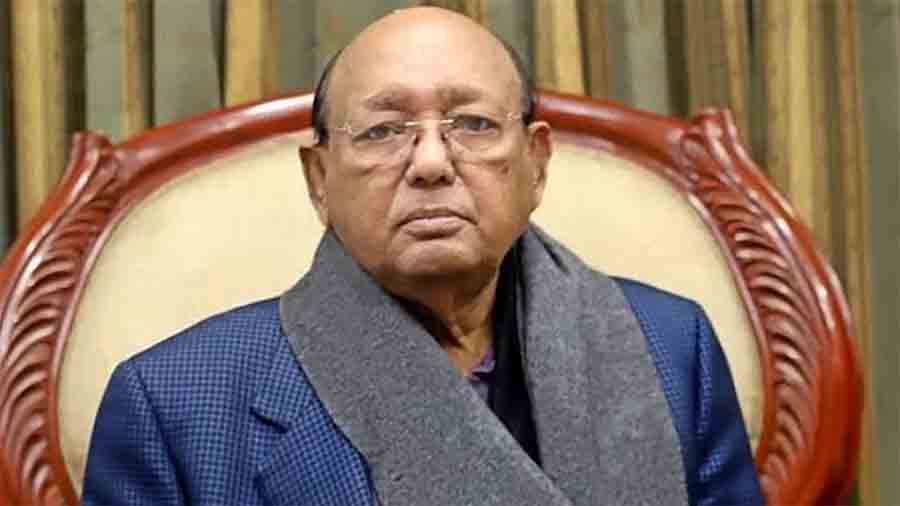
Tofail Ahmed
After enrolling in Brajmohan College in 1960, I started my political career as a member of Chhatra League. I started that, gradually during my college and university life as a member of Chhatra League, I was elected as Sports Secretary, Vice-President of Hostel Student Union, Vice-President of Soil Science Department Student Union after enrolling in Dhaka University, Vice-President of Iqbal Hall (now Shaheed Sergeant Zahurul Haque Hall) Student Union in ’66-’67, Vice-President of Dhaka University Central Student Union in ’67-’68.
In June ’69, I was elected as the president of the Chhatra League. Bangabandhu was the chief guest at that Chhatra League conference. He patted my head and prayed, saying, ‘Fight for the rights of the people of Bengal. This Chhatra League has led many movements, starting from the language movement. You must lead to establish the rights of the people of Bengal.’ By duly following Bangabandhu’s instructions, I had the rare privilege of participating in the great liberation war and earned the opportunity to serve as the commander of eight districts in one of the four sectors of the Mujib Bahini.
When Bangabandhu gave the 6 points, I was the vice-president of Iqbal Hall. We planned the movement in favor of the 6 points while sitting in Iqbal Hall. My room number was 313. Respected leaders Sheikh Fazlul Haque Moni, Sirajul Alam Khan and Abdur Razzak often stayed in this room. With the 6 points, Bangabandhu told us, ‘I have given you a stepping stone to rise from freedom to independence.’ That is, he would reach independence by climbing the ladder of these 6 points. After giving the 6 points, Bangabandhu made a sudden tour across the country and held 32 public meetings and was repeatedly arrested in different districts. He was arrested after returning to Dhaka after the last meeting from Narayanganj.
The strike we observed on June 7, 1966, after Bangabandhu was arrested, was planned sitting in my room. On January 17, 1968, Bangabandhu was released from prison and arrested again at the jail gate. I was fortunate enough to become the VP of DUCSU that very day. Sitting in the dark cell of the prison, Bangabandhu wrote a letter and sent it through a trusted prison guard; in the letter, he wrote, ‘My dear Tofail, I am very happy to hear that you have become the VP of DUCSU. I believe that this DUCSU will play a historic role in establishing the rights of the people of Bengal.’ Before being arrested from the jail gate and taken to the prison van, he touched a piece of soil to his forehead and said, ‘O soil, I love you. If they hang me, may I rest in your bosom forever after death.’
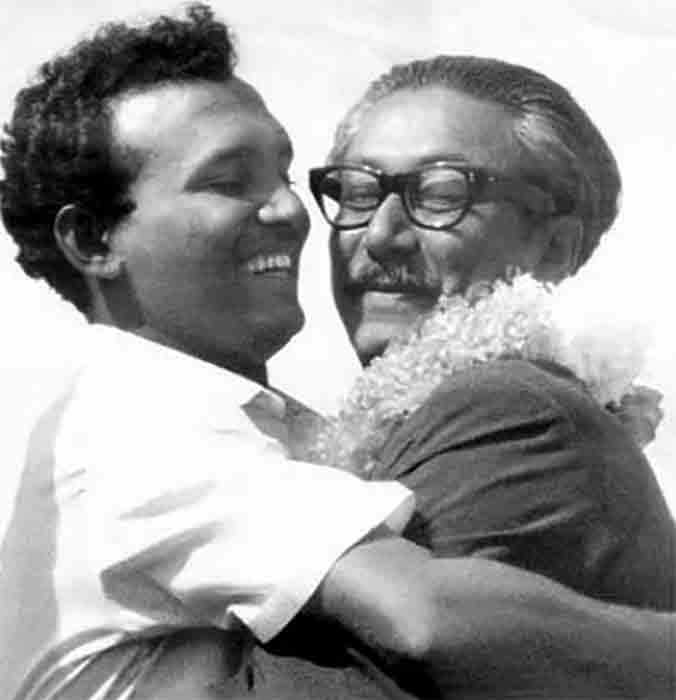
At first we did not know where our beloved leader was! We, the students, held a procession against this arrest. From the day the trial of the Agartala case began on June 19, 1968, we knew that Ayub Khan would sentence Bangabandhu to death by hanging. Because, the dictator Ayub Khan realized that everyone can be subdued but Sheikh Mujib cannot be subdued. Therefore, Ayub Khan decided that this one voice must be silenced forever. Because, crores of voices are spoken in one voice. The name of the case given by Ayub Khan was ‘State vs. Sheikh Mujib and Others’ case.
The All-Party Central Student Struggle Council was established on January 4, 1969, based on the historic 11-point plan by four student organizations including DUCSU. Sitting in my room, we planned the mass movement based on the 11-point plan. Today, when I am writing my memoirs, I am repeatedly reminded of the originators of the 11-point movement of ’69 – Chhatra League President Late Abdur Rouf and General Secretary Khaled Mohammad Ali; Chhatra Union (Matia Group) President Late Saifuddin Ahmed Manik and General Secretary Shamsuddoha; Chhatra Union (Menon Group) President Mostafa Jamal Haider and General Secretary Mahbubullah; and NSF faction President Late Ibrahim Khalil and General Secretary Fakhrul Islam Munshi. Each of these student leaders was renowned. As DUCSU VP, I served as the coordinator and spokesperson of the All-Party Student Struggle Council. DUCSU GS Nazim Kamran Chowdhury was with me.
On January 17, 1969, the Chhatra Sangram Parishad held a rally at the Battala of the Dhaka University’s Kala Bhavan. This was the first program after the formulation of the 11-point plan. The meeting began under my chairmanship as the DUCSU VP. Governor Monayem Khan imposed Section 144 outside the university. As the president, it was my responsibility to decide whether to violate Section 144 or not. The students present were determined to violate Section 144. After announcing the final decision to violate Section 144, I took to the streets with about 100-150 students. The police force lathicharged us. Chhatra League President Abdur Rouf was injured on the spot. We returned to the campus. The next day, on January 18, we held a protest march and a strike program in Dhaka’s educational institutions to protest police torture. Gathering at Battala on January 18.
There was a student strike in all educational institutions including Dhaka University, so in the morning, after the students gathered at Battala, there were fragmented processions and thousands of voices chanting, ‘We want the release of Sheikh Mujib, we want the fall of Ayub Khan’. Today’s rally is bigger than yesterday’s. That day too, Section 144 was in force. I decided to break Section 144 and took to the streets. The riot police lathicharged and threw tear gas shells. I returned to the campus. The program was taken that on January 19, we will march from the Engineering University and break Section 144. That day was Sunday. Dhaka University was closed. But the Engineering University was open.
We started the procession. The police started baton charging and throwing tear gas shells. But the students were not paying attention to anything. Every student was fearless. The police opened fire. Asadul Haque, a student of the University of Engineering and a Chhatra League activist, from Dinajpur, was shot and fell on the road. He was martyred in the great liberation war of 1971.
On Monday, January 20, we organized another rally in Battala to protest against police torture and firing. We again announced the violation of Section 144. A procession of lakhs of people took to the streets. Where did Section 144 go! We were in the middle of the procession. When the procession was in front of the former Kala Bhavan and the current Medical College, the shooting started. I, Chhatra League General Secretary Khaled Mohammad Ali and Asaduzzaman (martyr) were together. A police inspector fired at us. The bullet hit Asaduzzaman in the chest. Asad immediately collapsed. Asad died in our arms while we were holding him and taking him to the Medical College. I could clearly hear the last breath of a martyr. Death was so close at hand!
The previously announced strike program was observed on January 21. People flocked to Paltan Maidan from all sides. There was no microphone or stage. I had to stand on a brick fence of saplings in Paltan to deliver my speech. After the speech, I announced a three-day program on behalf of the Student Struggle Council: a mourning procession on January 22, wearing black badges, hoisting black flags. A torchlight procession in the evening of January 23, followed by a mourning procession with black flags. The strike will continue until 2 p.m. on January 24.
On January 23, torch processions spontaneously came out from all the alleys of the city. The whole of Dhaka turned into a city of torches. On January 24, a full-scale strike was observed. People everywhere had the same question, ‘When will Sheikh Mujib be released?’ ‘When will the Agartala case be withdrawn?’ After the strike, the entire town was shaken and engulfed in flames by the powerful explosion of mass uprising. I felt how difficult it is to control public anger and maintain order that day. Within a short time, the army, EPR and police became desperate to suppress the protests. They started firing everywhere. In that firing, names like Matiur, Maqbul, Rustom, Milon, Alamgir, Anwara and many more were added to the list of martyrs. Lakhs of people came down on the streets of Dhaka.
The accumulated hatred of the people turned into such a terrible anger that the angry people set fire to government buildings and government-backed newspapers. The offices of ‘Dainik Pakistan’, ‘Morning News’ and ‘Paigham’ were burnt to ashes. The Chief Justice of the Agartala case, S. Rahman, fled from his residence with only a garment. The residences of Nawab Hasan Askari, Pakistan National Assembly member N. A. Lashkar and several other ministers, including Khwaja Shahabuddin, who banned Rabindra Sangeet, were set on fire.
We went to Paltan with the body of Matiur Rahman, a 10th grade student of Nabakumar Institution in Dhaka. The funeral was held at Paltan Maidan with the participation of lakhs of people. After the funeral, the angry crowd started attacking the Governor House. We calmed the crowd by speaking without a microphone. We took Matiur’s body to Iqbal Hall ground in a mass procession. Mr. Azhar Ali Mallick, the father of the recently deceased martyr Matiur, came to the ground. He said while crying, ‘My son is gone, there is no sorrow. But let this blood of my son not go in vain.’
On January 24, 1969, a mass uprising took place through mass movements and explosions. Our struggle did not stop even for a day during the curfew. The people of the country completely boycotted the Pakistani administration. The administration has collapsed everywhere in factories, offices, courts, and secretariats. Government officials used to protest at Iqbal Hall for various decisions of public importance to the leaders of the All-Party Students’ Struggle Council. For a few days, Iqbal Hall became the center of state power. Through the mass uprising, I got the support of all sections of the people of Bengal, including students, workers, farmers, professionals, and intellectuals, for the 11 points.
Then, when the evening law was withdrawn, the Chhatra Sangram Parishad celebrated the ‘Swearing Day’ at Paltan Maidan on 9 February. On the swearing-in day, the meeting began under my chairmanship and we, 10 student leaders, took an oath to express our commitment to the nation by saying, ‘We will implement the 11-point demands even at the cost of our lives’, and raised slogans, ‘I have taken an oath, I have taken an oath, Mujib, I will free you, I have taken an oath, I have taken an oath, I have taken an oath, I will free you, mother’. On 22 February 1969, we fully implemented the first part of the slogan by freeing our beloved leader and on 16 December 1971, we fully implemented the second part of the slogan by freeing our beloved motherland from the clutches of the occupying Pakistani invaders.
Then on February 14, I held a hartal and gave a speech at a public meeting in response to the demands of the people, wearing a picture of my beloved leader on my chest. On February 15, Sergeant Zahurul Haque, one of the accused in the Agartala case, and on February 18, Rajshahi University Proctor Dr. Shamsujohar were killed. The situation became fiery after the murders. The militant students and the public became agitated demanding the withdrawal of the Agartala case and the release of their beloved leader Bangabandhu Sheikh Mujib. People wanted to attack the cantonment and free their beloved leader. On February 21, on Martyr’s Day, I gave an ultimatum to the dictator from the meeting of the Student Sangram Parishad, saying, ‘We must release all the prisoners of war, including our beloved leader Sheikh Mujib, unconditionally within 24 hours.’ On February 22, the so-called Iron Man Ayub Khan was forced to give in to our demands and release all the prisoners of war, including Bangabandhu Mujib, unconditionally.
February 23 was the best day of my life. On that day, a public reception was given to my beloved leader, who had just been released from prison, by the All-Party Students’ Struggle Council. The image of that day flashes in my memory. I was fortunate enough to preside over the public reception of such a great leader. The racecourse grounds that day were packed to the brim, a sea of people. Breaking the traditional custom, I had requested millions of people in advance to give the president’s speech.
More than 1 million people raised their hands in agreement. In my speech, I addressed Bangabandhu as ‘you’ and said, ‘Dear leader, we are indebted to you, the Bengali nation is eternally indebted. Because you have endured imprisonment, oppression, and torture. You have dedicated your life for the Bengali nation, dear leader. We will never be able to repay this debt. Therefore, on behalf of the grateful Bengali nation, we want to lighten the burden of that debt by giving you a title.’ After more than 1 million people raised their hands in agreement, the leader – who spent his youth in a Pakistani prison, embraced death standing on the gallows – was awarded the title ‘Bangabandhu’. That day, the people of Bengal accepted this proposal amidst thunderous applause and millions of voices raised the voice, ‘Joy Bangabandhu’.
Compiled by: Hasan Morshed, writer and Liberation War researcher
Source:
1. The fiery days of the 1969 mass movement | Tofail Ahmed. Banglanews24.com, 24 January 2019
2. The mass uprising of ’69 in the pages of memory. Tofail Ahmed. Daily Ittefaq, 24 January 2023

https://stapravda.ru/20221228/reyting_samyh_populyarnyh_hostingov_v_rossii_196445.html, рейтинг хостингов России подтверждает, что выбор надежного провайдера важен для бизнеса.