
❐ Special Correspondent
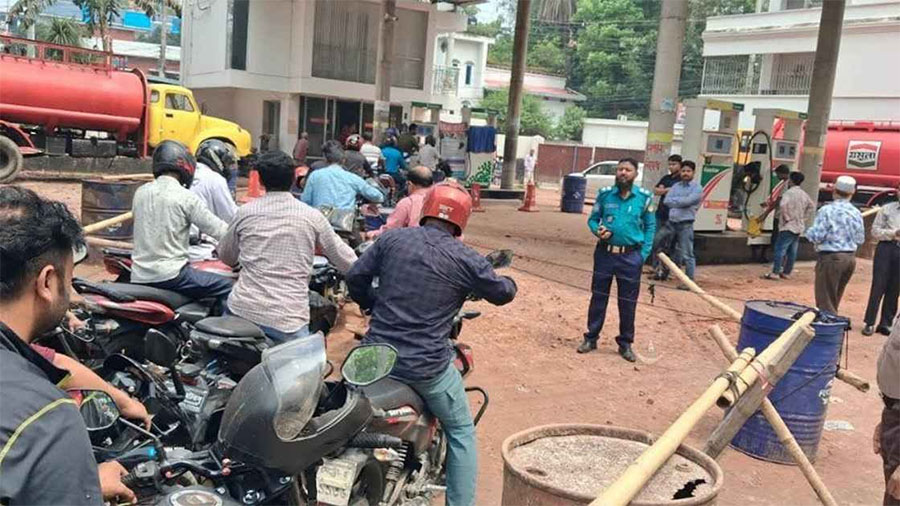
Traffic police are supposed to be busy on the busy roads of Dhaka, controlling traffic jams, maintaining order at intersections, and preventing accidents. But in reality, most of their time is spent managing long lines in front of fuel pumps. Traffic police officers are struggling to control the queues of cars, motorcycles, and goods vehicles that stretch for kilometers in front of various major filling stations in the capital.
For the past few days, drivers have been seen crowding petrol pumps in various areas of the capital including Tejgaon, Mohakhali, Mirpur, Uttara, Jatrabari, Sayedabad, Gabtoli, Mohammadpur, Elephant Road, Malibagh and Khilgaon since morning to get fuel. In some places, the queues did not reduce even till midnight. It is said that many drivers have to wait for three to five hours.
The pumps next to busy roads are under the most pressure. Because the lines are getting long and taking up a part of the main road. This is disrupting normal traffic flow, creating long traffic jams. In some places, the risk of accidents is also increasing when using alternative lanes.
Several traffic officers said that while earlier the members’ main focus was on signals, intersection management and keeping traffic flow moving, now managing the chaos centered around the pumps has become a big challenge. Drivers often argue about who is ahead of them in the line, sometimes even escalating into fights. In such situations, members have to intervene regularly.
A traffic sergeant in the capital said, “There is already pressure on the road, but now we also have to take the pressure of the pump line. Sometimes the line in front of a pump stretches for hundreds of meters. Then we have to spend more time straightening the line than leaving the car on the road.”
A traffic officer, who did not wish to be named, said, “Our main responsibility is to keep traffic flowing smoothly on the roads, reduce congestion and ensure order at intersections. But over the past few days, the situation has become such that more time has to be spent maintaining order in the lines in front of the petrol pumps than managing the roads.”
Somewhere there is a fight between drivers about going first and last, somewhere there is a jostling between motorcyclists, and somewhere else the arguments turn into fights. Then we have to go and bring the situation under control. This disrupts the performance of duties on the main road. Sometimes, while managing the line in front of a pump, traffic jams are created in the entire surrounding area.
He added, “There are such big lines in front of a single pump that the entire surrounding area is blocked. Then, instead of standing at the intersection and controlling traffic, more manpower is needed to maintain order in the lines.”
Drivers complain that due to uncertainty, many are trying to buy more fuel than necessary. Some are trying to cut corners in the line, taking advantage of the situation. This is increasing tension. Local sources said that there have been incidents of arguments and fights over fuel in some areas.
Meanwhile, the fuel crisis has also affected public transport. Bus owners say that due to lack of sufficient fuel, the scheduled number of buses are not being put on the road. This has increased passenger pressure and increased suffering. Drivers of goods vehicles also say that delivery schedules are being disrupted due to long waiting times in lines.
Police sources say that not only traffic members, but also vehicles on patrol and emergency duty have to wait for long periods to get fuel. This is also hampering the ability of law enforcement agencies to respond quickly in some cases.
Transport experts say that the capital’s road management is already fragile. If the fuel pump-centric lines spread out onto the main roads, there is a risk of the overall traffic management collapsing. It is important to quickly normalize supply and take special management in the pump area.

https://stapravda.ru/20221228/reyting_samyh_populyarnyh_hostingov_v_rossii_196445.html, рейтинг хостингов России подтверждает, что выбор надежного провайдера важен для бизнеса.