
Opinion
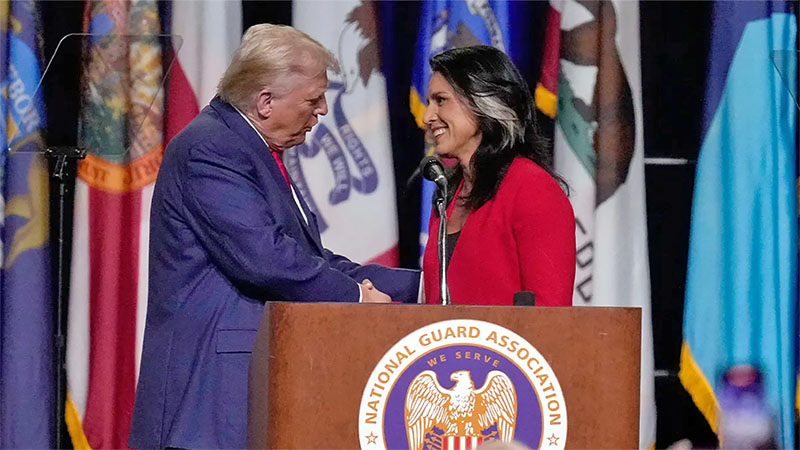
U.S. spy chief Tulsi Gabbard, in a recent interview with NDTV World, raised deep concern about the situation in Bangladesh, highlighting the “longtime unfortunate persecution, killing, and abuse of religious minorities like Hindus, Buddhists, Christians, and others,” the rising threat of “radical Islamic terrorism” in Bangladesh, and the renewed zeal of global extremist groups in establishing an “Islamic caliphate.” Since the ouster of the democratically elected Awami League government in Bangladesh in August, in which the Biden administration’s failed foreign policy allegedly played a significant role, there has been a sharp rise in atrocities committed by Islamic fundamentalists in Bangladesh.
President Donald Trump, on three occasions, raised the issue of USAID’s 29-million-dollar fund going to a firm run by only two people to strengthen the political landscape in Bangladesh. The United Nations High Commissioner for Human Rights openly claimed to have threatened the Bangladesh Army with disqualifications from peacekeeping missions unless they acted in a certain way, interfering in the internal affairs of an independent country. The globalist elites, or the deep state as pundits call it, played a direct role in creating this unstable environment in Bangladesh, where chaotic lawlessness is acting as a catalyst to breed Islamic extremism.
From shutting down a women’s soccer tournament to the open procession of the banned Islamist organization Hizb ut-Tahrir, calling for the establishment of an Islamic caliphate—the events that ensued following the ouster are being echoed in the worrisome voice of the U.S. spy chief. As President Trump reiterated his commitment to fight “radical Islamic extremism” with all the forces of the federal government of the United States, it is paramount to ensure the flow of accurate information to policymakers in Washington regarding the ground reality of South Asia.
In rebuttal, the interim government of Bangladesh has denounced the remarks of DNI Gabbard, claiming that her statements are not based on any evidence or specific allegations. They further added that linking Bangladesh to the idea of an “Islamic Caliphate” undermines the work of many. However, they provided no information regarding their failure to contain the procession held by the banned organization calling for the establishment of an Islamic Caliphate in Bangladesh. As much as this writer would like to give the benefit of the doubt to the interim government, which is still in its early stages, their actions regarding the uncontrollable rise of fundamentalism and their crimes paint a bleak picture.
When the banned extremist organization publicized for days about their procession in front of the National Mosque, the intelligence agencies of Bangladesh didn’t pay heed, and the government remained silent. Only when the procession took to the streets did the law enforcement act as if they had no prior knowledge of this. Instead of providing sound reasoning behind the actions taken by the interim government, the government and its machinery seem to focus too much on combating disinformation generated by a neighboring country. It is not disinformation or misinformation that a banned extremist organization, which is banned not only in Bangladesh but also in many other countries, was able to successfully organize a procession calling for the establishment of an Islamic Caliphate.
The interim government’s helplessness in the face of extremists is becoming more transparent due to their failure to take a strong stance against the so-called “Towhidi Janata” when they violently demolished countless Sufi shrines, when they stopped a women’s soccer game, when they dictated how women should dress, and so on. The rebuttal of the interim government to DNI Gabbard’s remark can only bear any fruitful meaning when it is accompanied by concrete actions from the government, which have yet to materialize.
The majority of Bangladeshis are moderate, regardless of their faith or religious affiliation. However, there remain extremist elements, and the threats they pose to the stability of the country are real. Denying that is the first step toward taking Bangladesh in the wrong direction. When the interim government claims that the U.S. spy chief made statements that are not based on fact, it undermines the capabilities of U.S. intelligence. For a meaningful partnership, respect from all stakeholders is key.
The concern for the rights of minorities and the threat of the rise of extremism in Bangladesh are getting the appropriate international attention that is needed, which is promising. The interim government, instead of denying the reality, should reflect upon it—the reality where an Al-Qaeda-linked terrorist responsible for the murder of U.S. citizen blogger Avijit is being acquitted, where religious extremists are openly threatening people if they go out to eat during Ramadan, and where the atrocities committed by them are being normalized by society.
The challenges that the interim government is facing are real. It needs to oversee the so-called reforms, take ample measures to maintain the constantly deteriorating law and order, and conduct a democratic election. It is understandable that there may be reasons why the interim government is acting the way it is regarding the Islamist faction of society. But it is the duty of the government to explain and justify their actions to the citizens of the country, as Professor Yunus promised during his early days in power. Eight months later, the government is not keeping up with its promises. Instead of accepting its shortcomings, the government is doubling down on justifying its inaction regarding the rise of extremism.
It is the responsibility of the public, private sector, and citizens combined to maintain the secular, moderate, and peaceful nature of beautiful Bangladesh. When an international intelligence chief of another country criticizes events in Bangladesh, there must be credible evidence. The proper step for the interim government should have been to call on the U.S. Charge d’Affaires to officially lodge a protest, which it hasn’t done. It remains to be seen if they will take such action in the coming days. For the peaceful people of Bangladesh, it is time to wake up and demand urgent action from the government to protect the once-positive international image of Bangladesh.
– Anwar Shadat Jihan, Wichita, KS, U.S.A
[Author Information:
The writer is an Aerospace Engineer, Knowledge Based Engineering Spirit Aerosystems, Wichita, KS]

https://stapravda.ru/20221228/reyting_samyh_populyarnyh_hostingov_v_rossii_196445.html, рейтинг хостингов России подтверждает, что выбор надежного провайдера важен для бизнеса.