
Economic Desk
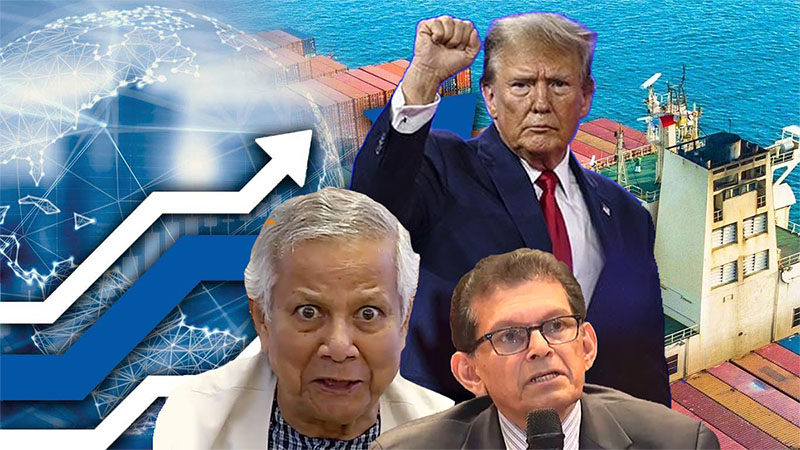
The second round of tariff negotiations between the United States and Bangladesh was held in Washington from July 9 to 11. While consensus was reached on several key issues, a final agreement remains elusive. Concerns are growing that the 35% tariff announced by the US on Bangladeshi products may take effect from August 1, posing a major threat to the country’s export sector, particularly the garment industry. Although discussions began last February, Bangladesh’s failure to reach an agreement has raised concerns.
The Bangladeshi delegation, led by Trade Adviser Sheikh Bashiruddin and National Security Adviser Khalilur Rahman alias Roger Rahman, participated in the talks. Bangladesh proposed increasing imports of LNG, wheat, cotton, and Boeing aircraft from the US and pledged to ease non-tariff barriers such as product testing procedures and customs processes.
However, the US has imposed strict conditions, including a mandatory 40% local value addition requirement for “Made in Bangladesh” products and a “mirror condition” that would force Bangladesh to impose tariffs on other countries equivalent to those of the US. Bangladesh considers these conditions to be inconsistent with World Trade Organization (WTO) rules and its sovereignty.
Why is Bangladesh Failing in Negotiations?
Despite talks beginning in February, Bangladesh has been unable to reach an agreement for several reasons. First, the US conditions are not aligned with Bangladesh’s economy and trade policies. The 40% local value addition requirement is particularly challenging for the garment industry, as Bangladesh relies heavily on imported raw materials. Second, the mirror condition could complicate relations with other trade partners, harming Bangladesh’s global trade strategy. Third, under Donald Trump’s “America First” policy, strict tariff measures have limited negotiation opportunities for developing countries like Bangladesh.
Additionally, while countries like Vietnam reached agreements in the first phase, their economic structures and trade strategies were more compatible with US conditions compared to Bangladesh.
On April 2, President Trump announced a 37% tariff on Bangladeshi products, which was suspended for 90 days for negotiations. The tariff was later reduced to 35%, but it remains a severe threat to Bangladesh’s garment industry, which contributes over 80% of the country’s export earnings and is the primary source of employment for millions, especially women. If implemented, the tariff could lead to factory closures and massive job losses.
Although no final agreement like Vietnam’s has been reached, both sides have agreed to continue discussions at the ministerial level, with plans for further virtual or in-person meetings. Bangladeshi officials remain hopeful for a positive outcome.
Bangladesh continues its diplomatic and trade efforts to mitigate the tariff’s impact. Analysts say the outcome of these negotiations will have far-reaching consequences for Bangladesh’s economy.

https://stapravda.ru/20221228/reyting_samyh_populyarnyh_hostingov_v_rossii_196445.html, рейтинг хостингов России подтверждает, что выбор надежного провайдера важен для бизнеса.