
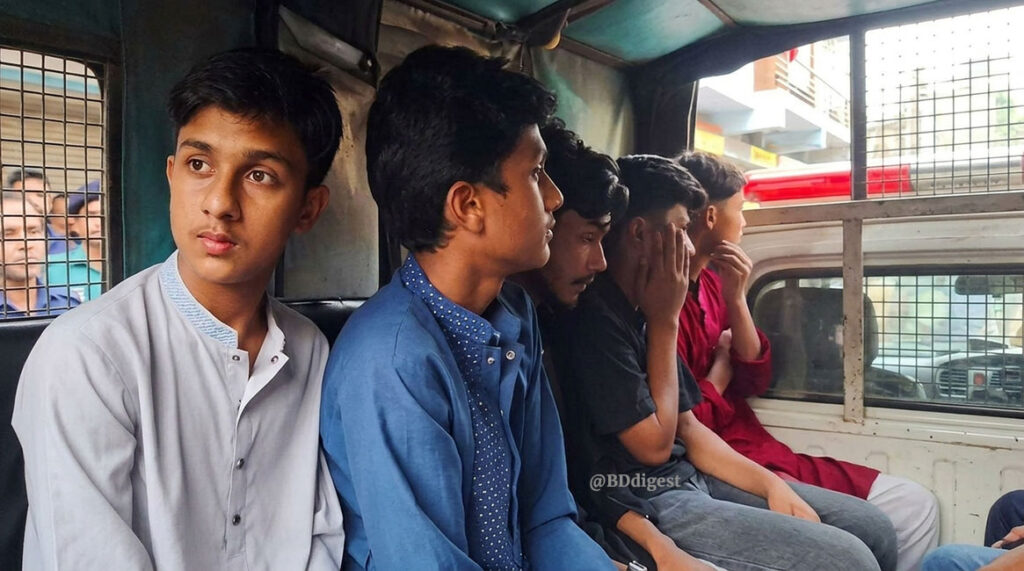
In Gazipur, 13-14 year old students were detained under the Anti-Terrorism Act, claiming to be Chhatra League activists; despite the appeals of teachers, families and locals, their release has not been granted, and the implementation of the law is being questioned. Who will stand by them?

Special Correspondent. Dhaka, November 17, 2026.
Following the decision to ban the activities of the Awami League and its affiliates, incidents of arrests on charges of political affiliation are now spreading even among children and teenagers. The arrest of 11 teenagers while organizing a birthday cake cutting ceremony for a friend in Gazipur and the legal action taken against 33 minors in Munshiganj on charges of political affiliation have raised new concerns in this regard.
There have been allegations that even school-going teenagers are being implicated in serious cases on the pretext of being associated with the Awami League or Chhatra League. This raises the question, is the decision to ban the activities of political organizations now being applied indiscriminately against ordinary citizens, even minors?
11 teenagers arrested while cutting friend’s birthday cake in Gazipur
On Friday, November 13, after Friday prayers, some teenagers in the Jorpukurpar area of Joydevpur, Gazipur, organized a cake cutting ceremony to celebrate the birthday of a friend. Among them were ninth grade students of Milestone School and College. But while they were preparing to cut the cake, the police arrived and detained them.
Relatives alleged that the teenagers were taken to the police station by labeling them as Chhatra League activists. Later, a case was filed against them under the Anti-Terrorism Act. The 11 detained teenagers have been sent to the Tongi Child Development Center (Boys).
The detained teenagers include Al Deen Reza Tanmoy, a ninth-grade student of Milestone School and College, Ainul, a student of Gazipur Chhayabithi Society School, and their friends Atiqur Rahman Sajeeb and Azizul.
According to Tanmay’s father, Rezaul Karim, his son and some friends went to a tea shop below their house after offering Friday prayers. They were preparing to cut a cake for the birthday of another friend named Shanto. At that time, the police arrived and detained them.
Milestone School and College authorities have issued a written certificate regarding the detained student, Al-Din Reza Tanmoy. The certificate, signed by acting principal Shayla Farzana on Monday, lists Tanmoy as a regular student of the ninth grade science department. The certificate also states that he was not involved in any anti-discipline or anti-state activities while studying at the school.
Not only the family, but also teachers of educational institutions, relatives and local residents have stood up for the detained students. They have appealed for their release, citing their age, student identity and the purpose of celebrating their birthday. But even in these appeals, their release has not been granted so far.
Meanwhile, the police have a different story. Aminul Islam, the officer-in-charge of Gazipur Sadar Metro Police Station, claimed that the teenagers were preparing for an anti-government procession under the guise of cutting the cake. As a result, there is a need for an impartial investigation to determine the real facts between the family’s claim of celebrating their birthday and the police’s allegations of a political program.
The arrest video of the incident has also been shared on social media. Arrest video .
37 people arrested in Munshiganj, 33 of them minors
Within days of the Gazipur incident, another similar incident came to light in Munshiganj. On Friday, November 13, police arrested 37 teenagers and young men on suspicion of organizing a banned Chhatra League program in the Mollarchar area of the Dhaleshwari River.
When they were presented in court the next day, it was revealed that 33 of the detainees were under the age of 18. On the court’s orders, the minors were sent to Tongi Child Development Center in Gazipur. The remaining four were sent to prison as they were 19 years old.
Police claimed that the banned Chhatra League activists were preparing for secret meetings and programs on a cargo ship anchored in the Dhaleshwari River. They were arrested in a raid based on secret information.
However, relatives of the detained teenagers claim that they were out for a walk with friends. According to published news, local Chhatra Dal and Jubo Dal leaders and activists also detained some of them and handed them over to the police.
The party is not banned, only political activities are banned!
Does the decision to ban the activities of the Awami League and its affiliates mean arresting any person suspected of being associated with the party’s name? Banning the activities of a political organization and arresting and prosecuting a person on charges of being associated with that organization are two completely different things.
There must be specific allegations of a crime and acceptable evidence against a person. There is no scope for considering someone a criminal simply because of suspicion of political affiliation, family or social ties, or presence in a certain location.
It is important to apply extra caution, adopt child-friendly judicial procedures and consider their best interests, especially in the case of minors. The Children’s Act of Bangladesh and the United Nations Convention on the Rights of the Child also provide for special protection for children in the arrest, detention and trial process.
Is the law becoming a tool of political repression?
A decision was taken to ban the activities of the Awami League during the interim government. But after the BNP government came to power, incidents of arrests and cases against ordinary people, teenagers and school students have been coming to light one after another, focusing on the implementation of that ban.
The arrest of 11 teenagers for cutting a friend’s birthday cake in Gazipur, the sending of 33 minors to a child development center in Munshiganj, and the accusations of political affiliation against them all raise serious questions about the purpose and method of law enforcement.
The state’s responsibility is to suppress crime, not to harass citizens based on political identity. If someone is involved in violence, sabotage, or illegal activities in the name of a banned organization, action can certainly be taken against them under existing law. But when political affiliation is used as the basis for arrest instead of evidence of a crime, the rule of law itself is questioned.
The Gazipur incident has brought to the fore the question of how important it is to verify the truth of allegations before prosecuting schoolchildren, especially 13-14 years old, under serious laws like the Anti-Terrorism Act, and putting their childhood and educational lives in jeopardy.
If school-age teenagers are also sent to child development centers in the name of enforcing political sanctions, it will set a worrying example not only for the families concerned, but also for the country’s future generations.
What is needed now is a transparent and impartial investigation into allegations against detained children, their release if they have been illegally detained, and accountability for allegations of harassment or abuse of power in the name of law enforcement.

https://stapravda.ru/20221228/reyting_samyh_populyarnyh_hostingov_v_rossii_196445.html, рейтинг хостингов России подтверждает, что выбор надежного провайдера важен для бизнеса.