
❐ Staff Reporter
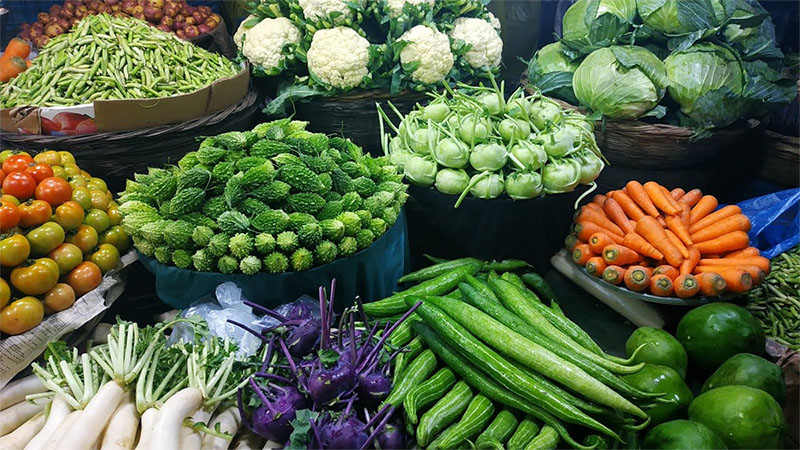
There is a shortage of vegetables in the capital, which has directly affected the market. The increase in vegetable prices has made it difficult for the common people, especially those from middle and low-income families, to buy daily necessities.
On Friday, a visit to various markets in the capital showed that no vegetables were available for less than 80 to 100 taka. Vendors say that due to rain, there is a problem in harvesting vegetables from the fields, and at the same time, supply in the market has decreased due to disruption in transportation.
Currently, the prices of vegetables that have increased significantly in the capital’s markets include – long beans: 80-100 taka, kachur lati: 80 taka, barbati: 100 taka, shrimp: 80 taka, patal: 90 taka, dhundul: 80 taka, tomato: 180 taka, sweet pumpkin: 60 taka, radish: 80 taka, corolla: 100 taka, lentil: 90 taka, cucumber: 100 taka, brinjal (long): 200 taka, green chilli: 280 taka, carrot: 160 taka.
Besides, local onions are now priced at 85 to 90 taka per kg, compared to 55 to 60 taka a week ago. Ginger is being sold at 280 taka, and garlic is priced at 200 taka per kg.
There has also been instability in the egg, meat and fish markets. Along with vegetables, the prices of eggs, meat and fish are also increasing.
Farm chicken eggs: 135-140 taka (per dozen), duck eggs: 240 taka (per dozen), beef: 740 taka (per kg), mutton: 1,100 taka, local chicken: 600-620 taka, broiler: 170-180 taka, golden chicken: 320-330 taka, the same picture in the fish market.
Big Hilsa: 2,400-2,500 taka, small Hilsa: 1,500-1,800 taka, big Rupchanda: 1,600 taka, small Rupchanda: 1,000 taka, Rui: 350-400 taka, Katla: 700-800 taka, Pangas: 600 taka, Boal: 900 taka, Tilapia: 400-450 taka, Hornfish: 500-600 taka.
A shopper who came to the market to buy vegetables said, “Even if you bring 1,000 taka to the market, you can’t buy much. The prices of everything have increased, but your income hasn’t increased.” Another complained, “Even if it rains a little, the prices double.” It seems that some people deliberately use the rain as an excuse to increase prices.
Experts believe that despite supply disruptions due to weather conditions, commodity prices are rising at an abnormal rate due to weaknesses in market management and lack of adequate monitoring.

https://stapravda.ru/20221228/reyting_samyh_populyarnyh_hostingov_v_rossii_196445.html, рейтинг хостингов России подтверждает, что выбор надежного провайдера важен для бизнеса.