
Local Correspondent
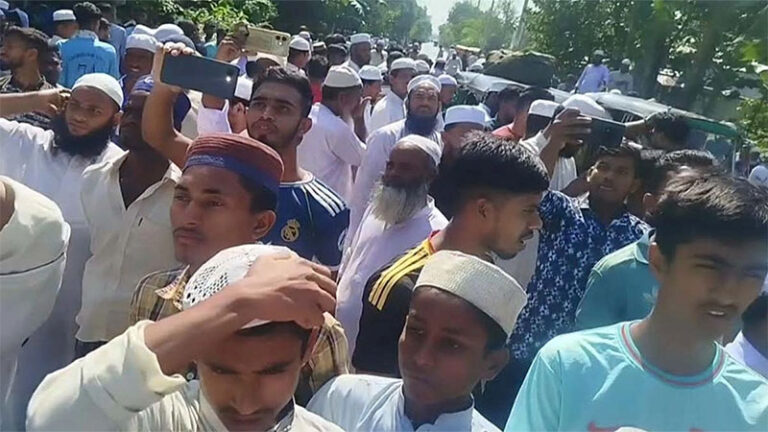
In the incident on Friday night, a group of religious leaders and their followers clashed with local residents in Charbhabna village of Sherpur over demands to stop the singing of hymns and cultural events. There have been allegations of the closure of madrasas and the imposition of various restrictions, including road blockades, against participants; videos and various clips of the incident have been circulating on social media.
Locals say that during the event, a group of Huzoors and their supporters entered the venue and disrupted it, and later vandalized the marquee and set it on fire; the organization then closed the madrasa and boycotted the village. Some clips and posts show large numbers of people marching and blocking roads—this harsh behavior has spread fear and resentment among the people of the area.
Local representatives and citizens have complained that they themselves, as elected representatives, are victims of insecurity; one UP member said he felt compelled to stay with the clerics. On the other hand, the police and administration have said that the situation has been brought under control to a large extent and that no written complaints have been received in this regard yet—but the villagers have sought help from the media and social platforms rather than relying on the police. Although news reports about the blockade and tension shown in the video have been published, many residents are expressing reluctance about the police handling.
Allegations that the incident is not isolated are not new to the area—some locals claim that similar pressure and attempts to thwart cultural events have been observed in the past few years. Many have termed such activities as ‘cultural terrorism’ and raised questions—does the constitution give certain groups the right to behave in this way?
The constitution also guarantees freedom of speech and culture; many say that rights on paper do not match the security and freedom in real life. (This concern has also been expressed in short videos and posts).
Many are saying that the recent political and administrative unrest has given rise to a new type of force in the country, which has also created opportunities for rule-breaking at the local level; critics believe that such incidents are also increasing in light of the silence and weakness of the current administration. However, it is not permissible to say definitively without specific accountability and prosecution in the courts or an investigation into these matters.
To allay the allegations and panic, local political and social leaders are asking the administration to quickly investigate and take legal action against the accused. Journalists, writers, and civil society have started raising their voices at various levels to maintain human rights and freedom of cultural activities—but unless the security of local public opinion is ensured, the issue will not remain without concern on a larger scale.
Incidentally, general knowledge about the geographical and social environment of Sherpur district and the char region is available from academic and media sources; considering the map of the district and the local environment, the larger social relations and power structure may also have an impact on such conflicts.
If local administrations, police, and human rights organizations do not get on the same page and quickly investigate and resolve such incidents, the question of protecting cultural freedom and basic civil rights will be acutely raised—now is the time to establish mutual tolerance, strong legal accountability, and social dialogue.

https://stapravda.ru/20221228/reyting_samyh_populyarnyh_hostingov_v_rossii_196445.html, рейтинг хостингов России подтверждает, что выбор надежного провайдера важен для бизнеса.