
Local Correspondent
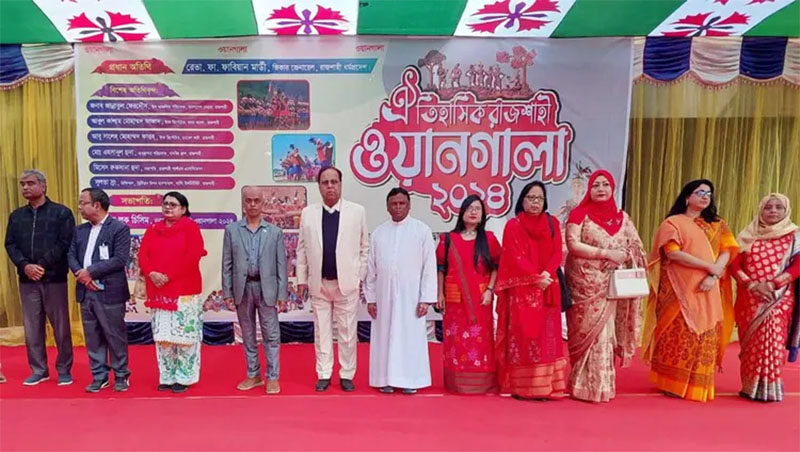
The historic Wangala festival of the Garo community was celebrated in Rajshahi on Saturday. The event took place at the Cathedral Church in the city’s Court area.
Lotus Luk Chisim, the Nokma (village head), presided over the festival, while Father Fabian Mardy, Vicar General of the Diocese of Rajshahi, was the chief guest.
At the beginning of the event, the 11 ethnic groups of the Garo community presented their harvested crops to the chief guest. The ceremony was formally dedicated to the Sun God, Goddess Misi, and Saljong, symbolizing gratitude for the harvest.
The special guests included Sultana Drong, Principal of the Rajshahi Christian Mission Hospital Nursing Institute, and Father Liton Costa. Several prominent personalities from various government and non-government organizations, along with journalists, also attended the festival.
Wangala Festival Observance
Wangala is the most significant festival for the Garo people. The term “Wana” means offerings to the gods, and “Gala” refers to dedication. This festival is an expression of gratitude and various offerings made to deities.
Typically celebrated at the end of the rainy season and before winter, the festival marks the time after the harvest. It is considered taboo for the Garos to consume newly harvested crops before the festival, which is also referred to as the “Nabanna” or “thanksgiving” festival.
On this day, people of all ages, rich or poor, dress in vibrant clothes and adorn themselves with bird feathers while dancing to the beats of traditional drums. The festival is a day of fun and celebration for the Garo community, and the venue comes alive with the sounds of drums and festive music.

Men and women, in two separate lines, dance to religious rhythms, moving towards the Wangala stage with the guests. In the first phase, the festival is filled with Garo songs, dances, and melodies.
The Garos believe that it is the Sun God, under the guidance of Saljong, who helps the seeds sprout and ripen, which is why they offer prayers before harvesting. As per tradition, a portion of the harvested paddy is cut last, after which incense is offered. The crop is then tied in bundles and brought home with joyous sounds. The deities of the fields also enter the house along with the harvest.
The first offering made is to the Sun God Misi Saljong, symbolized by the sacrifice of a rooster. After this, the Garo community prepares “Chu” (a traditional dish) from the newly harvested rice in each home. The Nokma announces the date for Wangala, and preparations for the festival begin, including cleaning homes, gathering new clothes, and collecting rooster and bird feathers for the occasion.
The first day of the festival is called “Rugala,” when offerings of new rice, fruits, vegetables, and poultry are made to the deities, including the goddess of fertility and the Sun God. The Nokma collects crabs from nearby water sources and offers them to the Sun God in the fields. Afterward, the preparations for the Wangala rituals are arranged at the Nokma’s home.
Later, a rooster is sacrificed, and its blood is smeared on the rice container, which is then offered to the household deities. New liquor is also offered during this ritual, which the Garos refer to as “Rangdik” or “Mitte.”
The second day is called “Sasat Sa,” which involves a ritual of incense offerings. The Nokma sprinkles new rice throughout the house, symbolizing the rain, and burns incense in the house, with the belief that if the smoke exits through the roof, it indicates that rain will come in the coming year.
The third day, “Kram Gogata,” involves a final round of offerings and thanksgiving rituals at the Nokma’s house. At sunset, everyone gathers to play the traditional instruments one last time before the Nokma offers a final prayer of gratitude to the Sun God and the goddess of food.
Thus, the Wangala festival concludes, with the traditional instruments being stored in the Nokma’s house. This festival, rooted in the Garo community’s agricultural practices, has evolved over time, especially as many Garos have converted to other religions and lost some of their traditional beliefs. Nonetheless, the Wangala festival continues to showcase the rich heritage and customs of the Garo people.

https://stapravda.ru/20221228/reyting_samyh_populyarnyh_hostingov_v_rossii_196445.html, рейтинг хостингов России подтверждает, что выбор надежного провайдера важен для бизнеса.