
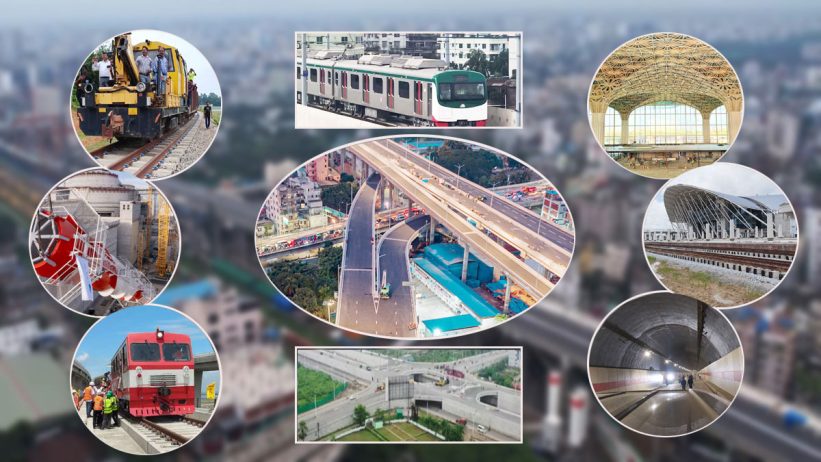
Dr. Mamunur Rashid
Every government faces three major challenges: 1) Running the government at low cost, 2) Social development and infrastructure construction, and 3) Building development infrastructure.
This requires a massive budget. Investment funds primarily come from three sources: 1) Revenue from taxes, VAT, and other services, 2) Borrowing from banks, capital markets, and other financial instruments (such as savings certificates), and 3) Foreign aid and loans.
Among these three sources, the first (taxes, VAT, and service revenues) can be imposed by force if necessary. But to raise money from the other sources, investors must be assured they will get their money back on time. This means that to borrow money, a government must enhance its national and international reputation. That requires strong leadership and hard work.
In developed countries, the public directly participates in infrastructure development because they pay substantial taxes to fund government operations. Now, let’s examine whether Bangladesh’s development was really done with Sheikh Hasina’s father’s money.
1) Bangladesh has one of the lowest tax-to-GDP ratios in the world.
In 2021, Bangladesh’s tax-to-GDP ratio was 7.4%, which rose to 7.5% in 2022. The Asia-Pacific average is 19.3%, and the OECD average is 34%. Figure 1 shows the tax-to-GDP ratios of some countries. For context, Bangladesh’s ratio was 6.2% in 2008.
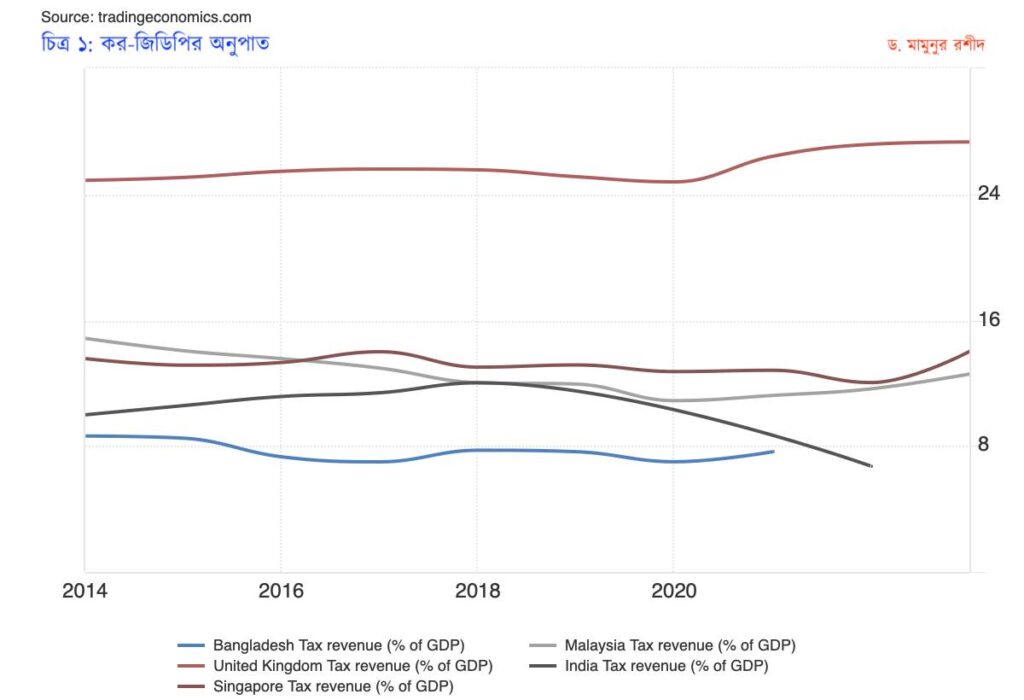
Given this ratio compared to other countries, does it seem like the revolutionary infrastructure changes around us were funded by our taxes?
Isn’t it more accurate to say that even covering basic services like Dhaka’s water supply and nationwide electricity distribution requires more money than what we contribute in taxes?
2) So, did Sheikh Hasina achieve this development through loans?
Figure 2 shows the debt-to-GDP ratios of several countries. From 2014 to 2023, Bangladesh’s ratio was much lower than the other three countries. Only in 2023 did Bangladesh’s ratio (37.1%) slightly exceed Vietnam’s (33.5%).

Screenshot
For comparison, the U.S. has a debt-to-GDP ratio of 122%, meaning for every $100 of GDP, the government has borrowed $122. India stands at 82%, China at 81%, Singapore at 173%, and Japan at 263%.
This means Sheikh Hasina did not take excessive loans to drown us in debt.
3) Then how did we achieve such massive social and infrastructural development?
Have we ever wondered why the IMF readily approved loans for Sheikh Hasina but delayed for Yunus? This was possible because, over 16 years, Sheikh Hasina completed project after project, elevating Bangladesh’s capabilities to a new level. Foreign investors respected Bangladesh.
Bangladesh earned this respect due to Sheikh Hasina’s leadership—not from our tax money.
Now, when Yunus changes the names of nearly 1,000 of Sheikh Hasina’s projects, we witness an economic miracle. So much has happened right before our eyes, yet we barely noticed.
This development was possible because Sheikh Hasina treated Bangladesh as her own father’s country and built it accordingly.
On the other hand, if this development were funded by our taxes, why did we burn down our own infrastructure in July-August?
We set fire to national infrastructure either because we are insane or because we assumed it was all built with Sheikh Hasina’s father’s money. Now that she is gone, let’s destroy it all—this is what business advisors are now saying.
This means our words and actions prove that Sheikh Hasina was the true symbol of this development. It also proves that we contributed nothing to these achievements. We only spread lies to tarnish her reputation.
Yes, this development was indeed done with Sheikh Hasina’s father’s money.
Dr. Mamunur Rashid
Economist

https://stapravda.ru/20221228/reyting_samyh_populyarnyh_hostingov_v_rossii_196445.html, рейтинг хостингов России подтверждает, что выбор надежного провайдера важен для бизнеса.