
Editorial
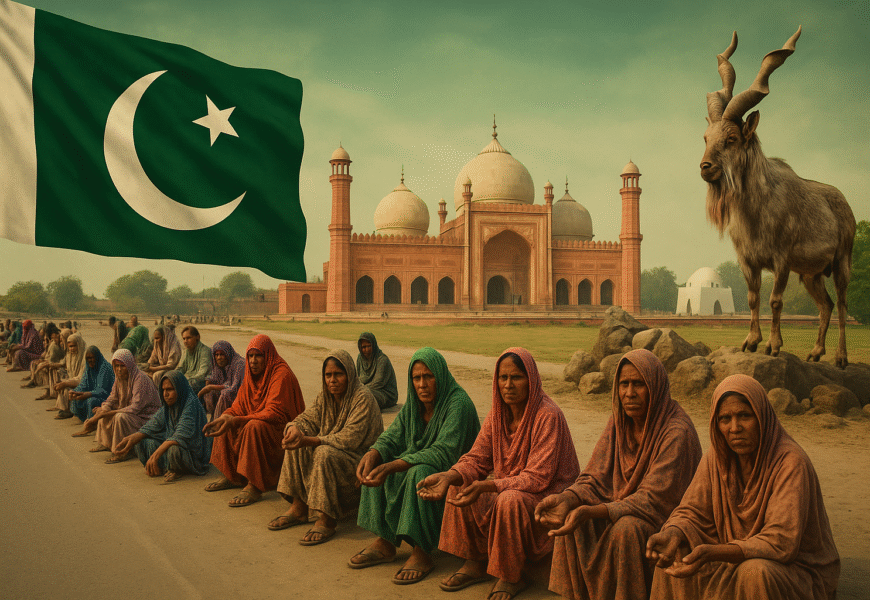
Pakistan, which has established itself as a “begging exporter,” is caught in a strange economic and political dilemma. While its economy is stuck between begging and war preparations, Bangladesh has achieved revolutionary success in economic and social development over the past decade. Bangladesh has nothing to borrow from Pakistan; rather, its social and economic model can show the way to turn Pakistan’s begging-dependent economy around. However, the question arises: Does the current government of Bangladesh aim to help revive this economy of Pakistan?
Pakistan’s begging economy:
An Unhealthy Reality Pakistan’s economic and social situation is currently going through a deep crisis. According to a reader’s letter (A Burden on Economy) published in the country’s leading daily *DAWN* on April 24, 2024, there are about 38 million beggars out of a population of 230 million in Pakistan. These beggars earn an average of Rs. 850 per day, which is equivalent to about US$ 42 billion per year. As this money flows into the market instead of being used for productive purposes, inflation has reached 21 percent.

In addition, 4,700 Pakistani beggars were deported from Saudi Arabia in 2024 and 552 in early 2025, tarnishing the country’s image. Pakistan’s Defense Minister Khawaja Muhammad Asif said in April this year that there are about 22 million beggars in the country, earning Rs 42 billion annually. A May 15, 2025, editorial in DAWN called Pakistan a “beggar exporting country,” with thousands of citizens being arrested and deported for begging abroad. According to a report in The Nation, 4,850 Pakistani beggars were deported from abroad in 2024 and 552 in early 2025, most of them from Saudi Arabia.
Economically, Pakistan is dependent on IMF loans. In September 2024, the IMF approved a $7 billion Extended Fund Facility (EFF) and disbursed the first tranche of $1.1 billion. In addition, a $1.3 billion climate-resilience fund was also approved. However, instead of investing the money from this loan in productive sectors, Pakistan increased its military budget by 20 percent to $9 billion in the fiscal year 2025-26. This dual character—on the one hand, begging, on the other hand, preparing for war—reveals Pakistan’s unhealthy political and economic structure.
Development of Bangladesh: A Self-Reliant Model
In the past decade, especially in the post-COVID era, Bangladesh has achieved revolutionary success in economic and social development. Housing has been provided to millions of low-income families through the shelter project. Food assistance has been provided to 30 to 40 million people at fair prices through the VGF card. In addition, poverty alleviation and social security have been ensured through 138 types of social allowances.
These projects are a testament to Bangladesh’s commitment to economic stability and social justice. Bangladesh’s GDP growth averaged 6-7 percent between 2010 and 2024, the highest in South Asia. Bangladesh has become a middle-income country thanks to the contributions of the garment industry, remittances, and the agricultural sector. The poverty rate has fallen from 40 percent to below 14 percent. Bangladesh is recognized as a role model in the world in education, health, and women’s empowerment. A DAWN reader’s letter noted that Bangladesh has earned $52 billion in 4 years by eliminating begging, which is a lesson for Pakistan.
What can Bangladesh want from Pakistan?
Pakistan’s economy is dependent on begging and war preparations, and its history is stained by the promotion of militancy, fundamentalism, regional separatism, and religious fanaticism. Pakistan’s intelligence agency, the ISI, is notorious for creating instability in neighboring countries. Besides, Pakistan has nothing else to offer Bangladesh. And if these militancy, including beggars, start being exported to Bangladesh, it won’t take long for Bangladesh to become the next Afghanistan.
Pakistan’s oppression during the Liberation War in 1971 is a dark chapter in Bangladesh’s history. Bangladesh has nothing to learn from such a country. Rather, Bangladesh’s social security schemes, poverty alleviation programs, and economic growth model can be a guide for Pakistan.
The renewed interest in Pakistan by the current unelected government of Bangladesh is tantamount to an insult to historical truth. While some analysts have labeled it a “South Asian balancing act,” it is at odds with Bangladesh’s values of independence and national pride. Bangladesh should prioritize its own achievements and values over strengthening ties with Pakistan.
Dr. What is Yunus’s goal?
Questions have been raised about the tendency of the current government of Bangladesh to lean towards Pakistan. Is this an attempt to revive Pakistan’s begging-dependent economy under the leadership of Dr. Muhammad Yunus? Such a move is contrary to the ideals of the Liberation War and national pride of Bangladesh, and it is also a bad sign for the overall regional security of Bangladesh. It may be true that the good will go to Pakistan, but with it, the possibility of all the bad characteristics of Pakistan entering Bangladesh, history is witness, is very dangerous.
Bangladesh should maintain its distance from Pakistan and continue its economic and social progress.
Conclusion Bangladesh is far ahead of Pakistan economically, socially, and historically. Pakistan’s begging-based economy and war-making strategy cannot bring any lessons or benefits to Bangladesh. Rather, Bangladesh’s model of social security and economic growth can be a model for Pakistan. Bangladesh should maintain a cautious distance from Pakistan and move forward on its own path of progress in order to protect its national interests and the values of the liberation war.

https://stapravda.ru/20221228/reyting_samyh_populyarnyh_hostingov_v_rossii_196445.html, рейтинг хостингов России подтверждает, что выбор надежного провайдера важен для бизнеса.