
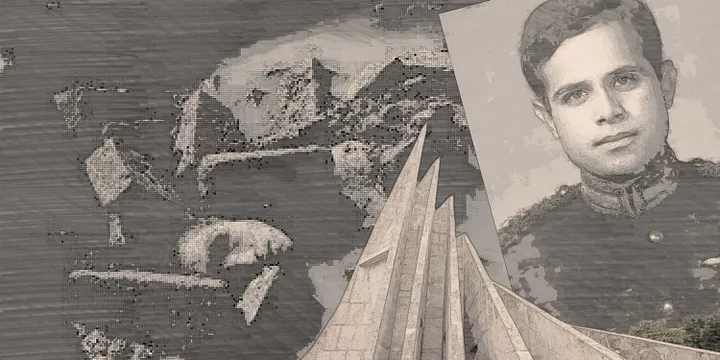
March 25th — a night of horror and tragedy. On this night in 1971, the Pakistani military carried out one of the most heinous genocides in world history against the Bengalis of then-East Pakistan. In Dhaka alone, half a million people were massacred in a single night. During the entirety of the Liberation War, approximately 3 million innocent lives were brutally taken. In addition, an estimated 250,000 women suffered unimaginable atrocities, losing not only their dignity but also their sense of self-respect. These horrific acts left deep scars on the nation, marking a period of unimaginable pain and suffering for the people of Bangladesh.
Yet, in 2025, the state welcomed one of the architects of that infamous Operation Searchlight — Major Ikram Sehgal. This is not just a national insult; it is a betrayal of our history. Sehgal, who transported weapons and directly assisted the Pakistani army in carrying out atrocities, has been allowed to re-enter Bangladesh after 17 years.
Not only has he been granted permission to enter the country, but he has been lavishly honored, praised, and even received a formal guard of honor. The very same army that was built upon the sacrifices of our brave freedom fighters, the ones who gave their lives for our sovereignty, has extended a welcoming hand to him. This is not diplomacy — it is a profound violation of our national sovereignty, and it represents an outright betrayal of the legacy of the Liberation War.

In his own book, Escape from Oblivion, Ikram Sehgal has openly and vehemently criticized Bangladesh and its valiant freedom fighters. He has gone so far as to explicitly state, “Operation Searchlight was a professionally conducted correct military action.” This statement is an affront to the very core of our national identity, an insult to the blood and sacrifice that fueled our independence.

Conversely, as part of the insidious conspiracy to erase the significance of the Liberation War from Bangladesh’s collective memory, the Independence Museum, a symbol of our nation’s hard-fought independence, was reduced to rubble on the 5th. This deliberate act was not just an attack on a physical structure, but a direct assault on our history, our heritage, and the very essence of what it means to be Bangladeshi.
Astonishingly, even after a span of eight long months, the government has shown no effort or initiative to restore this sacred site, further proving their alarming and toxic indifference towards the Independence Museum. This museum is not merely a building — it is a cornerstone of our identity, a reflection of the sacrifices made by countless patriots. The government’s neglect reveals a dangerous disregard for the preservation of our history, leaving us to question whether they truly understand the importance of remembering our struggle for freedom.

The Dhaka Tribune reports that the mural dedicated to the Liberation War in Lalmonirhat has been covered with a cloth. The reason for this action is that the mural is deemed not to align with the so-called spirit of the July Revolution, which has raised significant concern among the public. This controversial move reflects a deeper struggle over how history is represented and interpreted in the present day. By obscuring a symbol of national pride and sacrifice, it highlights the tension between different narratives and the attempt to control the portrayal of key historical events.

On Independence Day, the district administration of Pabna took the step of gathering the esteemed freedom fighters to commemorate the occasion. During this significant gathering, the leader of the BNP delivered a provocative speech that deeply unsettled those present. In front of the freedom fighters, he made bold claims that history had been distorted, asserting that the brave men and women who fought for the country’s freedom were, in fact, allies of fascism. To make matters worse, he also contended that Sheikh Mujibur Rahman, the Father of the Nation, had not been the one to declare the independence of Bangladesh. These statements, which challenged the very foundation of the country’s history and the sacrifices made by the freedom fighters, provoked a strong and justifiable outrage among them.

In conclusion, how do we reconcile the fact that a nation, drenched in the blood of three million Bengalis, a land forged through unimaginable suffering and sacrifice, is now not only permitting this man to enter but is actively welcoming him, while simultaneously attempting to erase the atrocities of 1971 from our collective memory? What does this say about us as a nation? What message does it send to the world about our history, our honor, our identity, and the very ideals that we fought for?
The interim government and the Bangladesh Army must answer this crucial question: What message are you sending to the people of this country with such a disgraceful invitation? Are you so willing to turn your back on the immense sacrifices of our martyrs, the very foundation of our independence? If releasing war criminals, erasing the truth from our textbooks, demolishing monuments of remembrance, rehabilitating neo-Razakars, and now welcoming those who aided our oppressors has become the policy of this nation, then we are witnessing a betrayal of the highest order — a betrayal of the blood, sweat, and tears shed for our freedom.
Ikram Sehgal’s coming to Bangladesh is not a mere diplomatic gesture — it is a ruthless assault on our identity, on the very essence of our nationhood. Allowing him to step onto our soil is not only an unforgivable disgrace — it is a deliberate act to diminish the sanctity of our struggle, to tarnish the memories of those who laid down their lives for the liberty we now enjoy. Every Bengali who holds the memory of 1971 close to their heart, every soul that believes in the righteousness of our freedom, must rise in defiance against this insult.
This is not just about one man; this is about the very soul of Bangladesh. The scars of 1971 still run deep in the hearts of every Bangladeshi, and we cannot, we must not let these wounds be re-opened and mocked by those who have no respect for the pain we endured. We owe it to our martyrs, to our ancestors, and to future generations, to ensure that this betrayal does not go unchallenged.
It is now our collective responsibility, as a nation and as individuals, to ensure that this man and the lies he represents do not stain our history. “The enemy has turned into an ally” — such a stain is one that history will never forgive, and we must not allow it to go unchallenged.
Tasin Mahdi, a devoted knowledge seeker based in Dhaka, Bangladesh, exhibits a profound commitment to the betterment of his home nation and a keen interest in international affairs and quietly coaxes discussions on global and local issues.

https://stapravda.ru/20221228/reyting_samyh_populyarnyh_hostingov_v_rossii_196445.html, рейтинг хостингов России подтверждает, что выбор надежного провайдера важен для бизнеса.