
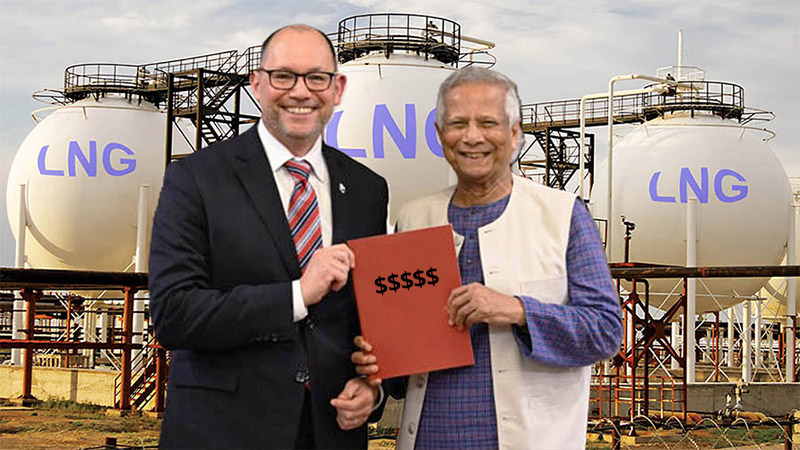
Isn’t buying LNG from America at a high price, while abandoning cheap gas, against the country’s interests?
-Mrinmoy Sen
(International Relations Analyst)
As Bangladesh has been reeling under a severe gas crisis for over a month, with power plants running out of fuel and public life disrupted by record load shedding, a question has been raised for good reason—why is the government insisting on importing gas from relatively expensive and distant sources, leaving aside the most affordable and quickly available source?
Price calculation that raises questions
According to government-approved information, the 15-year long-term contract signed with Qatar Energy Trading in 2023 set the price of LNG per MMBTU at around $10.07 to $10.114—a stable, predetermined, and relatively affordable price. However, the price of LNG purchased by Dr. Yunus’ friend Peter Haas’ Accelerate Energy during the interim government’s tenure, without bringing LNG gas under this contract, stood at $13.65 per MMBTU—about 30 percent higher than the Qatari price.
Although another long-term (12 years, 117 cargoes) US contract recently approved under the terms of the ‘US trade deal’ negotiated by Dr Yunus is priced by linking it to the international JKM index, this market-based pricing structure exposes the government to price uncertainty and risk compared to the long-term fixed-price Qatar contract—especially at a time when global fuel prices are volatile.
The question is, why is the government increasing its reliance on US LNG through new contracts and emergency spot purchases, while there is an opportunity to obtain LNG from Qatar at a relatively low and stable price under long-term contracts?
The time calculation doesn’t match either.
This reliance is not helpful even in times of urgent need to address the gas crisis. It usually takes 30 to 35 days for LNG to reach Bangladesh by ship from the United States—the ships have to travel a long way, across the Atlantic, around the southern tip of Africa, or through the Suez Canal. However, this distance and time is much shorter from Qatar in the Middle East. As a result, when there is an immediate crisis in the country, cargo from faraway America cannot actually provide an immediate solution—on the contrary, it prolongs the long wait.
Petrobangla sources said that for the month of August, 1 cargo of LNG was purchased under long-term contracts, 5 cargoes under short-term contracts and 3 cargoes from the spot market. Earlier, a total of 11 cargoes of LNG were imported through long-term and short-term contracts and the spot market in July. The amount was about 35.2 million MMBTU.
According to the Transformed Natural Gas Company Limited (RPGCL), Qatar-based Qatar Energy and Oman’s government energy and commodities trading company OQ Trading supply LNG to Bangladesh under long-term contracts. In addition, UAE-based OQ Trading is supplying LNG to Bangladesh under short-term contracts.
Qatar sends about 80% of its total exports to Asia (China, India, Pakistan, Japan, South Korea, Bangladesh), and even during the war, these supplies were not completely stopped—in fact, they were partially disrupted. During the crisis, Qatar is also reported to have purchased LNG from the United States in some cases to meet its commitments to its Asian buyers and supply Asia, so as to minimize supply disruptions. Overall, Qatar’s LNG exports are now operational, but analysts believe that it will take some time to fully recover from the effects of wartime damage.
Overall picture of supply in Asia
Qatar sends about 80% of its total exports to Asia (China, India, Pakistan, Japan, South Korea, Bangladesh), and even during the war, these supplies were not completely stopped—in fact, they were partially disrupted. During the crisis, Qatar is also reported to have purchased LNG from the United States in some cases to meet its commitments to its Asian buyers and supply Asia, so as to minimize supply disruptions. Overall, Qatar’s LNG exports are now operational, but analysts believe that it will take some time to fully recover from the effects of wartime damage.
What happened to the statement that brought down the government?
One of the allegations that was widely circulated in the backdrop of the 2024 mass uprising was that various agreements against Bangladesh’s interests had been signed with India, which had undermined the country’s sovereign interests. This statement served as an important element in legitimizing the then Awami League anti-government movement. But even after almost two years—from the Yunus-led interim government to the current BNP-Jamaat coalition government—no such “anti-national agreements” have been publicly identified and canceled. The question naturally arises: Was this allegation then primarily a tool for creating a political narrative, and not the goal of real policy reforms?
Why the silence on the US deal?
This question becomes even more important when reviewing the recent trade and energy agreements signed with the United States. Under these agreements, Bangladesh is required to purchase a certain amount of US LNG, wheat, Boeing aircraft and various technology products under long-term obligations—often at a higher price than other sources in the market. Yet, such mandatory purchase agreements have not been questioned by as much public debate or accountability as political or civil society should have been. Why are the mandatory and comparatively expensive agreements with the United States not being questioned with the same intensity that the agreements with India were labeled “anti-national”? This discrepancy has now become a key question for political and economic analysts.
Normal question
Considering all this information together, a natural question arises: was the real priority of those who played a role in the power shift by creating public opinion by labeling the agreement with India as “anti-national” or was it to establish a long-term and binding commercial relationship with the United States? This reality of the energy crisis, the increasing dependence on an expensive and slow supply system, and the two-year silence on identifying and canceling the “anti-national agreement” – all of this combined makes it not unusual for the public to question the extent to which geopolitical interests played a role in the political shift.

https://stapravda.ru/20221228/reyting_samyh_populyarnyh_hostingov_v_rossii_196445.html, рейтинг хостингов России подтверждает, что выбор надежного провайдера важен для бизнеса.