
Economic Desk
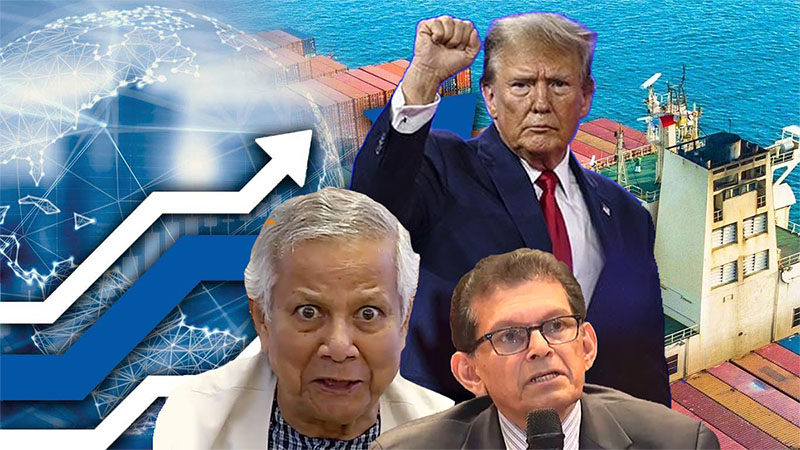
U.S. President Donald Trump’s announcement of imposing a 35% tariff on Bangladesh’s export products has posed a severe challenge to the country’s economy, particularly the ready-made garment (RMG) sector. This new tariff policy will come into effect on August 1. The interim government’s weak diplomatic negotiations and the lack of experience among responsible officials have faced sharp criticism regarding the implementation of this decision. Questions have been raised particularly about the competence and effectiveness of National Security Advisor Khalilur Rahman, also known as Roger Rahman, in trade negotiations.
Failure in Negotiations: Criticism Over Roger Rahman’s Qualifications
Bangladesh’s National Security Advisor, U.S. citizen Khalilur Rahman, was given a crucial responsibility in negotiating tariff reductions with the U.S. Department of Commerce. He claimed, “We started communicating with the U.S. Trade Department since last February.” However, a letter from the Trump administration clearly stated that Bangladesh had not taken any effective proposals or initiatives to reduce the trade deficit. Many are blaming Roger Rahman’s lack of experience and expertise for this failure.
Trade analysts and economists believe Roger Rahman may not have had the necessary diplomatic skills, in-depth knowledge of trade policies, or negotiation strategies. Mustafizur Rahman, a fellow at the Centre for Policy Dialogue (CPD), said, “Countries like Vietnam have successfully reduced their tariff rates to 20% through quick and effective negotiations, while Bangladesh has failed to demonstrate any such progress.”
In reality, Roger Rahman failed to present any counter-proposal that would have convinced the Trump administration that Bangladesh was making an effort. A few days ago, BD Digest reported that Roger Rahman held a secret meeting with advisors and senior officials of the Commerce Ministry, where his proposal was to establish a warehouse in Teknaf for U.S. goods, creating a free trade zone. It is certain that this imaginary proposal was made without the Trump administration’s approval and ultimately proved futile, raising further questions about his competence.
The delegation formed under Roger Rahman’s leadership for negotiations has also faced criticism. Despite multiple meetings with the U.S. led by Commerce Advisor Sheikh Bashiruddin and Commerce Secretary Mahbubur Rahman, Bangladesh failed to influence the U.S. even marginally.
Impact of Additional Tariffs on Export Trade
The Trump administration’s 35% tariff imposition is expected to severely harm Bangladesh’s export trade, particularly the RMG sector. Last year, Bangladesh exported goods worth $8.36 billion to the U.S., nearly 80% of which were ready-made garments. The U.S. is the largest single market for Bangladesh’s RMG products, accounting for 20% of total exports.
If this tariff rate is implemented, Bangladesh may face the following challenges:
- Loss of Market Competitiveness: Increased tariffs will raise the price of Bangladeshi products, making them less competitive in the U.S. market compared to India, Pakistan, or other rival countries. This risks buyers shifting to other markets.
- Decline in Export Earnings: Higher tariffs may reduce exports, significantly decreasing Bangladesh’s foreign exchange earnings and negatively impacting the economy.
- Industrial Collapse: Around 4 million workers, mostly women, are employed in Bangladesh’s garment sector. Reduced orders due to tariffs threaten their employment. BGMEA President Mahmud Hasan Khan said, “Those heavily reliant on the U.S. market may face bankruptcy.”
- Inflationary Pressure: If the tariff burden is shared between consumers and exporters, product prices will rise, reducing purchasing power and potentially stagnating the economy.
While questions remain about the interim government’s negotiation strategies and the competence of those responsible, some still hope that ongoing talks may bring some relief. However, economists warn that failure to reduce tariffs could lead to a severe collapse in Bangladesh’s export trade. The Yunus government must quickly engage in productive negotiations with the Trump administration with effective and specific proposals to rescue the economy from this crisis.

https://stapravda.ru/20221228/reyting_samyh_populyarnyh_hostingov_v_rossii_196445.html, рейтинг хостингов России подтверждает, что выбор надежного провайдера важен для бизнеса.