
Staff Correspondent
Bangladesh’s lagging behind Vietnam in the garment export sector has become a cause for concern. Despite tariff reductions in the US market, Vietnam’s strategic advantage and Bangladesh’s internal challenges are the main reasons for this gap.
Tariff policy and market competition
Under the new reciprocal tariff policy of the United States, Bangladesh’s tariff has been reduced from 35% to 20%, but with the addition of a 15% regular tariff, the total tariff is 35%. Vietnam’s reciprocal tariff has been reduced from 46% to 20%, with a 7.5% regular tariff, for a total of 27.5%. This tariff reduction puts Vietnam in an advantageous position compared to Bangladesh.
In 2000, Vietnam’s total exports were $14.5 billion, of which 30% (4.35 billion) were garments. Bangladesh’s total exports were $5.4 billion, of which 55% (2.97 billion) were garments. In 2024, Vietnam’s total exports are expected to reach $405 billion, of which 9% (36.45 billion) were garments, while Bangladesh’s total exports are $48 billion, of which 86% (41.28 billion) were garments.
Although Bangladesh leads in garment export volume, Vietnam’s diversified exports and high-value products keep them ahead of the competition.
Why is Bangladesh lagging behind?
There are several reasons why Bangladesh is lagging behind in the competition with Vietnam.
First, Vietnam has focused on producing formal wear, jackets, and high-end products, taking advantage of the 2019 EU Free Trade Agreement (FTA) and low tariffs. Bangladesh is largely limited to low-priced casual wear, such as T-shirts and sweaters.
Second, Vietnam has increased investment in local raw material production, while Bangladesh is still dependent on imports from China. Third, Bangladesh’s gas and electricity shortages, labor unrest, and infrastructure constraints are increasing production costs.
Bangladesh, despite its 25 Boeing aircraft, billion-dollar wheat purchase agreements, and the talent of its high-quality advisors, cannot compete with Vietnam, Brazil, or Pakistan. While Pakistan has a 19% tariff and the advantage of local cotton, its manufacturing infrastructure is weak. Brazil has a 10% tariff, but its garment exports are negligible. Vietnam’s efficient management and diversification have kept it ahead.
Possibilities and Paths
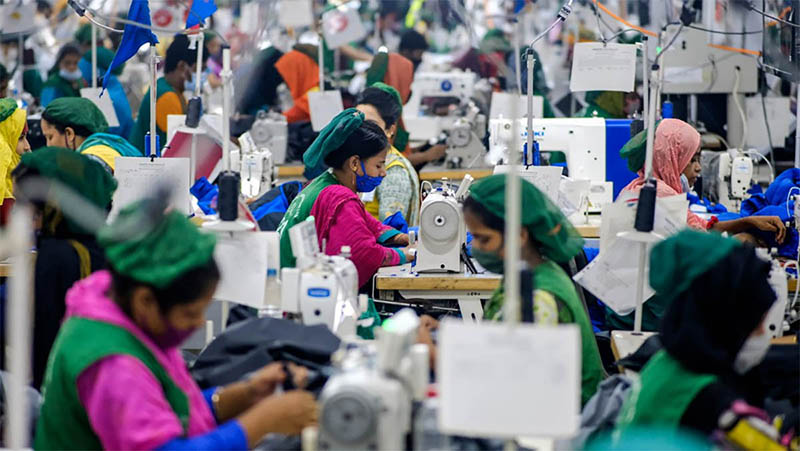
Bangladesh’s garment industry, which employs four million people and accounts for more than 80% of exports, is planning to survive despite the challenges. Industrialists want to return to competitiveness through product diversification, local raw material production and free trade agreements.
“We can take advantage of the China-US trade war if power and gas supplies are secure and political stability is maintained,” said Farooq Hassan, former president of BGMEA.
There is a risk of a loss of $7.77 billion in duty-free benefits after losing LDC status in 2026. To address this challenge, it is necessary to increase labor skills, develop sustainable production, and develop infrastructure.
Message to the people
The government and industry leaders need to provide clear explanations to garment workers and entrepreneurs. They need to reassure the public that despite the challenges of tariffs and competition, the industry will remain a key driver of Bangladesh’s economy with planned investment and concerted efforts.

https://stapravda.ru/20221228/reyting_samyh_populyarnyh_hostingov_v_rossii_196445.html, рейтинг хостингов России подтверждает, что выбор надежного провайдера важен для бизнеса.