
Opinion
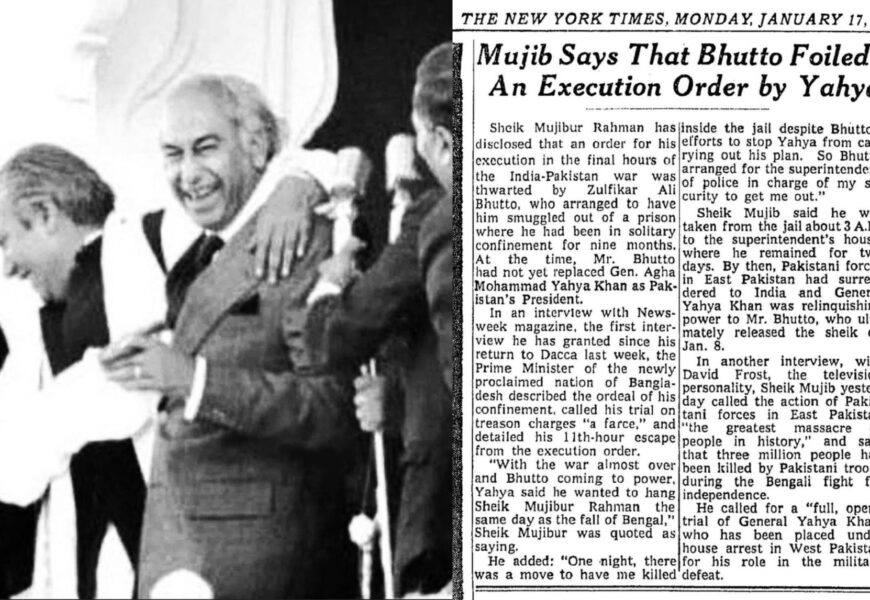
If Bhutto hadn’t intervened, both Sheikh Mujib’s assassination and the jail killings would have occurred in 1971, not 1975!!
—
To understand politics, you must judge the same event or person from various perspectives. If you judge someone from just one angle and place them either on a pedestal or in a position of hatred, you are a devotee, not a political thinker. The political behavior of devotees, though it may seem revolutionary at first, always ends up being communal. Americans exhibit the same communal behavior when they think that Osama Bin Laden committed terrorism, and since he was a Muslim, all Muslims are terrorists and must be eradicated.
It is crucial to understand what happened in Pakistan before and after 1971 to comprehend it ourselves and to protect democracy. Without understanding this, simply harboring hatred is the same kind of devotion or hatred-driven mentality. Due to the events of 1971, harboring hatred for everything about Pakistan is similar. Tagging individuals with something bad without analyzing them critically and belittling them is a kind of group slander, which is a criminal offense.
In 1947, ten years after Pakistan was partitioned from India, on October 27, 1958, a military coup led by then-military chief General Ayub Khan killed the nascent democracy and seized power. Notably, even though Pakistan was independent, until March 23, 1956, it was under the governance of British-appointed leaders like Muhammad Ali Jinnah, Khawaja Nazimuddin, Ghulam Mohammad, and Iskandar Mirza. At this time, Pakistan was known as the Dominion of Pakistan, a British Commonwealth realm. On March 23, 1956, it adopted a constitution, becoming a presidential democratic state named the Islamic Republic of Pakistan.
Within two years, Ayub Khan seized power through a coup and imposed military rule. From then until 1973, Pakistan was under military rule, with the last two years under Zulfikar Ali Bhutto (even though he was a civilian). From 1973 to 1977, Bhutto served as Pakistan’s Prime Minister, but despite his party’s victory in the 1977 elections, military chief Zia-ul-Haq seized power again in 1977 through a coup.
Thus, it is evident that from the beginning, Pakistan’s people were oppressed by the infighting of its power-hungry military elites. The Bengali independence movement gained momentum, and the atrocities of 1971 occurred due to the military’s Islamic ideals and Bengali-hating policies. They considered Bengali culture to be Hindu practices and despised it. This systematic hatred was ingrained in their mindset. However, many officers in the Pakistani military were against the military attack in Dhaka in March. In early 1971, three senior military officials resigned. They opposed a military operation.
Lt. Gen. Sahibzada Yaqub Khan, the Eastern Command’s commander in Pakistan, refused to follow orders for a military operation to suppress the Bengali nationalist movement. He believed in finding a political solution rather than using military force. His stance was based on the political situation and the ethics of using force against civilians. After his refusal, he was recalled to West Pakistan and replaced by Lt. Gen. Tikka Khan, who assumed the role of the new military commander.
In March 1971, the Governor of East Pakistan, Vice-Admiral Syed Mohammad Ahsan, and the Chief of the Pakistan Air Force in Dhaka, Air Commodore Muhammad Zafar Masud, opposed using military force against the people. Both resigned at the beginning of March.
In this context, while Bangladesh was oppressed by misrule, Pakistan’s civil society and free thinkers were also oppressed—and still are. They continue to suffer under various forms of military and violent political tactics in Pakistan. While Pakistan is institutionally responsible for the atrocities of 1971, examining its internal governance reveals that the state had long been under the control of a small group of military oligarchs or rogue forces. Thus, it is unfair to hold all Pakistanis collectively responsible for the actions of 1971.
Why they should not all be held responsible is a lesson left by Sheikh Mujib himself. A photograph of Sheikh Mujib jovially putting his hand on Zulfikar Ali Bhutto’s shoulder, taken likely during the OIC summit in 1974, serves as a testament. If all Pakistanis were to be held responsible, why would Sheikh Mujib behave so openly with Bhutto, who was a significant figure in the oppressive regime of 1971? Politics is not religion. In religion, one expects prophets or religious leaders to be immaculate and pure, but politics is not like that.
In politics, personal character is not as important as one’s actions or current credibility. A freedom fighter can later become a fundamentalist or anti-state individual (as seen with Major Zia and many other military officers). Before the Liberation War, many individuals, particularly highly educated professionals like Ph.D. professors, were pro-Pakistan. But after experiencing personal losses, many of them supported the Liberation War.
On December 14, 1971, when Pakistan’s defeat was imminent, Yahya Khan and his generals were furious and frustrated. Out of anger and to ensure that Bangladesh could never stand tall, they executed the blueprint for the intellectual massacre. Whose name was supposed to top that list? Sheikh Mujib, wasn’t it? Yes, after the intellectual killings, during the Pakistani surrender, Yahya decided to execute Sheikh Mujib. But Bhutto opposed it.
He initially tried to persuade Yahya Khan that it wouldn’t be the right thing to do. But Yahya didn’t listen. Orders were issued to kill Mujib in jail on the morning of Victory Day. Around 3 a.m., the prison superintendent woke Sheikh Mujib, moved him out of his solitary cell, and hid him at his home for two days. The soldiers ordered to kill Mujib couldn’t find him. This arrangement to save Sheikh Mujib was Bhutto’s personal initiative. On December 20, when Bhutto became President and Chief Martial Law Administrator, he released Sheikh Mujib on January 8, 1972.
In a village in China, there lived an honest farmer, a simple man whom everyone respected. His wealth consisted of a piece of farmland and a horse used for farming. The farmer also had a son, beloved by the villagers. One day, the farmer’s horse went missing. Everyone sympathized with him, lamenting his misfortune. The farmer replied, “How do you know this isn’t a blessing?”
Later, the horse returned with another horse. Villagers rejoiced, saying the farmer was rewarded for his goodness. The farmer remarked, “How do you know this is a blessing?”
One day, the farmer’s son was injured by the new horse and broke his leg. The villagers pitied him again, but the farmer remarked, “This might also bring blessings.”
Soon, a war broke out. Every young man in the village had to fight. The farmer’s son was exempted due to his injury, saving his life, while all other village boys perished.
The story teaches that events cannot always be judged as good or bad. Psychologist Carl Jung noted that human dilemmas often revolve around whether something is meaningful or meaningless rather than good or bad.
Let’s judge people not by good or bad but by whether their actions are meaningful or meaningless. This is the essence of critical thinking in politics.
-Sirajul Hossain
Blogger and Online Activist

https://stapravda.ru/20221228/reyting_samyh_populyarnyh_hostingov_v_rossii_196445.html, рейтинг хостингов России подтверждает, что выбор надежного провайдера важен для бизнеса.