
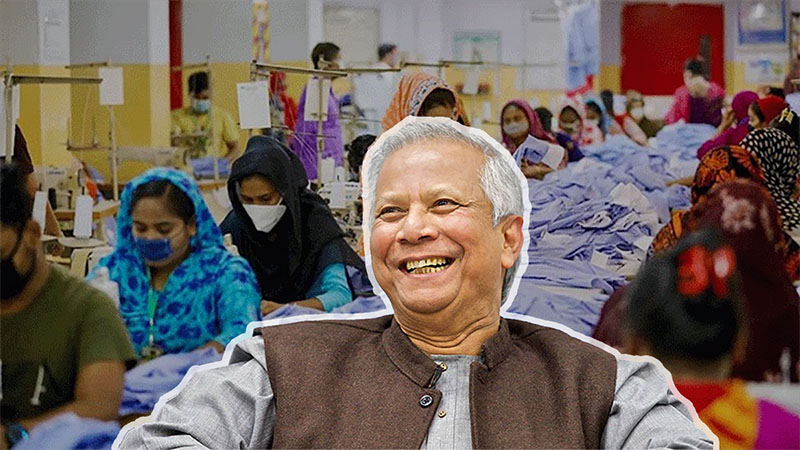
Concerns in Bangladesh’s garment sector after India’s ‘Mother of All Deals’ agreement with the European Union!
Staff Correspondent
The recently concluded Free Trade Agreement (FTA) between the European Union (EU) and India — dubbed the ‘mother of all deals’ by EU Commission President Ursula von der Leyen — has put new pressure on Bangladesh’s export sector. The deal gives Indian goods duty-free or low-tariff access to the EU market, which is seen as a competitive threat to Bangladesh’s garment exports.
In this context, the interim government’s chief advisor, Dr. Muhammad Yunus, hastily met with EU representatives and sought assurances of Bangladesh’s FTA agreement.
“There is a need to initiate an FTA agreement with the EU before the current duty-free benefits end,” he said in a meeting with Eurochem Bangladesh Chairperson Nuria Lopez and EU Ambassador Michael Miller in Dhaka on February 1.
He also noted that after signing the Economic Partnership Agreement (EPA) with Japan, now a similar agreement with the EU will help increase Bangladesh’s exports.
At the same time, Dr. Yunus has called for attracting foreign investment from the Eurasian Economic Union (EAU). However, analysts believe that it will be difficult for Bangladesh to maintain its monopoly in the EU market for a long time based on mere lip service.
Concerns are growing in Bangladesh’s garment sector after the EU-India agreement as the country faces the risk of losing its current duty-free benefits (GSP Plus) after its transition from LDC (least developed country) status (around 2029). The EU’s FTA agreement with a large economy like India could reduce the competitive advantage of Bangladesh’s garment exports.
Meanwhile, the garment sector has been in a state of crisis during the interim government. According to government data, more than 240 factories have closed since August 2024, many of which are textile and garment factories. According to various sources, more than a thousand garment units have closed across the country and more than 2 million workers have lost their jobs, including about 1.4 million female garment workers. These workers were the main force supplying cheap clothing to the EU market.
India has earned trust through infrastructure development, capacity building and structural reforms before signing the agreement with the EU. Bangladesh has also been exporting duty-free under the EU’s GSP+ facility for a long time through strict compliance, factory modernization and improvement of labor rights. But now, when the sector is in crisis, how much is it possible to maintain a competitive advantage in the EU market with just verbal assurances — this is the big question now.
Analysts say that Bangladesh needs to focus on rapid structural reforms, rehabilitating workers, reopening factories, and attracting investment to secure an FTA with the EU. Otherwise, it risks falling behind competitors like India.
(Source: European Commission, Reuters, Dhaka Tribune, The Daily Star, The Diplomat and others)

https://stapravda.ru/20221228/reyting_samyh_populyarnyh_hostingov_v_rossii_196445.html, рейтинг хостингов России подтверждает, что выбор надежного провайдера важен для бизнеса.