
Staff Reporter
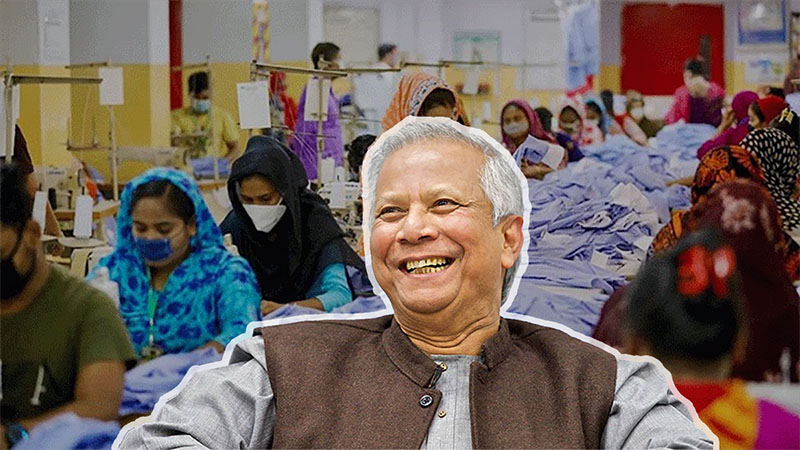
Due to the indifference of the Yunus government, Bangladesh’s export-dependent economy’s largest sector, the ready-made garment industry, is once again facing extreme uncertainty. Following US President Donald Trump’s announcement of imposing a new 35% tariff on Bangladeshi apparel products, foreign buyers have begun losing confidence. Major buyers like Walmart have already suspended some orders, and others are likely to follow suit. This has placed Bangladesh’s garment-dependent economy in a tough challenge, and the Yunus government is yet to take any effective measures to overcome it.
Bangladesh is the single largest exporter of apparel to the US. In the last fiscal year, the country exported $8.4 billion worth of goods to the US. If the new tariff is implemented, the total duty on many products will rise to nearly 51%, severely damaging Bangladesh’s competitive position in this market.
During the third and final day of the second round of trade talks, the two countries agreed on some issues, but several critical matters remain unresolved. It has been decided that inter-ministerial discussions will continue on these topics.
Bangladesh Garment Manufacturers and Exporters Association (BGMEA) President Mahmud Hasan Khan said, “The new tariff is a bad omen for us. We hope for a positive resolution through discussions. However, if this tariff remains in place, survival will be difficult.”
Several factory owners have confirmed that Walmart has suspended a major order. Meanwhile, some US buyers are pressuring Bangladeshi suppliers to share the burden of tariff costs on pipeline goods.
Former BGMEA Vice President Rakibul Alam Chowdhury said, “If this tariff is implemented, not only exports but the entire economy, employment, and social stability will be at risk.”
Washington has cited Bangladesh’s reliance on Chinese raw materials as the main reason for the tariff hike. The US has advised reducing dependence on China, increasing local value addition in production, and strengthening labor rights and intellectual property laws.
However, some US proposals—such as requiring Bangladesh to boycott countries under US sanctions or granting exclusive duty-free benefits to US products—have been deemed unacceptable by Bangladesh.
In this situation, leaders of the garment sector are awaiting a meeting with Chief Advisor Dr. Muhammad Yunus. The BGMEA president has expressed interest in detailed discussions with the government regarding hiring lobbyists, assessing losses, and finding ways to sustain business in the US.
Meanwhile, Vietnam has reduced its US tariffs to just 20% through a bilateral agreement. However, with Bangladesh’s tariffs still at 35%, concerns are growing about falling behind in competition.

https://stapravda.ru/20221228/reyting_samyh_populyarnyh_hostingov_v_rossii_196445.html, рейтинг хостингов России подтверждает, что выбор надежного провайдера важен для бизнеса.