
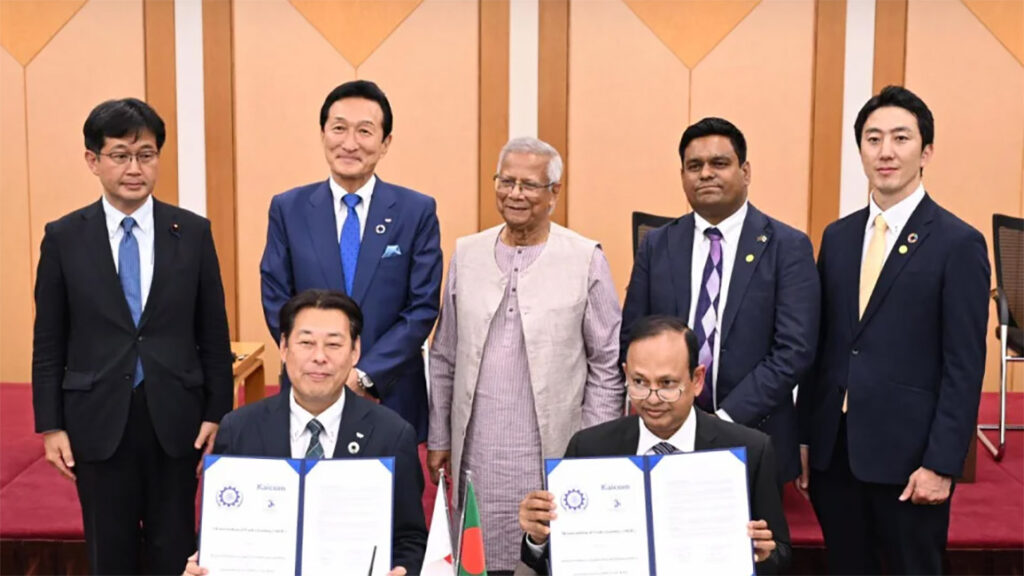
Manpower export deal during Yunus’ visit to Japan in 2025;
Japan’s interest in meeting labor shortage but questions over implementation progress

Special Correspondent. October 28, 2026.
A plan to recruit at least 100,000 Bangladeshi workers in five years was announced to create employment opportunities for skilled and semi-skilled Bangladeshi workers in the Japanese labor market. Two memorandums of understanding (MoUs) were signed in this regard during the visit of the interim government’s chief advisor, Professor Muhammad Yunus, to Japan in May 2025. But if even after a year and a half, not a single worker has been sent to Japan from Bangladesh under this initiative, questions naturally arise about the implementation of the agreement.
There is a need to recruit foreign workers to address the growing labor shortage in Japan. On the other hand, the Japanese labor market can provide significant opportunities for creating employment abroad for a large number of Bangladeshi youth and earning foreign exchange. The plan to recruit 100,000 workers comes from this convergence of interests between the two countries.
The Japanese government has set a target of hiring 820,000 foreign workers in 16 sectors under the ‘SSW’ category by March 2029. According to experts and officials, Bangladesh could be able to supply up to 40 percent of this demand—more than 300,000 workers—if it prepares effectively.
The Labor Welfare Wing of the Bangladesh Embassy in Tokyo, citing a recent report published in ‘The Japan Times’, said that Japan has set a target of hiring about 1.2 million foreign workers, both in the ‘Employment Skill Development’ (ESD) and ‘SSW’ categories, by March 2029.
Dr. Yunus’ agreement to send 100,000 workers in 2025
However, signing a memorandum of understanding and actually sending workers is not the same thing. Such initiatives can only be implemented after going through multiple steps such as language skills, technical training, employer requirements, visa process and selection of workers. As a result, there is a need for a clear explanation from the concerned authorities on what steps have been taken to meet the declared target and how many workers have actually been sent.
Sending Bangladeshi workers to Japan and sending workers under the 2025 government memorandum of understanding are not the same thing. In September 2026, a Japanese business delegation met at the Yunus Center, the business organization of former Bangladesh chief advisor Dr. Yunus, with a plan to hire 100,000 workers.
However, the press release on the website of the Japanese Ministry of Foreign Affairs does not mention any details of the visit or any issues related to the labor export agreement, other than the announcement of Dr. Yunus’ visit to Japan.
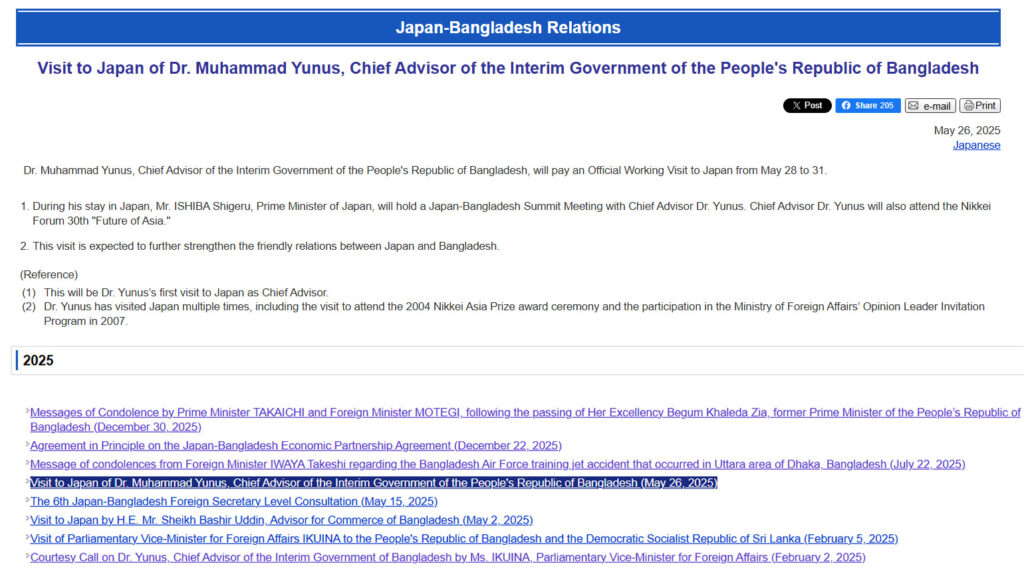
Dr. Yunus’s 2025 itinerary on the Japanese Ministry of Foreign Affairs website
Announcement to hire 100,000 workers, how many left in 17 months?
Japanese delegation briefs on training center and recruitment plan; demands disclosure of specific accounts of sending workers
About five months after the signing of the MoU in Tokyo, a 23-member delegation from Japan’s National Business Support Combined Cooperatives (NBCC) met with Bangladesh’s Chief Adviser Professor Muhammad Yunus in October 2025. During the meeting, the delegation said that work was underway on a plan to recruit more than 100,000 skilled Bangladeshi workers over five years. It was also announced that the first phase would recruit 2,000 workers by 2026.
But reports published up to October 2026 did not provide a clear number of how many Bangladeshi workers had actually arrived in Japan under the MoU, raising questions about the gap between the announcement of hiring 100,000 workers and the actual progress.
According to the information released, the Japanese delegation said that there is a demand for workers in the construction, services, aviation, garment and agriculture sectors. It was also announced that two training centers will be established in Khulna and Gazipur to produce skilled workers. At the same time, acquiring proficiency in the Japanese language was identified as a major challenge.
In September 2026, the NBCC delegation also discussed the recruitment plan for Bangladesh. The report published at that time stated that it planned to recruit 2,000 workers in 2027, 6,000 in 2028, and 18,000 in 2029. However, this schedule does not fully match the first phase schedule announced in October 2025. A detailed explanation is needed on why the new schedule is needed, to what extent the first phase goals have been met, and at what stage the recruitment process is.
Demand for workers in Japan, opportunities ahead for Bangladesh
Due to the labor shortage in Japan, opportunities for hiring foreign skilled workers are increasing. Japan has set a target of hiring 820,000 foreign workers under the Skilled Worker Program in 16 sectors by March 2029. To capitalize on this opportunity, Bangladesh has taken initiatives to increase the capacity of Japanese language education, technical training, and training centers.
However, a memorandum of understanding alone is not enough to enter the Japanese labor market. Workers will have to complete language skills, vocational training, Japanese employer requirements, exams and certifications, visas, and immigration procedures. Without disclosing the progress of these steps, it is difficult to assess how realistic the target of hiring 100,000 workers is.
The success of the announcement will be determined by the actual number of workers sent, not the number of MoUs. The plan to employ 100,000 Bangladeshi workers in Japan is an important opportunity for both countries. But to understand how much this opportunity is being used in practice, it is important to publish statistics on training, recruitment, visas and worker dispatch in stages.

https://stapravda.ru/20221228/reyting_samyh_populyarnyh_hostingov_v_rossii_196445.html, рейтинг хостингов России подтверждает, что выбор надежного провайдера важен для бизнеса.